What’s the Difference Between Radium, Tritium and Super-LumiNova?

What is the difference between radium, tritium and Super-LumiNova? The question may seem simple, but it touches on one of the most fascinating details of a watch: its ability to make the time legible when the dial disappears into darkness. Behind those luminous markers, however, lie three radically different technologies, three eras of watchmaking and, incidentally, several decades of questionable industrial decisions.
Radium is radioactive and belongs to the early history of the wristwatch. Tritium is also radioactive, but far less penetrating and used according to more carefully controlled processes. Super-LumiNova, meanwhile, is not radioactive: it stores light and then releases it gradually. To understand what one is reading on a vintage dial or observing on a contemporary watch, it is therefore necessary to distinguish between the nature of the material, how it works and how it ages.
Radium, the first great luminous paint
From the 1910s onwards, the watchmaking industry made extensive use of radium to make hands and hour markers visible in the dark. The principle relied on a mixture of radium salts and a phosphorescent material, generally zinc sulfide. The radium continuously emitted particles that excited the phosphor. The watch could therefore glow without needing to be exposed to a light source.
At the time, this was a major innovation. A military watch, cockpit clock or navigational instrument could be read at night without switching on a lamp. Legibility gained in effectiveness what it sometimes lost in innocence. The dial painters, nicknamed the “Radium Girls”, paid a very high price for exposure to dust and the ingestion of radioactive material, particularly when they were instructed to shape their brushes with their lips.
Radium-226 has a half-life of approximately 1,600 years. This means that its radioactivity decays extremely slowly. The dial, however, does not remain luminous for sixteen centuries. The zinc sulfide deteriorates under the effects of radiation and eventually produces only a very faint glow, or none at all. An old radium watch can therefore still be radioactive without glowing in the dark. This is an essential distinction.
On an old watch, the presence of radium cannot be inferred solely from a cream, brownish or greenish hue. The patina also depends on the binder, humidity, exposure to UV light and successive restorations. The dial markings, production date and examination by a professional equipped with a Geiger counter are far more reliable indicators.
Is radium dangerous in an old watch?
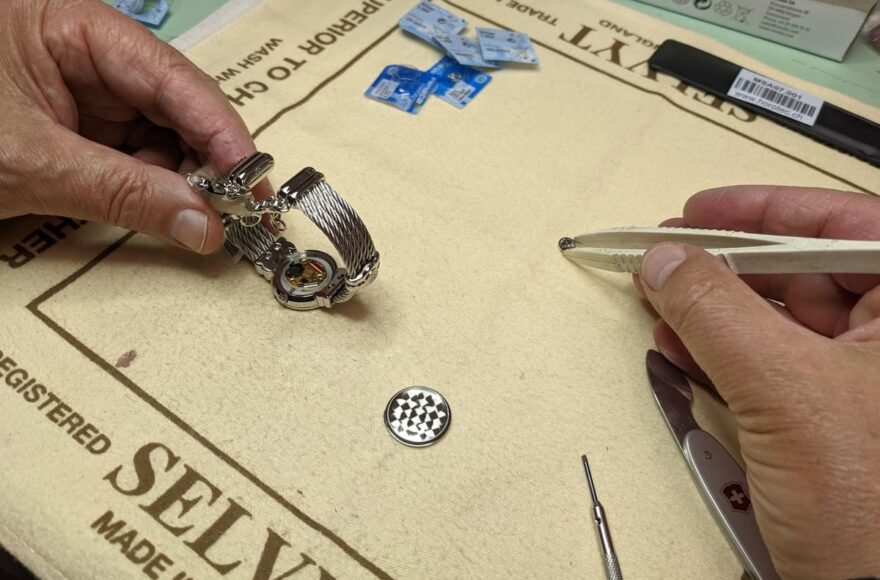
An intact radium dial does not automatically turn a collector’s watch into a highly toxic object. The main risk arises when the material is detached, scraped, sanded or inhaled. Opening a watch without taking proper precautions can release particles inside the case or onto the workbench. It is therefore inadvisable to handle the paint yourself, blow on a dial or attempt an improvised cosmetic restoration.
If a watch is suspected of containing radium, it is best to entrust its opening and cleaning to a watchmaker experienced in working with vintage timepieces. Radioactivity is not vintage decoration. It deserves neither theatrical panic nor a flea-market dealer’s nonchalance.
Tritium, a more measured transition
Tritium, or hydrogen-3, gradually replaced radium in many watchmaking applications from the second half of the 20th century onwards. It is also a radioactive isotope, but its beta radiation is low-energy and penetrates matter only weakly. Its half-life is approximately 12.3 years.
In older tritium paints, the radioactive material likewise excited a luminous pigment. Modern watchmaking, however, has mainly adopted a cleaner and more legible solution: glass microtubes filled with gaseous tritium. Their inner walls are coated with a photoluminescent material. The tritium continuously excites this coating, producing a constant light without the need to “charge” the watch under a light source.
This technology is particularly associated with specialist microtube manufacturers such as mb-microtec. The tubes can be fitted to the hands or hour markers in the form of fine, even lines. They offer a discreet, permanent glow, especially valued on military watches, professional instruments and certain dive watches.
The downside of this constancy is predictable: tritium gradually loses its intensity. After a half-life of 12.3 years, half of the original radioactive nuclei have decayed. The light does not switch off abruptly, but its level diminishes over the years. A tritium-equipped watch can therefore remain perfectly functional while displaying a glow far weaker than when it was new.
What do the markings “T Swiss Made T” and “T<25” mean?
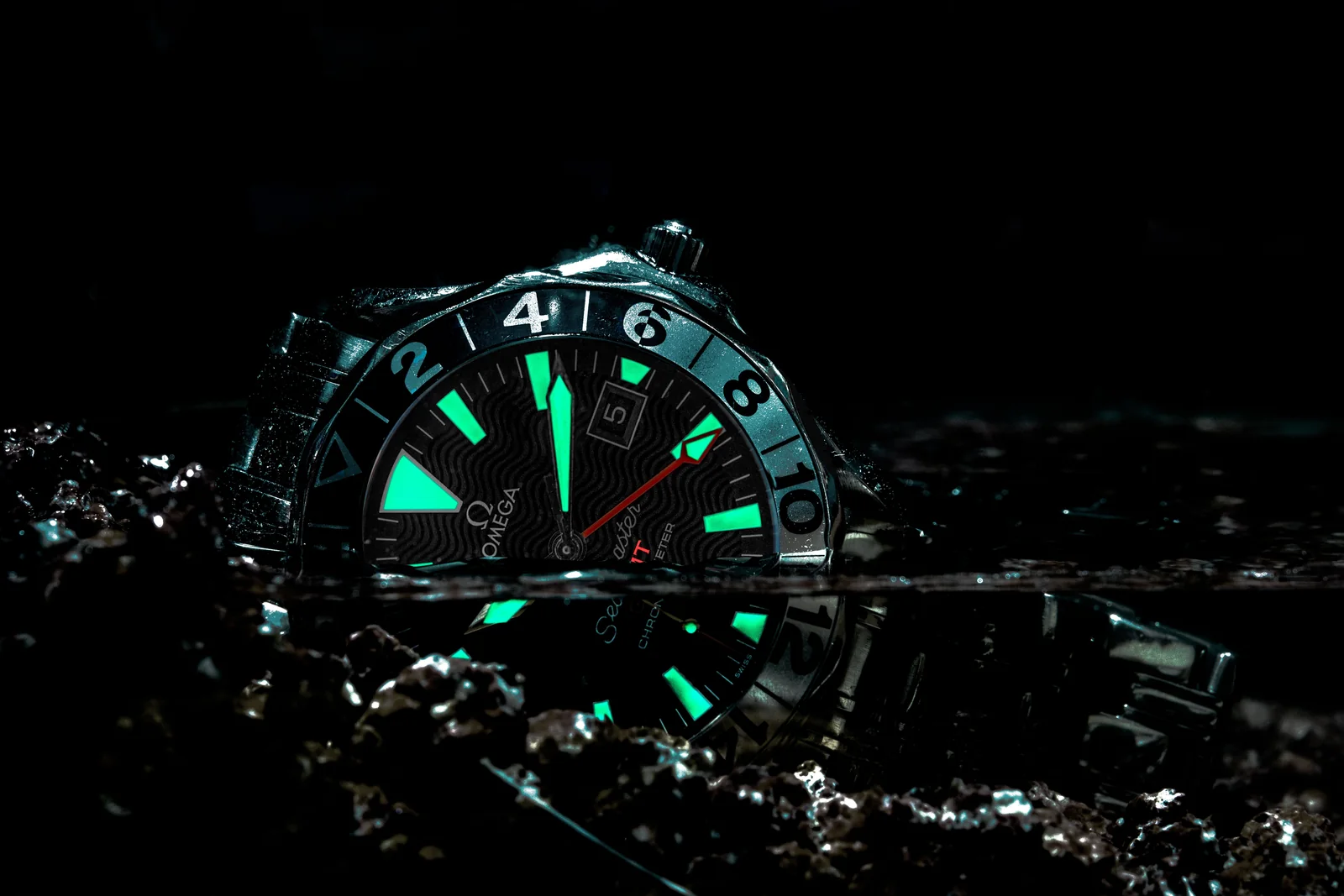
On certain Swiss dials from the late 20th century, the markings “T Swiss Made T”, “T Swiss T” or “Swiss Made T<25” indicate the use of luminous material containing tritium. “T<25” indicates radioactive activity below 25 millicuries, or approximately 925 megabecquerels for the complete item concerned, according to the regulatory conventions of the period.
These markings are valuable to collectors, but they do not replace an examination of the watch itself. A dial may have been replaced, relumed or restored. In the vintage world, an inscription sometimes tells part of a watch’s story, but it is not always the final chapter.
Super-LumiNova, light without radioactivity
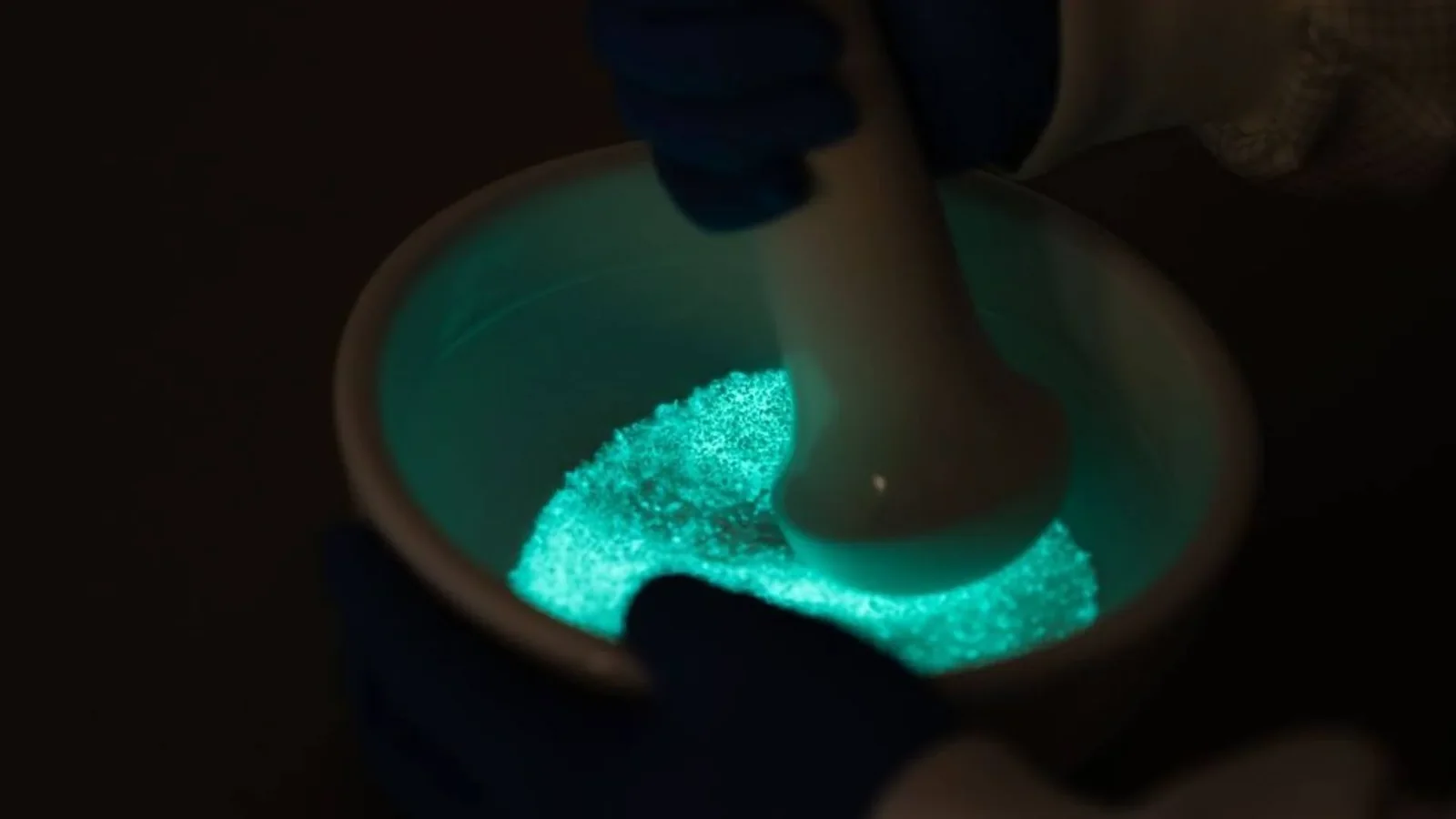
Super-LumiNova belongs to a different family. It is neither an isotope nor a radioactive paint, but a photoluminescent pigment based on strontium aluminate. The brand was developed by the Swiss company RC Tritec in the 1990s and gradually established itself as the benchmark luminous material in contemporary watchmaking.
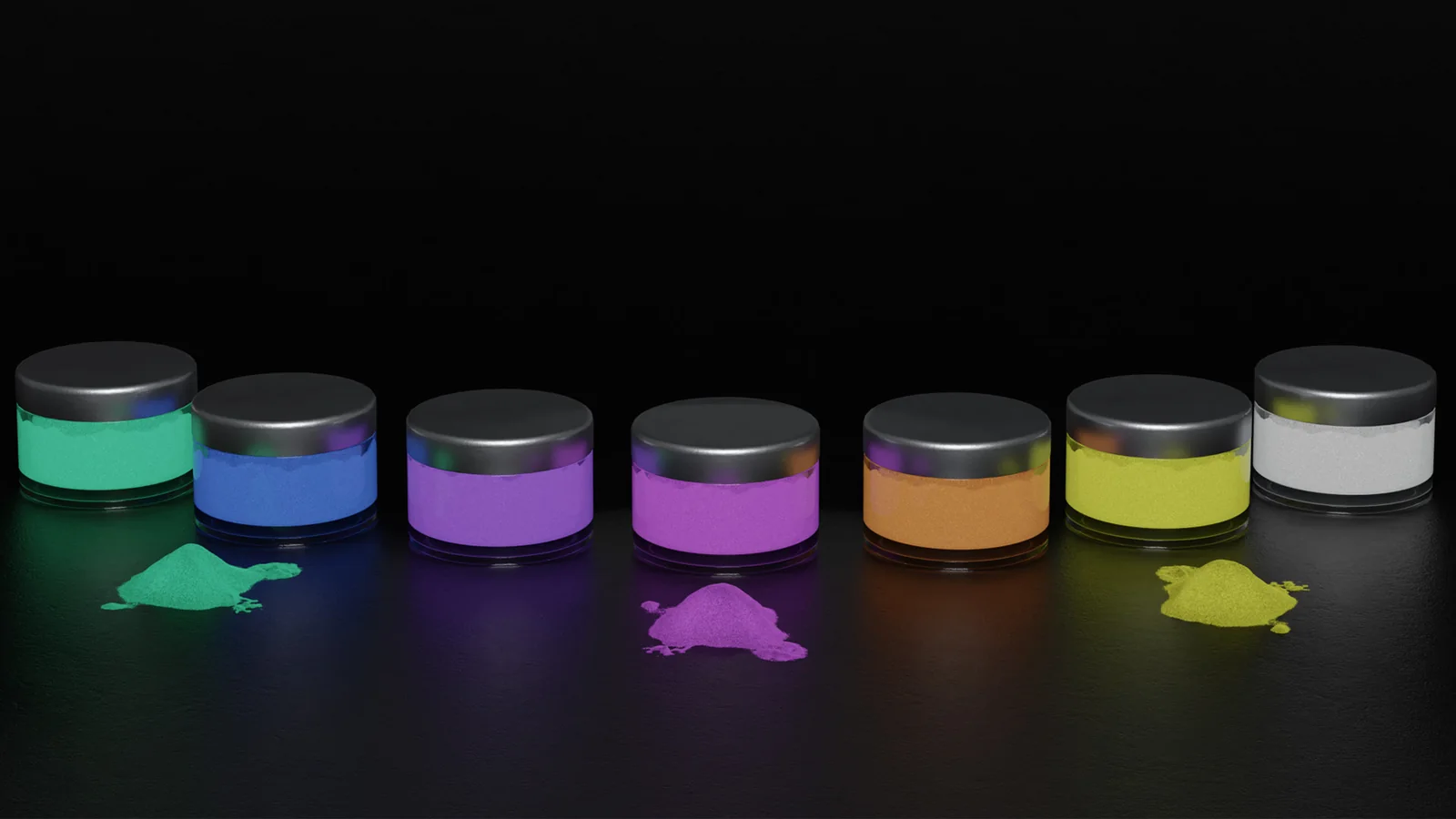
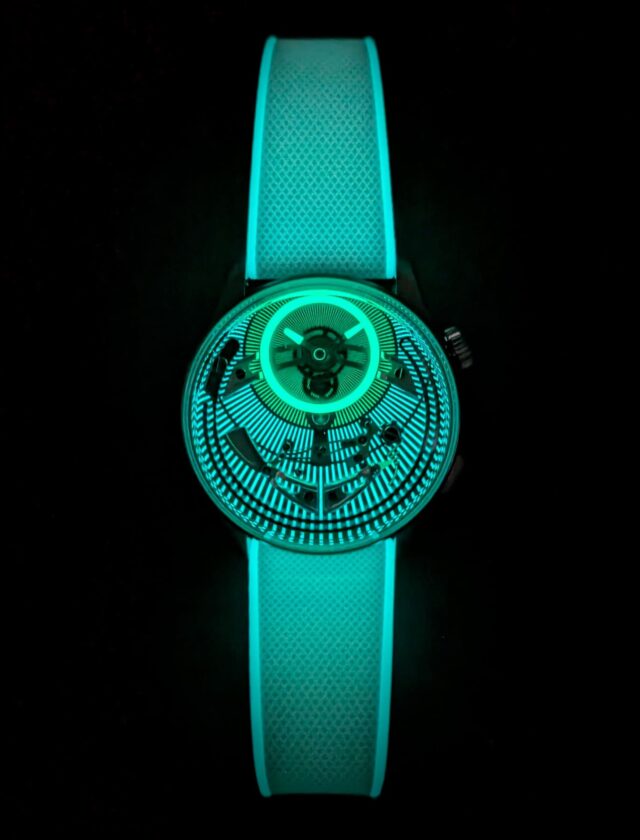
Its operation is easy to understand. The pigment absorbs energy from a natural or artificial light source and then releases it in the dark. Exposure for a few seconds under a lamp or in daylight is enough to trigger a strong glow. This then fades quickly at first, followed by a slower decline. Unlike tritium, Super-LumiNova does not generate light by itself: without prior exposure to light, it cannot glow.
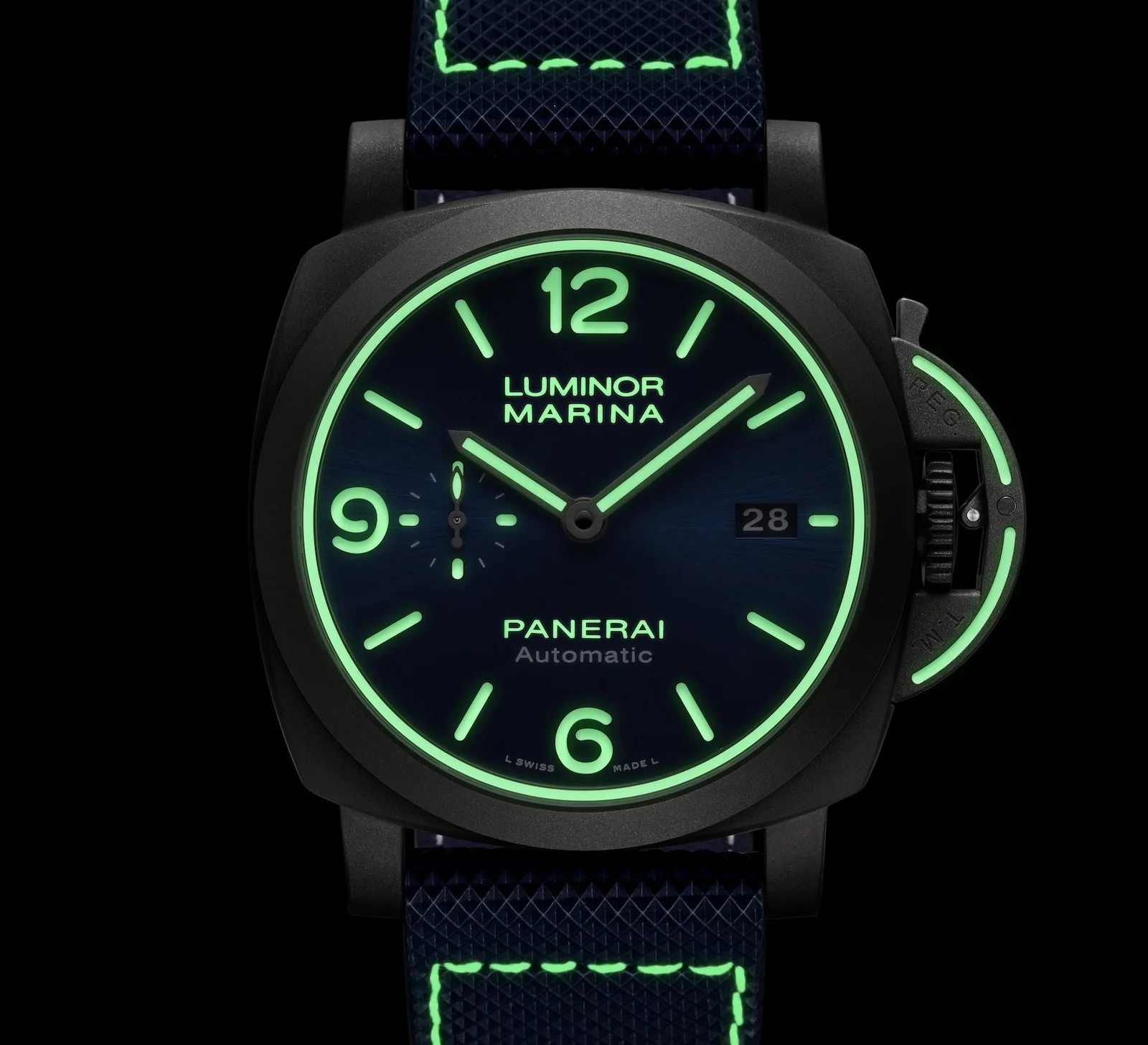
It does, however, offer one decisive advantage: the absence of radioactivity. It can be applied to a watch’s hour markers, hands and sometimes bezel without the constraints associated with radium or tritium. Its initial brightness is generally greater than that of old tritium material, although performance depends on the thickness of the application, the colour, the surface area and the quality of the application.
The most common colours are green, often associated with C3-type references, and blue, frequently found in BGW9 variants. Green generally appears more intense to the eye, while blue offers a cooler, more contemporary visual signature. Manufacturers can also tint the material beige, orange or white to imitate the appearance of an aged dial, sometimes creating a deliberately “faux patina”.
Which luminous material should you choose for different uses?
For a modern hiking, diving or aviation watch, Super-LumiNova provides immediate and spectacular legibility after exposure to light. It is particularly well suited to everyday use, when the watch regularly moves from bright daylight into darkness.
Tritium retains an advantage in environments where no light source is available. In a cockpit, underwater or in a completely dark room, its microtubes continue to produce a glow. Their intensity is nevertheless low and decreases over the years. They should be viewed as permanent illumination, not as a spotlight.
Radium, meanwhile, belongs primarily to watchmaking heritage. Its presence gives historical value to certain military watches and many collectible models, but it demands responsible handling. A radium dial should neither be restored indiscriminately nor cleaned like an ordinary decorative surface.
How can you identify the material in a vintage watch?
The first step is to examine the date, the dial markings and the watch’s overall consistency. A model from the 1930s may reasonably contain radium, while a timepiece from the 1990s is more likely to contain tritium. But the watchmaking industry does not follow perfectly clear-cut boundaries, and replacement dials often muddy the clues.
Colour alone is never enough. Tritium material can take on a cream hue over time, just as a radium dial may have been cleaned or relumed. A Geiger counter can detect radioactive emissions, but the measurement should be carried out by a competent person using suitable equipment. For a valuable watch, expert examination of the movement, dial, case and provenance remains essential.
In summary, three lights, three philosophies
Radium belongs to the heroic age, when nighttime legibility justified compromises that would be considered unacceptable today. Tritium introduced a more controlled solution, capable of providing a continuous glow but destined to fade over the decades. Super-LumiNova broke with radioactivity and imposed a different logic: light is stored and then released.
When a collector observes the warm hue of an old hour marker or the blue glow of a contemporary watch, they are therefore looking at more than a finish. They are reading a technical, industrial and sometimes social history. Luminescence is a tiny detail on a dial, but it reveals a great deal about the era that produced it.