Maison MORFIN Triomphe: All of the Place de l’Étoile in 40 Millimetres

It took thirty years to complete the Arc de Triomphe. Napoleon I commissioned its construction in 1806, but the monument was not inaugurated until 1836, during the reign of Louis-Philippe. Two centuries later, Maison MORFIN draws on its lines, architecture and symbolism to bring its interpretation to life in a 40-millimetre watch.
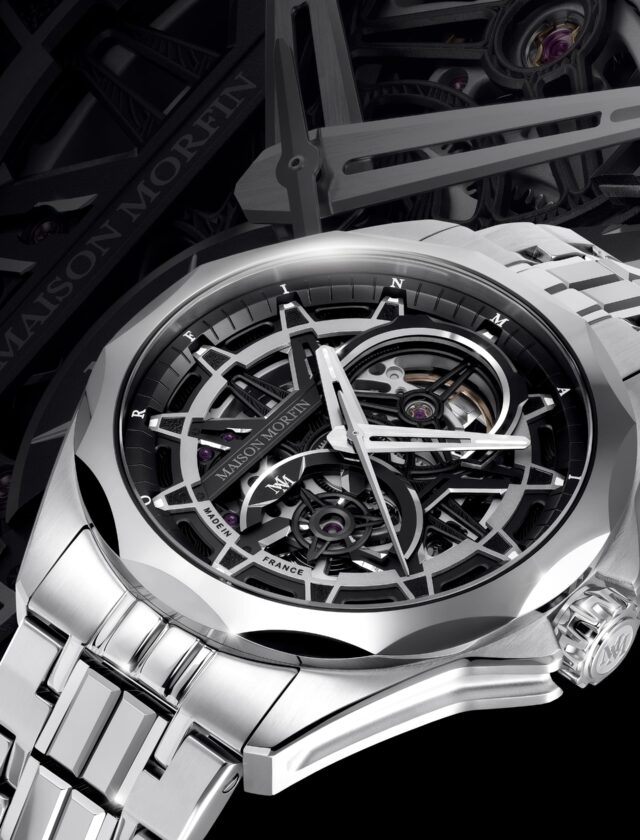
With the Triomphe, Maison MORFIN pays tribute to one of Paris’s most iconic monuments. This automatic skeleton watch is made in France and powered by a Swiss movement, with a design that is rich in references to the Arc de Triomphe and the famous Place de l’Étoile.
The idea particularly appealed to me because, beyond its aesthetics, this inspiration provides a genuine story to tell. The twelve avenues, the monument’s pillars and the flame of the Unknown Soldier: each of these elements has found its place in the watch’s design and invites closer inspection.
The Arc de Triomphe as muse

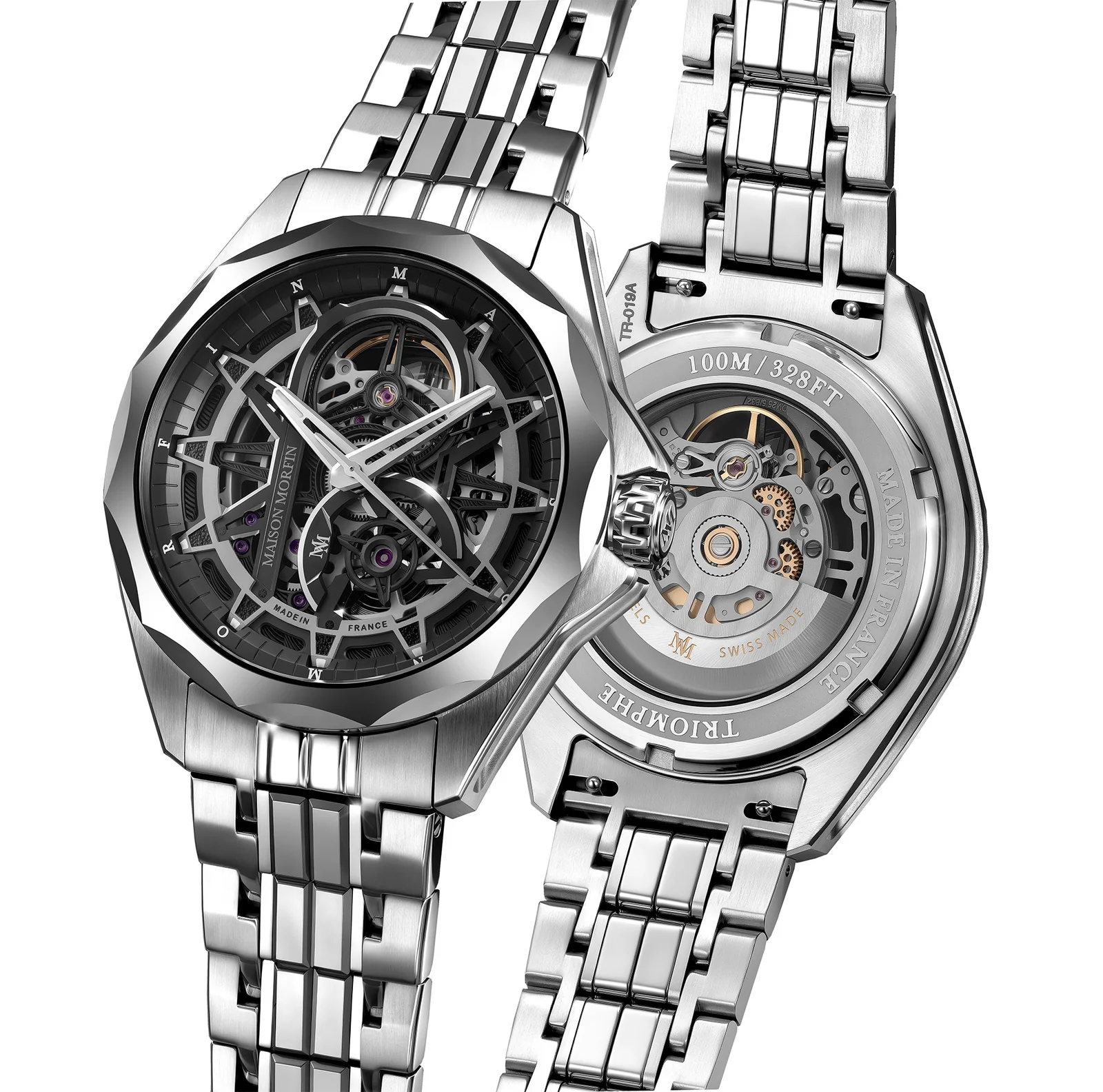
The first thing that strikes you about the Triomphe’s design is the geometry of its dial. Radiating lines, layered volumes and a central structure recall the architecture of the Arc de Triomphe.
The inspiration extends well beyond the monument’s silhouette.

The Place de l’Étoile, now known as Place Charles-de-Gaulle, takes its name from the arrangement of the avenues that converge at its centre. Twelve major thoroughfares now form this Parisian star, including the Champs-Élysées and Avenue de la Grande-Armée.

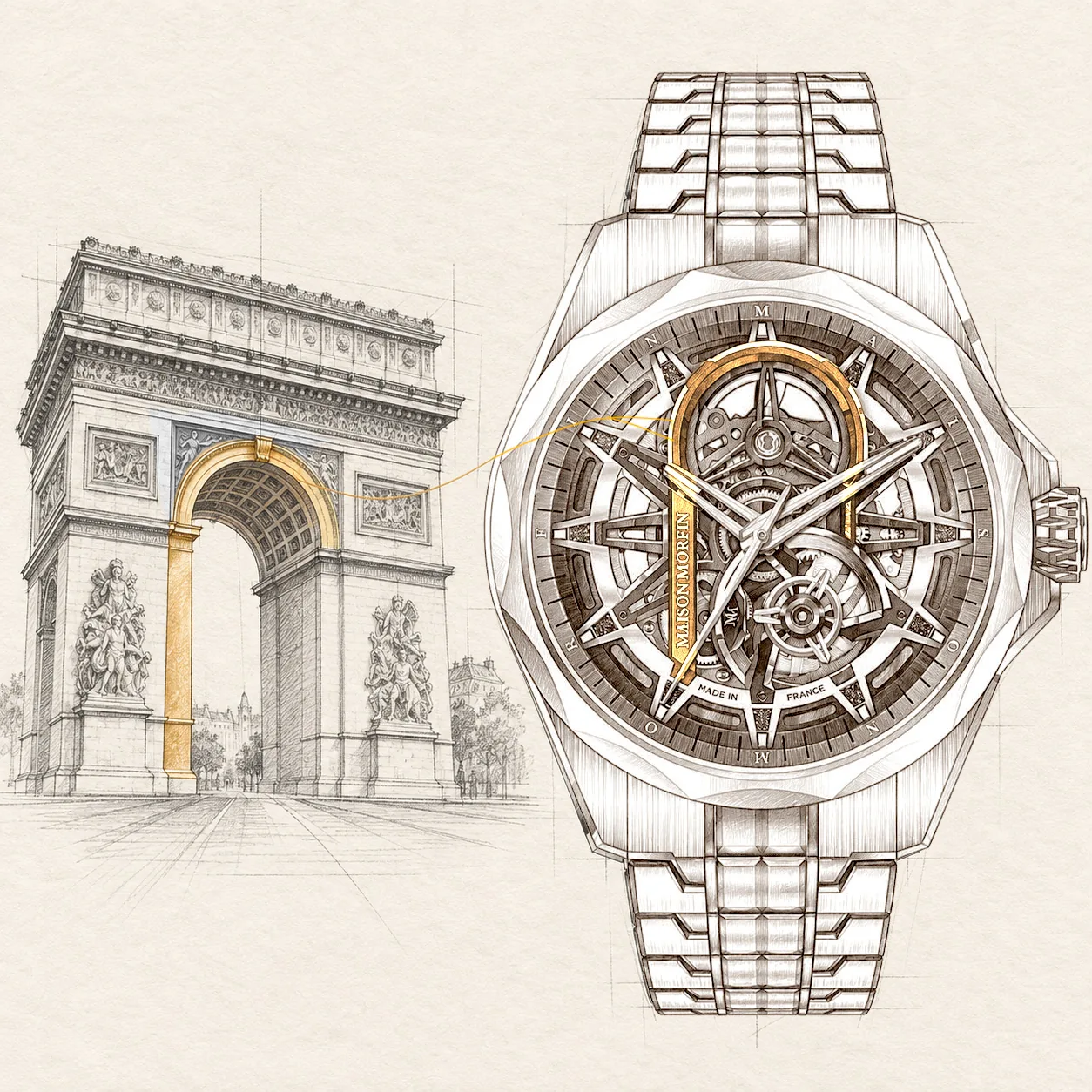
This radial arrangement is echoed in the Triomphe’s dial. The number twelve also appears on the bezel, made up of twelve facets, and on the screw-down crown, which features twelve notches. A particularly apt correspondence for an instrument whose dial already divides time into twelve hours.


The work becomes more subtle when you look at the central structure. One of its elements takes the form of a pillar from the Arc de Triomphe before extending into an arch that frames the watch’s mechanical heart.
At five o’clock, the visible mainspring barrel evokes the flame of the Unknown Soldier, first lit beneath the Arc de Triomphe on 11 November 1923. The sword-shaped motifs surrounding it recall the brazier in which this eternal flame burns, while the ruby set at the heart of the spring symbolises its brilliance.
A particularly thoughtful interpretation, in which the watch’s components themselves contribute to the tribute paid to the monument.
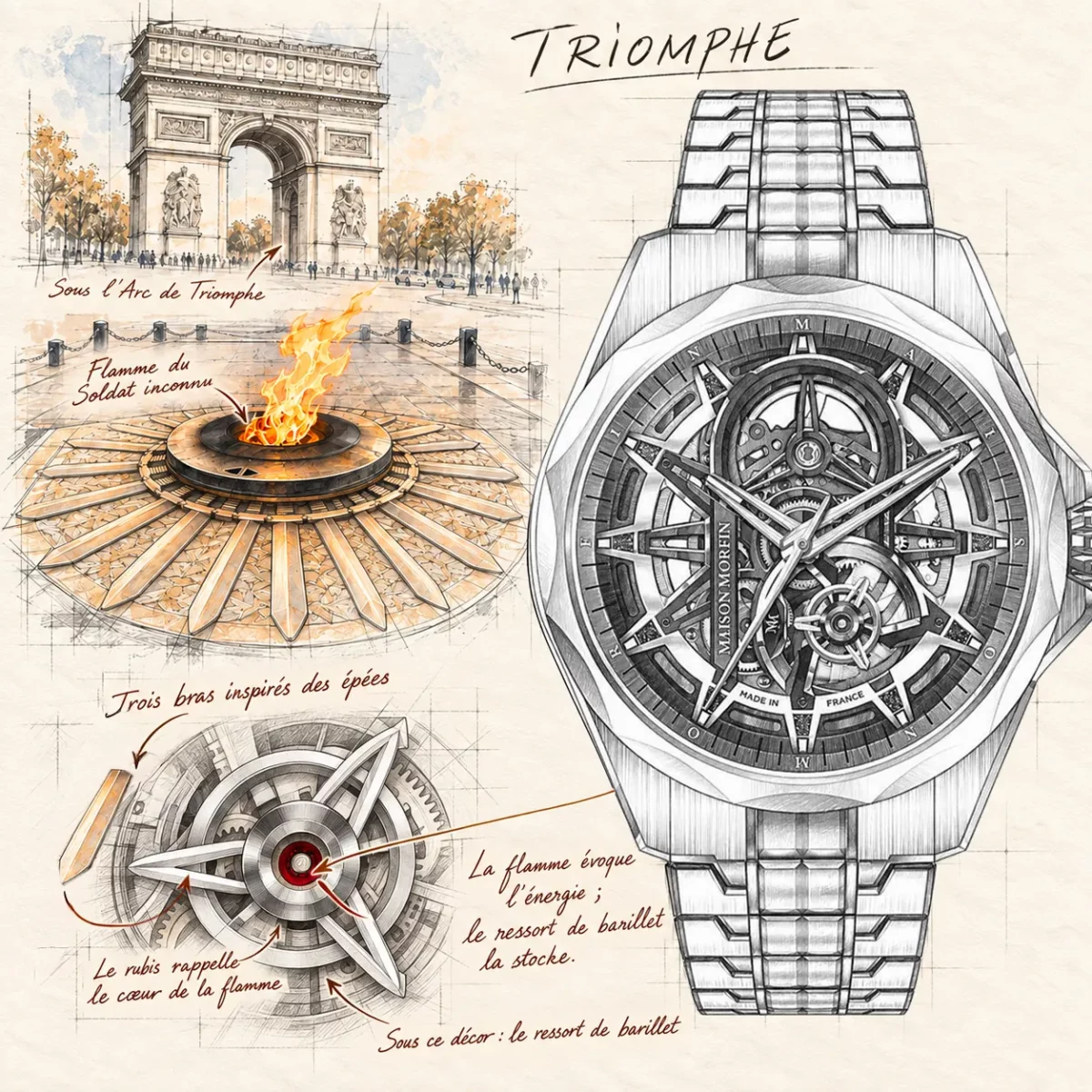

I like this way of integrating historical symbols into a watch composition. Some are immediately apparent, while others reveal their full meaning once you know their origins.
The whole design invites you to look more closely at the watch, recognise its elements and understand the creator’s intentions.
One final detail deserves attention: the Maison MORFIN signature also appears on the rehaut, in a position that leaves the dial’s construction centre stage.
A remarkably complex dial
To my mind, the dial is the Triomphe’s greatest technical achievement. Most traditional dials are built around a main plate, generally made of brass, enhanced with surface treatments, applied hour markers and various decorative elements.
For the Triomphe, Maison MORFIN developed a construction made up of several independent layers. Each has its own geometry, finishes and assembly constraints.

The various elements are CNC-machined and then worked on separately before assembly. The first layer features machined Côtes de Genève, along with polished bevels and anglage.
The upper levels introduce further volumes, polished edges, brushed surfaces and openings through which the mechanical components can be seen.
The result offers genuine depth. The relief does not come from a simple visual effect printed onto a plate. It is created by assembling several components positioned at different heights.
This work is considerably more demanding than it might appear. On a watch dial, a few tenths of a millimetre can alter the overall balance. A structure that is too thin compromises rigidity. An angle that is too thick obscures part of the mechanics. A difference in height changes the way light travels across the dial and the appearance of its finishes.

Development required several months of work and numerous prototypes before the final composition was achieved. CNC machining delivers high precision and excellent repeatability. It does not, however, eliminate the need to design each component, work on its finishes and inspect its assembly.
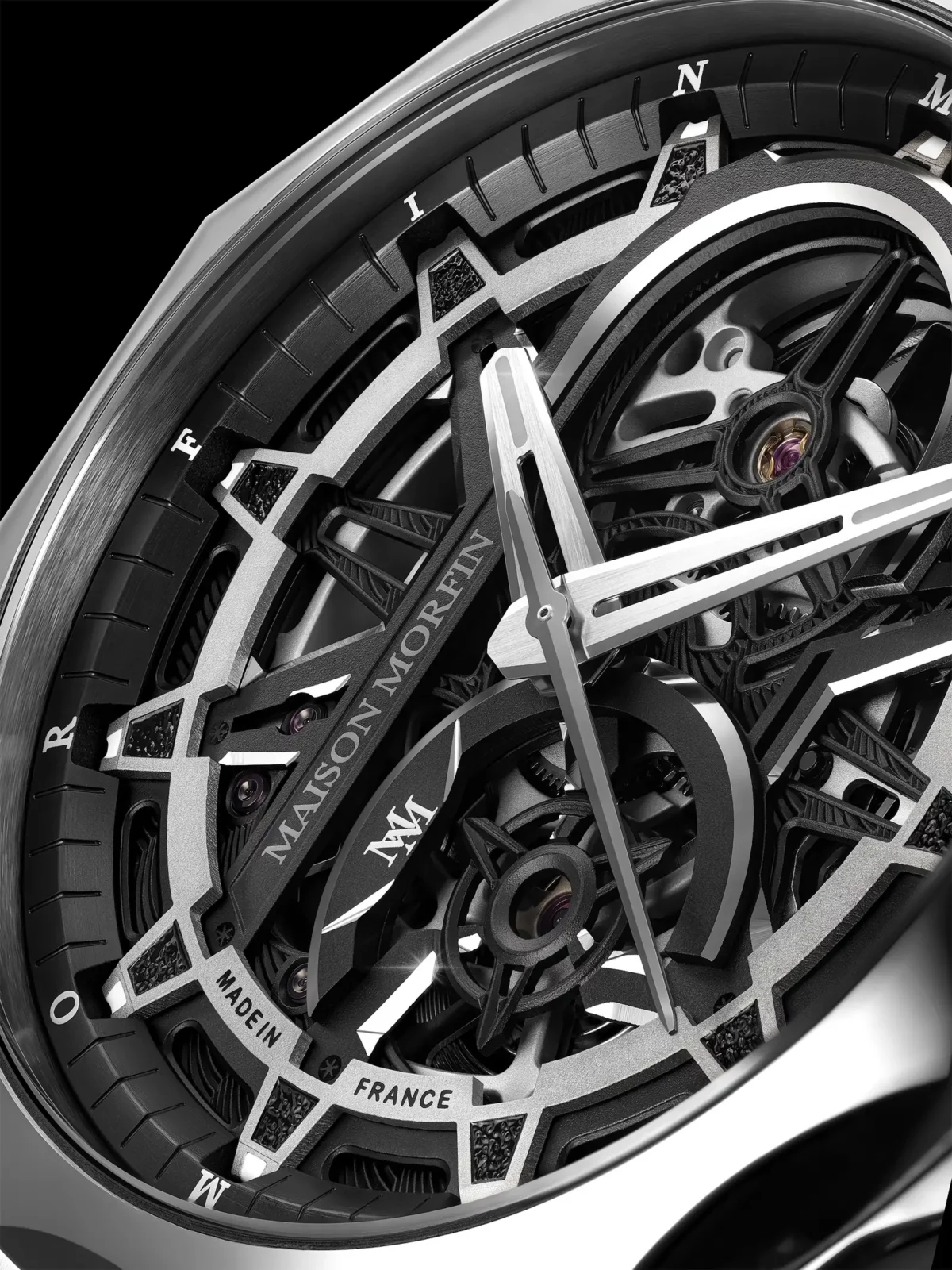
I particularly appreciate this search for depth and the wealth of finishes. The dial offers several levels of interpretation, both literally and figuratively. First you notice its overall composition, then the surfaces, bevels, openings and details that emerge with closer observation.
A fine demonstration of the work a young independent maison can devote to an element as decisive as the dial.
A skeleton watch that does not forget to tell the time
Creating a skeleton watch is particularly challenging. Opening up a dial to reveal the mechanics is appealing in principle, but good legibility must still be preserved. Some models multiply the openings, bridges and decorative elements to such an extent that the hands end up merging with the movement. You then spend more time searching for the time than reading it.

On the Triomphe, the skeletonisation benefits from a carefully considered composition. The openings follow the dial’s architectural lines, while the various finishes make it possible to distinguish the structures and preserve a certain visual hierarchy.
Despite the wealth of detail, I find the overall balance particularly successful.
Legibility extends into the darkness thanks to two distinct luminous treatments: the hour markers receive Super-LumiNova BGW9, while the hands use Super-LumiNova C3. An additional consideration that makes reading the time easier, particularly welcome on a skeleton watch.
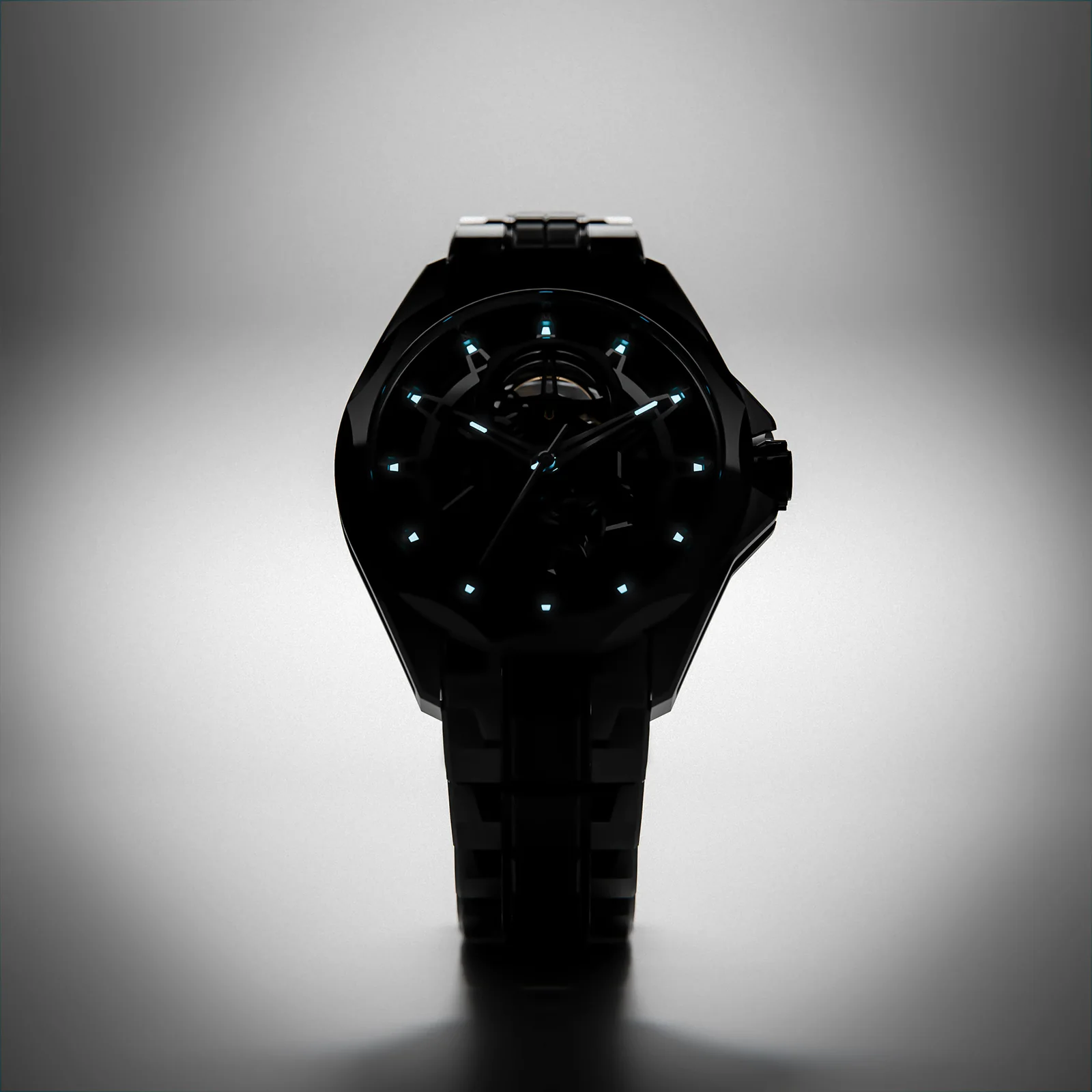
Legibility is, of course, essential on a watch of this type. Nevertheless, I feel that the Triomphe succeeds at a difficult task: offering elaborate and spectacular skeletonisation while preserving the necessary cues for reading the time.
A Sellita SW200 regulated to chronometric standards
Behind this particularly elaborate dial sits the Sellita SW200, a proven Swiss automatic movement. The choice seems a sound one to me.
This calibre enjoys a strong reputation for reliability and offers an advantage that matters greatly to me: serviceability. Its widespread use in the watch industry means that competent professionals can maintain it without relying on a little-known proprietary movement.

It operates at a frequency of 28,800 vibrations per hour, contains 26 jewels and offers a power reserve of approximately 40 hours. This autonomy is in line with that of a well-proven movement, even if more recent calibres now offer longer power reserves.
So Maison MORFIN needed to go further, turning its attention to the regulation of the movement.
The watch houses a Top-grade version of the Sellita SW200, regulated in the workshop to COSC chronometric tolerances: a rate deviation between -4 and +6 seconds per day, with checks in three positions and a chronometric report. I particularly appreciate this effort.
At this price level, it would have been easy to devote most of the budget to the dial, materials and visible finishes. Maison MORFIN has instead chosen not to sacrifice mechanical performance in favour of aesthetics.
This is an approach I can relate to. A watch can be original, elegant and exceptionally well executed. It must also perform its primary function precisely.
This pursuit of performance, applied to a calibre as familiar as the SW200, reflects the perfectionism driving the project.
A 40 mm case to accommodate the Place de l’Étoile
The Triomphe’s case measures 40 mm in diameter and 11.3 mm thick. These proportions seem quite reasonable to me for a watch whose dial plays such an important role in the overall design. Even so, considerable ingenuity is required to fit the Place de l’Étoile into a watch!
316L stainless steel forms the case structure. The flanks combine horizontal brushing and microbead blasting, two finishes that help emphasise the lines without multiplying polished surfaces.
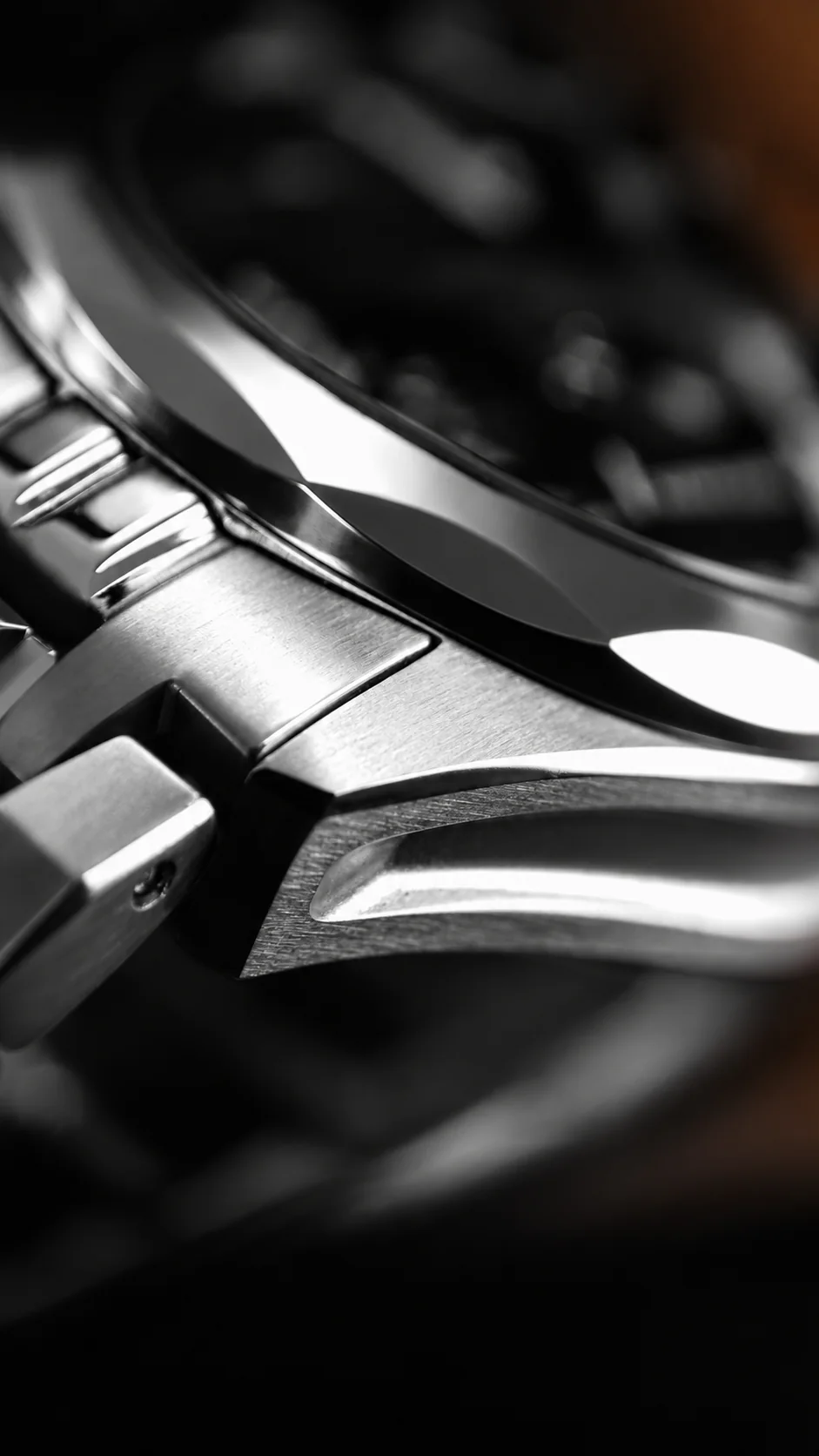
The bezel is made of tungsten, an exceptionally hard material renowned for its scratch resistance.
We had already encountered this technical choice on Maison MORFIN’s The One, which we presented on Montres Passion.
Tungsten has obvious advantages on a bezel, which is exposed to friction and the minor knocks of everyday life. Its density and appearance also contribute to the overall perception of quality.
Both sides of the watch are protected by sapphire crystals, each featuring a five-layer anti-reflective treatment. This additional care makes it easier to appreciate the dial’s many details and, on the reverse, those of the Sellita SW200 movement and its decorated rotor.
Water resistance reaches 100 metres, thanks in particular to the screw-down crown. This is a welcome level for a watch with such a highly worked aesthetic, even though it makes no claim to be a dive watch. It is further evidence of the maison’s seriousness and quality.
The crown has another interesting feature: a disengagement system designed to reduce mechanical stresses during winding. Its slightly bevelled thread facilitates engagement and limits friction.
These are small details, but they matter in everyday use.
The crown is handled regularly. Its operation, the sensation it provides and the precision of its engagement all contribute to the pleasure of owning a fine timepiece.
Two straps, two personalities
Maison MORFIN offers two configurations for the Triomphe: a metal bracelet combining steel and tungsten, or an alligator-leather strap made in Geneva.
The metal bracelet naturally continues the lines of the case. The central tungsten links create an aesthetic continuity with the bezel and reinforce the impression of an ensemble designed with care.
The links use individual screwed pins. This solution facilitates work on the bracelet and ensures a secure mechanical connection.
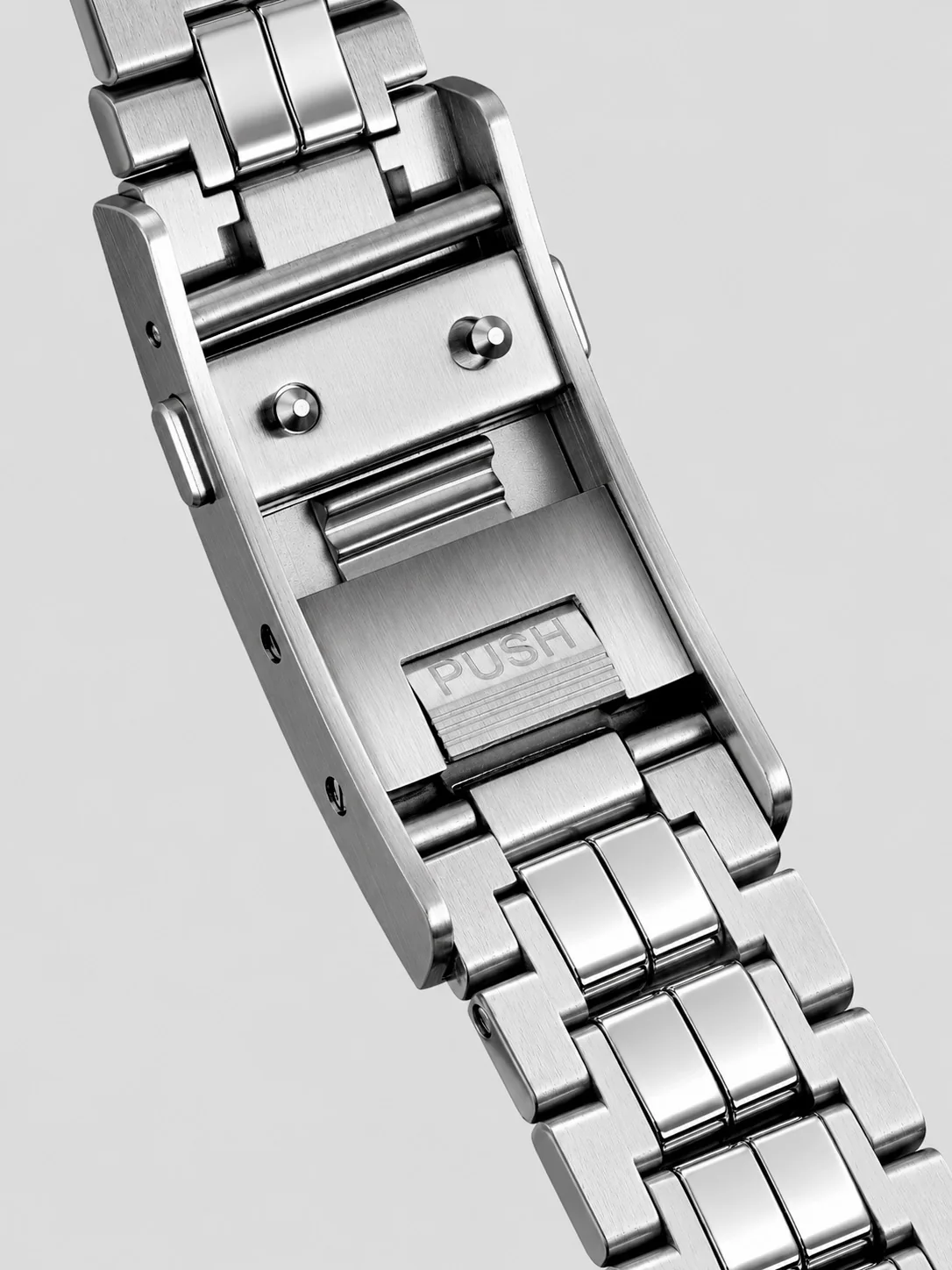
I also appreciate the presence of a folding clasp with push-button micro-adjustment. It allows the bracelet length to be adapted to changes in wrist size without having to handle the links.
In everyday use, this kind of detail can make a real difference.
The maison has also provided 1.8 mm quick-release spring bars, allowing the bracelet to be changed without tools.
The Geneva-made alligator-leather option features a folded-edge construction with a calfskin lining. The leather wraps around the edges rather than leaving simply cut edges exposed. This technique produces a particularly refined finish.

The two bracelets offer different interpretations of the Triomphe.
Steel and tungsten extend its architectural and technical personality. The leather brings a more classic touch, creating a pleasing contrast with the sophistication of the dial.
The specifications state a weight of 170 grams with the bracelet, a figure that remains within the usual range for many automatic watches fitted with a steel bracelet.
Beautiful harmony despite the wealth of detail
This is probably what stands out most to me about the Triomphe aesthetically: the quality of its overall balance. The dial is packed with components, levels, textures and finishes. Yet the whole retains a genuine harmony.

The radial lines organise the design. The different heights create depth. Polished bevels emphasise the shapes, while brushed surfaces and Côtes de Genève introduce more understated contrasts.
Every element finds its place in a composition that could easily have become confusing.
I particularly like the way the dial openings reveal the mechanics without making the movement look as though it has simply been stripped of its upper plate.
The skeletonisation is fully integrated into the design. The shapes have been conceived to work together, with their volumes, proportions and different surface treatments.
It is a recipe involving many ingredients, yet the result strikes me as remarkably balanced.
The originality does not lie in one isolated detail. It comes from the way all these decisions converge to give the Triomphe an immediately recognisable identity.
Maison MORFIN Triomphe: €2,990 for a watch with a story to tell
The Triomphe is priced at €2,990, whether fitted with its metal bracelet or its alligator-leather strap. Competition is obviously intense at this price. Historic Swiss maisons, Japanese manufacturers and numerous independent brands offer an extensive choice of automatic watches.
Yet when you look at certain collections, you could almost swap the logos on the dials because they lack so much character.
A classic case, three hands, an automatic movement and a familiar design. The formula can produce very attractive watches, but it sometimes leaves little room for personality.
The Triomphe takes a different path. Its dial has an original construction, its historical references genuinely contribute to the design, and its technical choices reflect particular attention to manufacturing.
The Sellita SW200 movement benefits from demanding chronometric regulation. The tungsten bezel, 100-metre water resistance, case finishing and bracelet construction complete a particularly compelling proposition.
The first series was announced at 100 pieces, each accompanied by a numbered certificate. The two-year warranty can be extended, while servicing and repairs are handled by a watchmaking team in France.
There is also one quality I value enormously in a watch, and it does not appear on any specification sheet.
I like it when someone notices the watch I am wearing and asks what it is. I like being able to tell the story of the brand, explain a technical choice and point out a detail that had not been noticed at first glance.
The Triomphe is one of those watches you can talk about for many minutes.
You can begin with Napoleon and the Arc de Triomphe, explain the geometry of the Place de l’Étoile, find the flame of the Unknown Soldier on the dial, then move on to the various machined layers, the anglage and the movement’s regulation.
Every detail offers a new opportunity to extend the conversation.
Ultimately, that is also what I love about watchmaking: when a watch sparks curiosity, conveys a story and makes you want to discover more.
With the Triomphe, Clément Morfin has created a watch that brings these qualities together with a strong personality, genuine technical richness and a design that I find particularly successful.
Maison MORFIN Triomphe specifications
| Feature | Details |
|---|---|
| Brand | Maison MORFIN |
| Model | Triomphe |
| Origin | Assembled in France |
| Movement | Swiss automatic Sellita SW200, Top grade |
| Regulation | COSC tolerances, -4/+6 s/day in three positions |
| Frequency | 28,800 vibrations/hour (4 Hz) |
| Power reserve | Approximately 40 hours |
| Jewels | 26 |
| Case | 316L stainless steel |
| Diameter | 40 mm |
| Thickness | 11.3 mm |
| Lug width | 20 mm |
| Bezel | Tungsten, twelve facets |
| Dial | Multi-layer skeleton, CNC machining, Côtes de Genève and anglage |
| Hour markers | Applied markers, Super-LumiNova BGW9 |
| Hands | Openworked, Super-LumiNova C3 |
| Crystals | Five-layer anti-reflective sapphire, front and caseback |
| Water resistance | 100 metres, screw-down crown |
| Bracelets | Steel and tungsten or Geneva-made alligator leather |
| Steel clasp | Folding clasp with micro-adjustment |
| Stated weight | 170 grams with bracelet |
| Warranty | 2 years, extendable |
| First announced series | 100 pieces |
| Retail price | €2,990 |
To discover the different configurations, visit the Triomphe collection on the official Maison MORFIN website.
Interested in this watch?
Price, availability, contact: we can activate our watch-industry network to help you.