De Bethune DB25 Digitale: Jumping Hours Beneath a Blued Titanium Sky

When I received De Bethune’s press release and saw its title, “DE BETHUNE presents DB25 DIGITALE”, I felt a brief mixture of curiosity and concern. “Oh no, not De Bethune… They’re not going to start making smartwatches, are they?”
I have no idea why my brain immediately connected “digitale” with smartwatch. Perhaps the morning coffee had not yet taken full effect. Especially since TAG Heuer seems to have (finally) brought that strange connected-watch interlude to an end.
Fortunately, this brief moment of doubt lasted only until I scrolled down to the first photograph in the press release. It was simply a digital display. I was reassured.
An Unusual Way of Telling Time at De Bethune
Once that brief misunderstanding over the word “digitale” was out of the way, we quickly found ourselves on much more familiar ground.
This is obviously not a revolution. Mechanical digital displays have existed for a long time, and the Manufacture had already used one in the DBD, a model explicitly referenced for this new DB25 Digitale. The novelty lies instead in the way De Bethune reinterprets the principle within the aesthetic world of the DB25 collection.
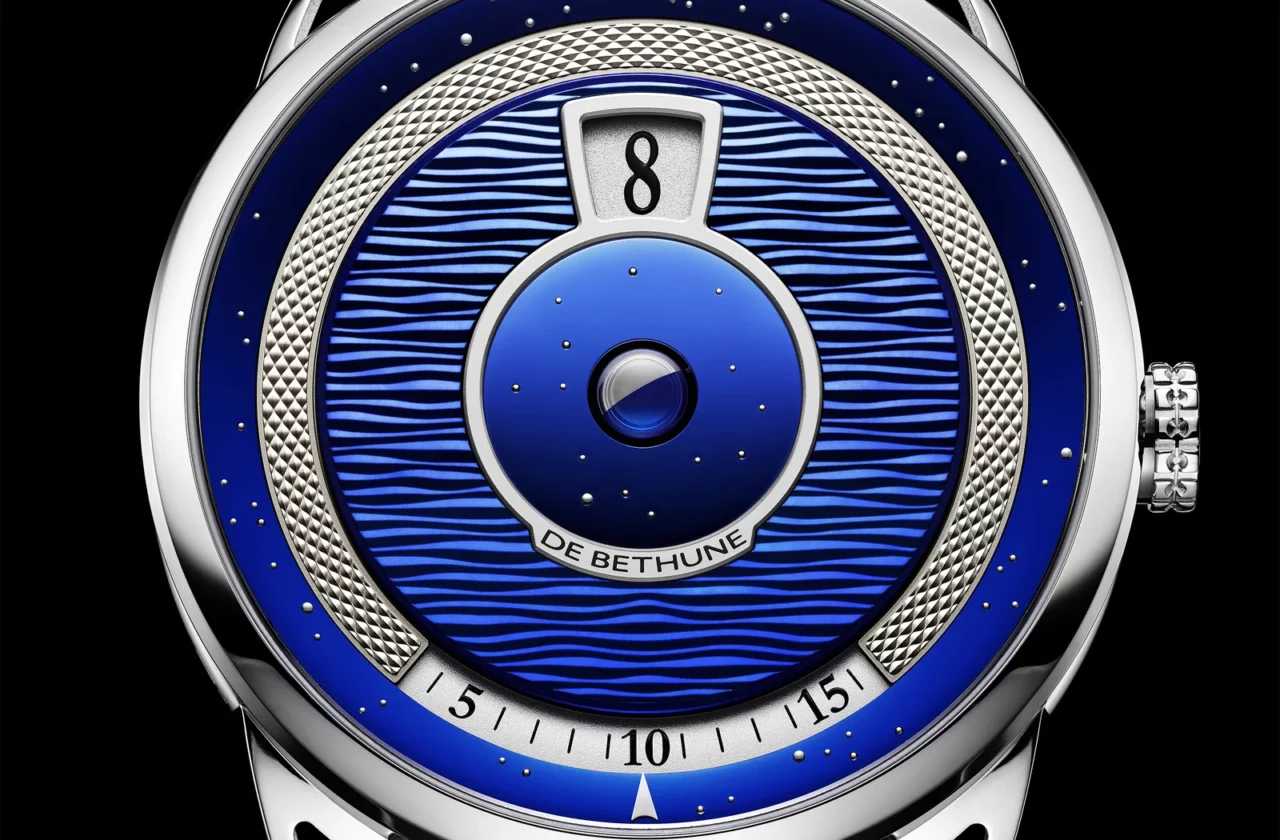
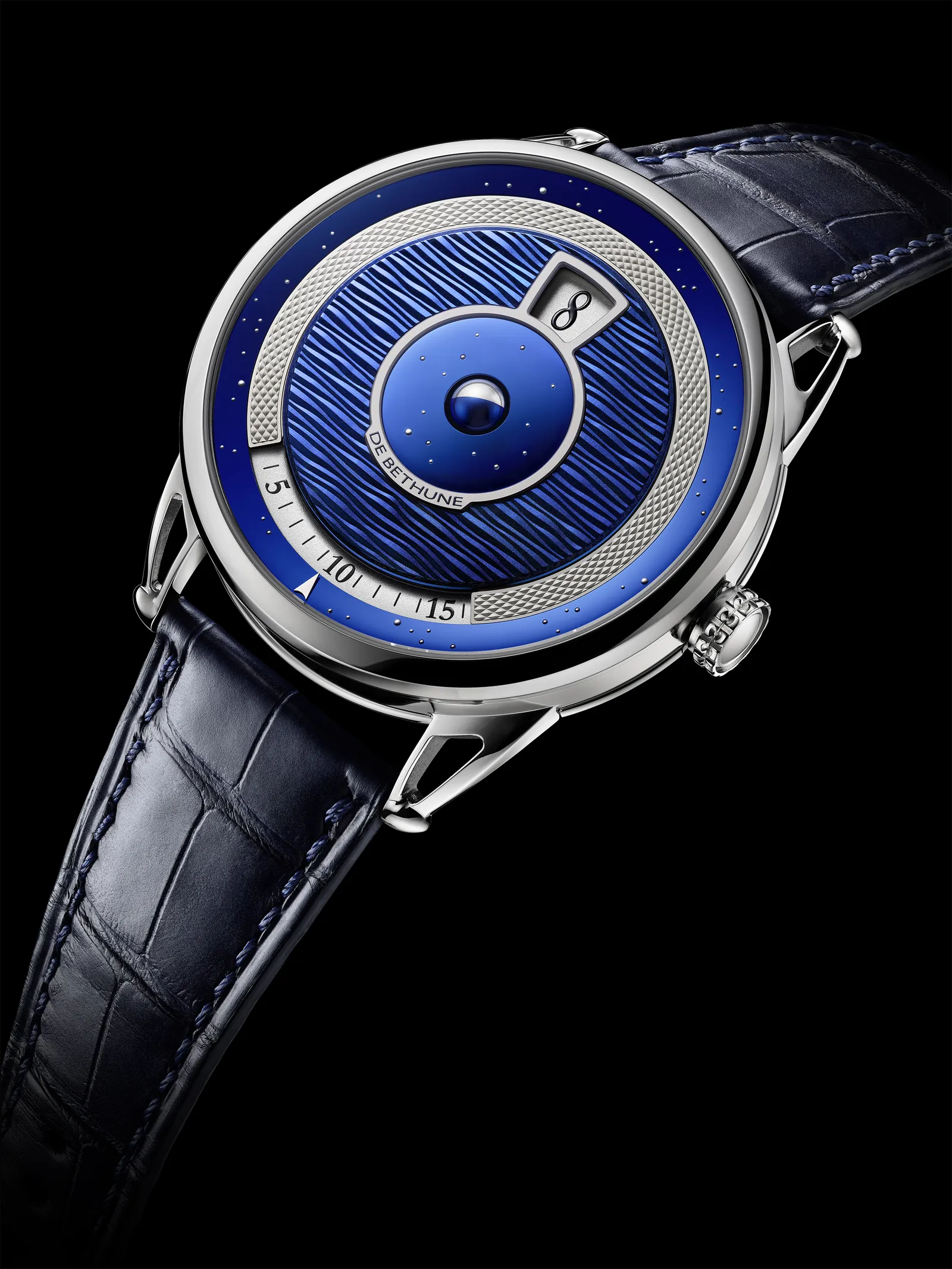
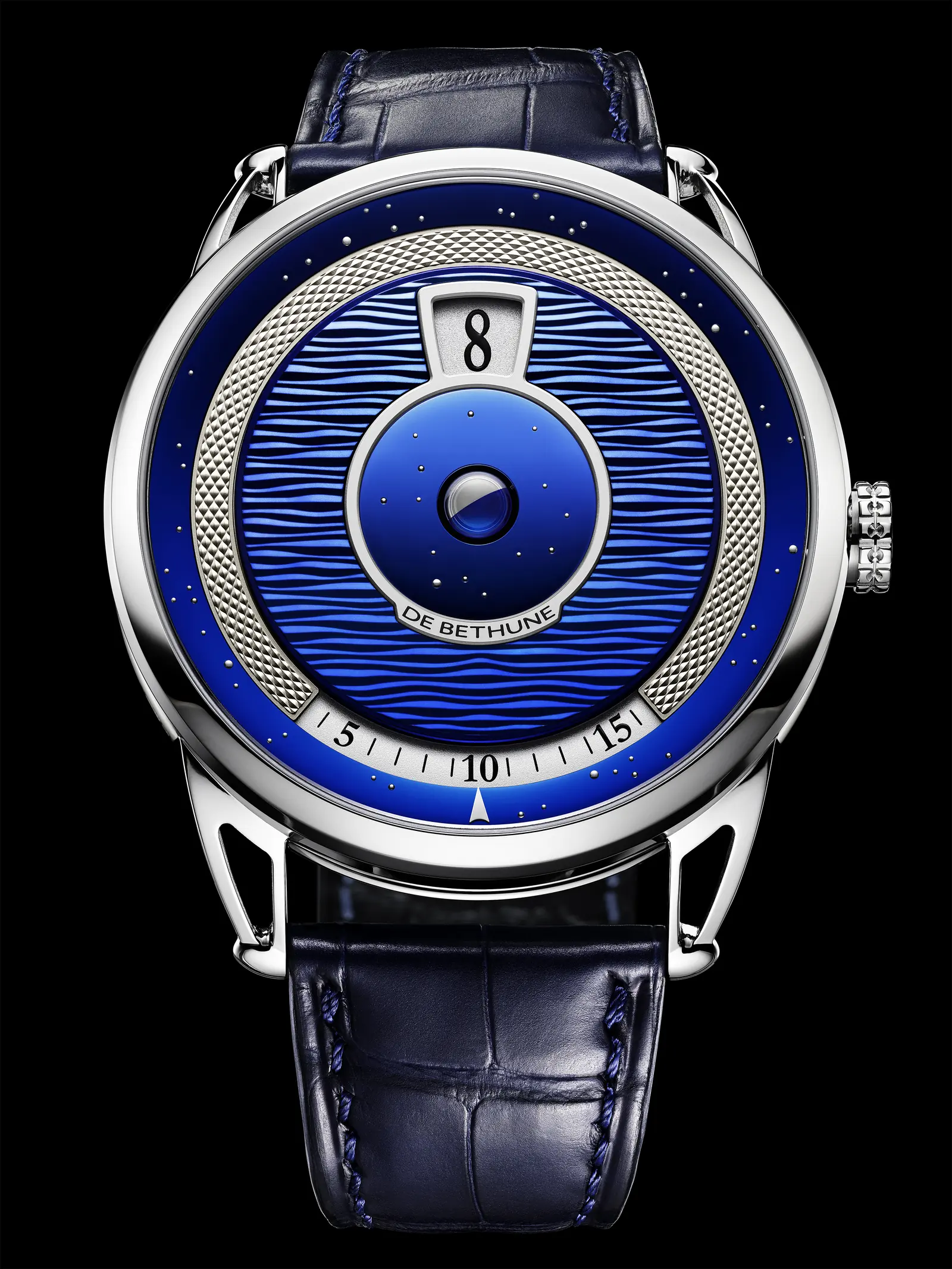
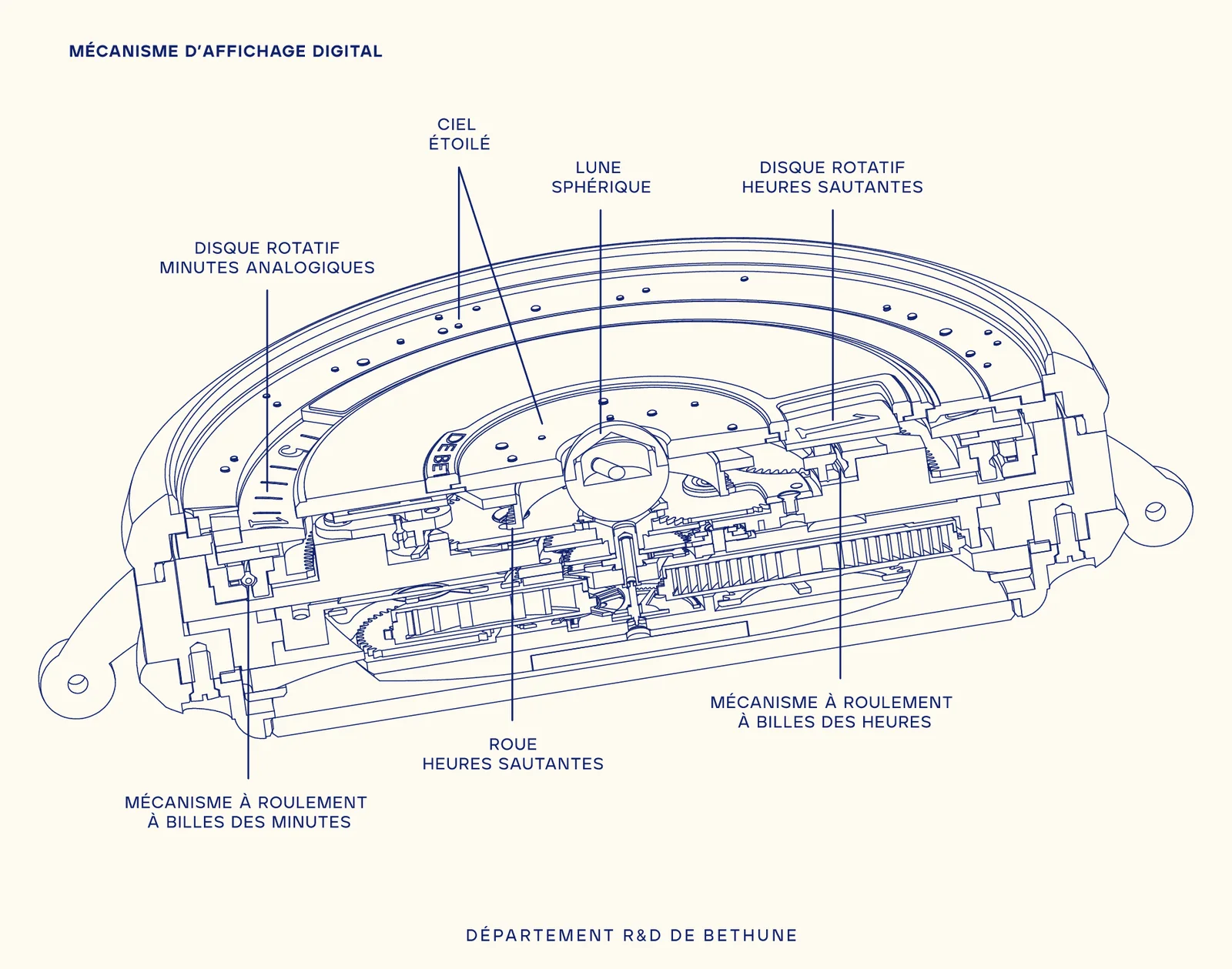
The watch combines three types of indications. A window at 12 o’clock displays the jumping hours. At 6 o’clock, a rotating disc indicates the minutes analogically. Finally, the spherical moon occupies the centre of the dial to display the lunar phases. De Bethune tilts it at an angle of 60 degrees.
The overall display remains highly legible, but the appeal of the system is not limited to telling the time. By removing traditional hands from the centre of the dial, De Bethune primarily creates more space in which to work with materials and volumes.
A Dial Conceived as a Nocturnal Landscape
De Bethune says it imagined the dial as a nocturnal scene, with moonlight reflected on a river—a reference to Moon River by Johnny Mercer and Henry Mancini. The image becomes much more obvious when you look at the watch.
The centre of the dial is made from blue titanium guilloché with a random pattern. The irregular lines create a sense of movement that genuinely evokes the surface of water. Around it, De Bethune shifts completely into a different register with a silvered sector, hand-guillochéd in a classic barleycorn pattern.
This contrast between traditional guilloché and a much more contemporary decoration works particularly well. It also prevents the DB25 Digitale from becoming a mere showcase for blue, even though blued titanium obviously plays a central role in the watch’s visual identity.
The minute track and the moon’s circumference are also made from polished and blued Grade 5 titanium. De Bethune sets them with small grey-gold stars. The Manufacture says that the decoration comprises a total of 82 elements.
The Spherical Moon Remains the Star of the Show
At the centre of the dial, De Bethune places one of its most recognisable signatures: its spherical moon.
Here, it combines two hemispheres: one in polished palladium, the other in flame-blued steel. Beyond its aesthetic appeal, this moon-phase display is distinguished above all by its precision. The mechanism deviates by just one lunar day every 1,112 years.
In other words, the future owner can afford to be fairly relaxed about when it next needs adjusting.
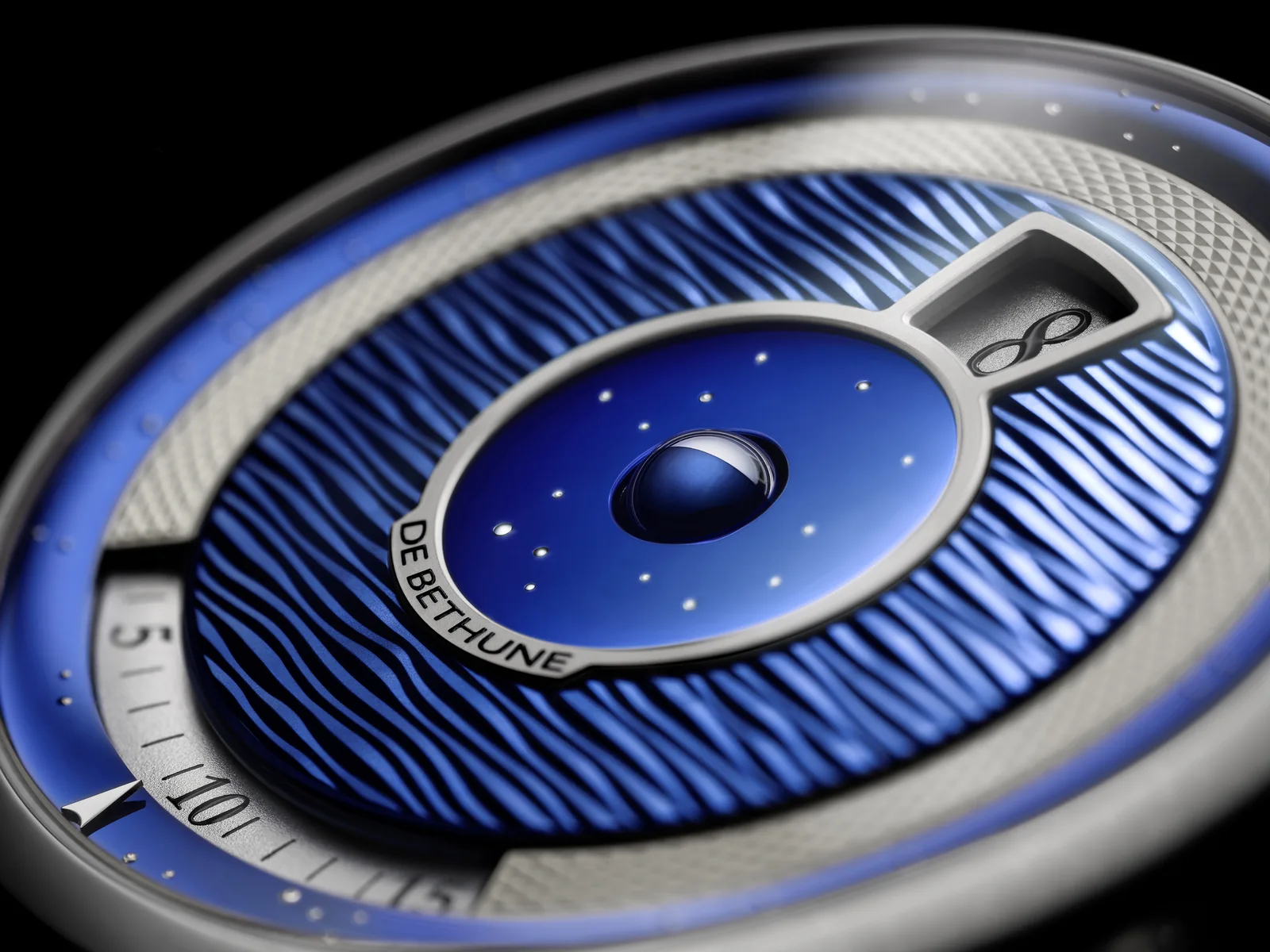
The moon also provides the logic behind the entire dial. De Bethune arranges the various decorations and indications around it in successive circles. The hour window at 12 o’clock and the minute sector at 6 o’clock then break that perfect symmetry by just the right amount.
The DB2144V3 Calibre at Work
Beneath the dial, De Bethune uses the DB2144V3, a hand-wound mechanical movement.
The calibre comprises 416 components, includes 32 jewels and beats at 28,800 vibrations per hour. Its self-regulating double barrel provides five days of power reserve.
De Bethune has also equipped the movement with several technical solutions that have now become part of its in-house vocabulary: a titanium balance with grey-gold inserts, a hairspring with a flat terminal curve, a silicon escape wheel and the triple shock-protection system designed to absorb impacts.
The jumping-hours mechanism and the minute disc mechanism, meanwhile, rely on miniature ball bearings.
Once again, De Bethune is not particularly interested in making a grand announcement. Most of these solutions already existed in its technical arsenal. The DB25 Digitale simply brings them together in a different configuration.
A Movement That Echoes the Dial’s Decoration
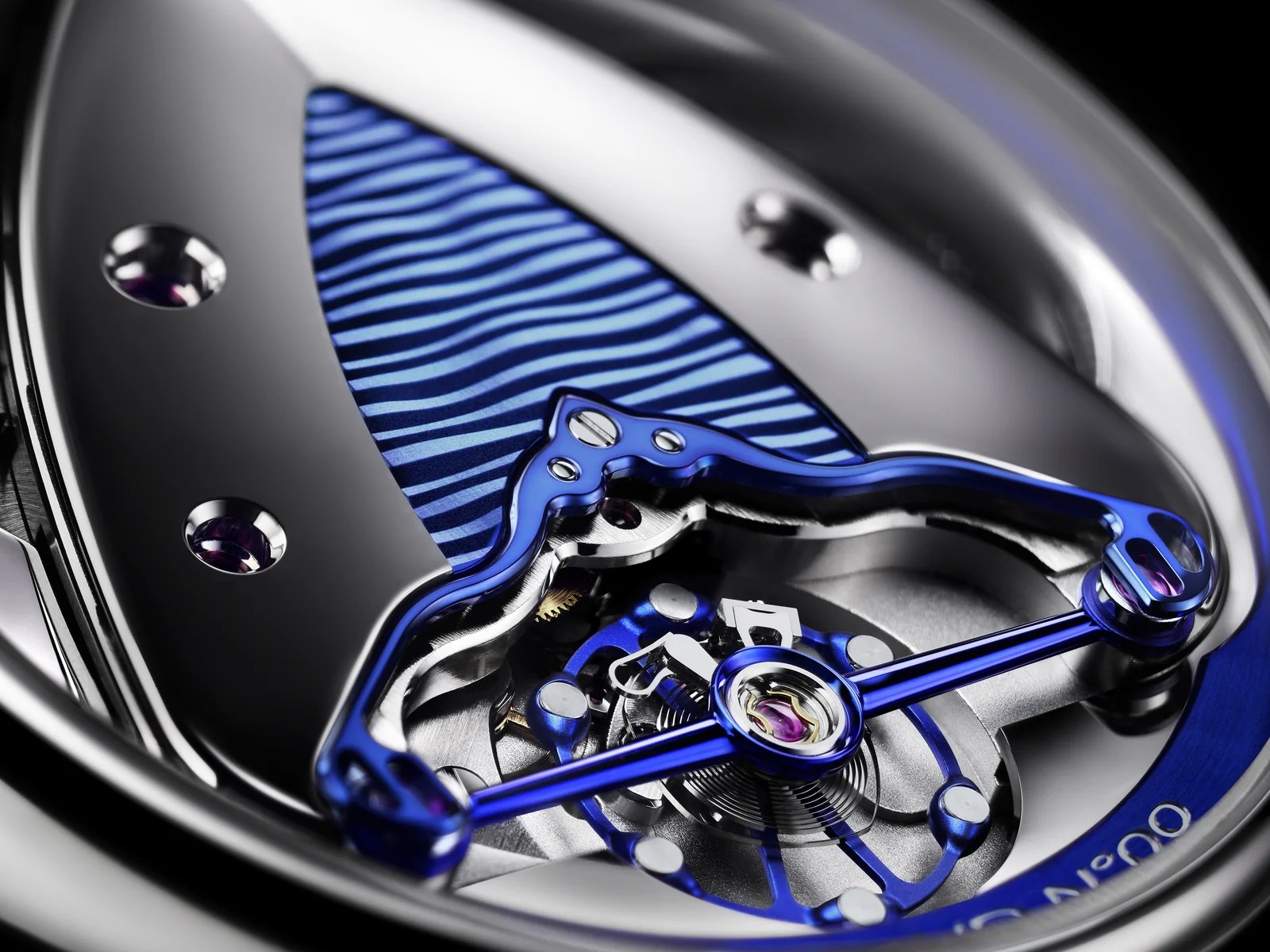
The sapphire caseback reveals the DB2144V3 and allows us to see, on the movement side, some of the work carried out on the dial.
For the first time, De Bethune applies its random guilloché to the deltoid bridge. A central insert in blued titanium thus echoes the same visual language found on the front.
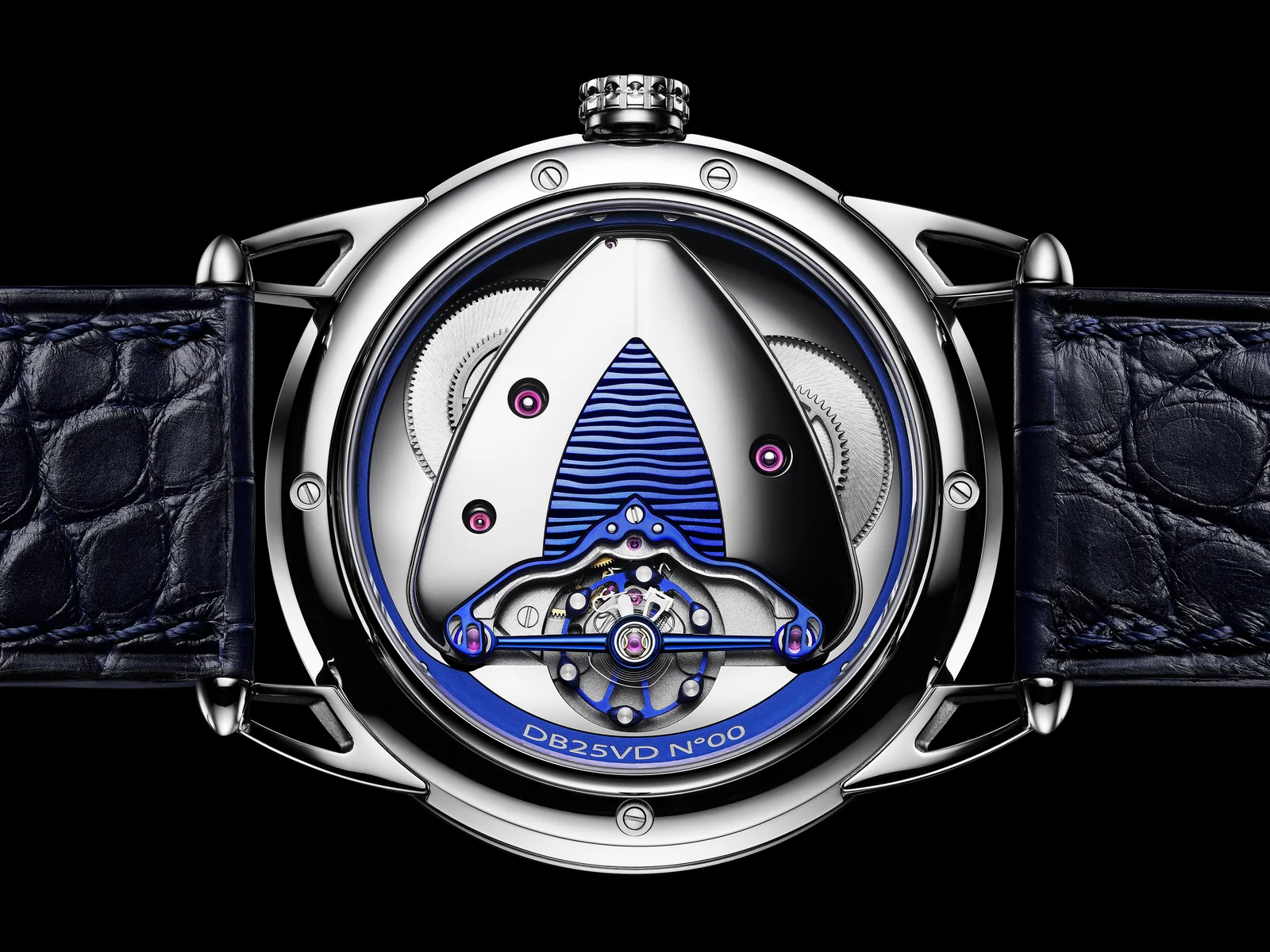
This detail gives the watch genuine coherence. The front and back do not feel as though they belong to two different pieces. We find the same shades of blue, the same interplay of light and the same desire to make traditional decoration converse with a far more contemporary treatment of titanium.
A 42 mm DB25 Case
The DB25 Digitale retains the classic proportions of this family.
Its case in polished Grade 5 titanium measures 42 mm in diameter and 11.9 mm in thickness. The integrated, openworked lugs extend the case middle while visually lightening the overall design.
The dial’s generous opening suits this watch particularly well. It leaves enough room for the central moon and the various guilloché zones without making the indications appear to compete with one another.
De Bethune equips the watch with a sapphire crystal featuring double-sided anti-reflective treatment. Water resistance is limited to 3 ATM, which will surprise no one on a watch of this kind. The Manufacture completes the package with an extra-supple, hand-stitched dark-blue alligator strap and a polished Grade 5 titanium buckle.
A Different De Bethune, but Still Very Much De Bethune
The DB25 Digitale does not therefore overturn the codes of watchmaking—and that is not what is being asked of it.
Its appeal lies instead in the way De Bethune brings together several elements already well known from the brand: blued titanium, the spherical moon, guilloché work, heat treatments and a particularly sophisticated mechanical movement.
The digital display primarily changes the balance of the dial. It allows De Bethune to do away with hands and give even more space to materials, textures and reflections.
In the end, behind the name that had caused me a few moments of concern when I woke up, there was nothing particularly alarming. Just another, fairly logical variation on De Bethune’s watchmaking language.
De Bethune DB25 Digitale
Technical specifications
DB25VD
Polished Grade 5 titanium
42 mm
11.9 mm
Manufacture calibre DB2144V3, hand-wound
5 days
28,800 vibrations/hour
416 components, 32 jewels
Jumping hours through a window, minutes on a rotating disc
Spherical moon in palladium and blued steel, tilted at 60°
1 lunar day every 1,112 years
3 ATM
Extra-supple, hand-stitched dark-blue alligator
Pin buckle in polished Grade 5 titanium
Interested in this watch?
Price, availability, contact: we can activate our watch-industry network to help you.