Swatch Sistem51: the first fully automated mechanical movement assembly
This information is not intended for the general public, yet it remains of great importance to the world of watchmaking.
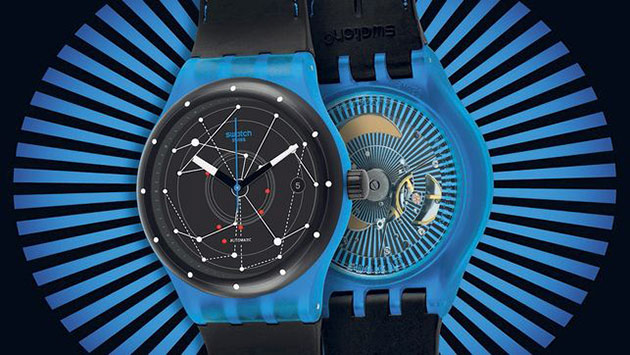
Swatch announced a few days ago at the Baselworld show the launch of the Sistem51. 51 is the number of components in this new automatic mechanical movement. 51 is also half as many parts as in traditional mechanical movements.
But that’s not all: the Sistem51 boasts an audacious 90-hour power reserve!
Another development that borders on a revolution: this movement is the world’s first mechanical calibre to be assembled entirely by automation. The components are welded together in an assembly built around a single central screw.
The consequences of this industrialisation in the manufacture of a mechanical movement are difficult to gauge, but one must acknowledge that it is a formidable, ingenious, unstoppable strategy.
Some are talking about the death of quartz because of the very low price of watches equipped with this movement, which should range between 75 and 150 euros (first models available in October 2013). In my view, quartz still has bright days ahead of it, because beyond owning several watches, an owner does not necessarily have a burning desire to have to wind and set their mechanical watches every time they switch. Besides, it is hard to imagine Swatch drawing a line under the quartz market!
The effects could, however, be positive by breaking down the existing barrier between mechanical watches and the “quartz” consumer. The accessibility of this watch will play an educational role for a (large) population with little or no familiarity with mechanical movements. The future success of entry-level timepieces will further sharpen the distinction between quartz and mechanical in the consumer’s mind, while preaching the gospel and the nobility of mechanical watchmaking. Ultimately, it is the consumer’s use case that will steer them towards mechanical or quartz (with price obviously remaining a major criterion of choice). One can, however, imagine that this movement will be the consumer’s first contact with mechanical watchmaking, leading to conversion and an upward journey towards more sophisticated models (from the Swatch Group?).
This revolution does not, however, mean the Group will necessarily stop at the entry level. A cheaper movement also makes it possible to concentrate costs on gem-setting, the dial, the case… In short, a crossroads of possibilities for occupying multiple segments (a gem-set mechanical women’s watch, for example).
Swatch, with this first announcement, affords itself the luxury of targeting a gigantic segment in terms of volume while logically generating a healthy margin on a product manufactured through automation. The only possible strategy for brands outside the Group is to continue with quartz or to flee the entry-level mechanical segment, because it will become even more of Swatch’s private hunting ground.

Interested in this watch?
Price, availability, contact: we can activate our watch-industry network to help you.
I’m interested in this watch