Why Can a Watch Become Magnetized Without Us Realizing It?
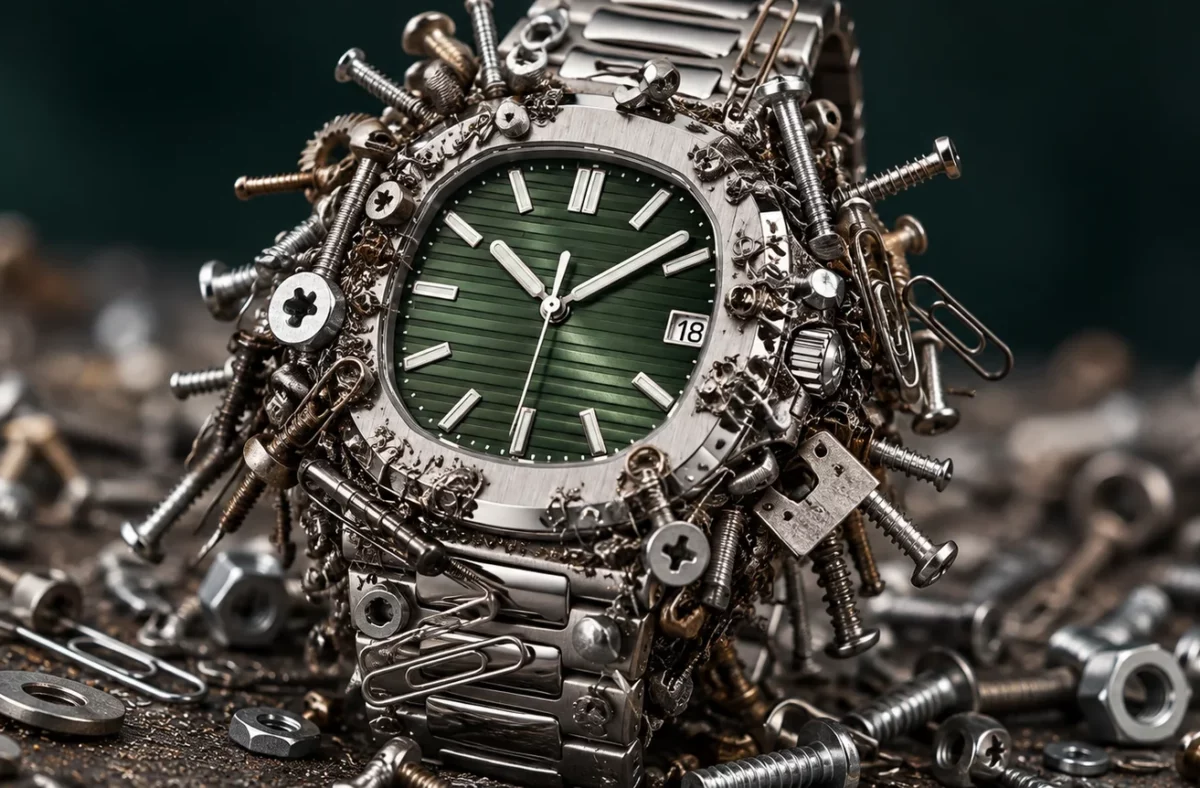
A watch can become magnetised without being knocked, without any visible fault and sometimes without ever having been near a refrigerator magnet. All it takes is a bag clasp, a speaker, a case fitted with a magnetic closure or a laptop to expose its movement to a magnetic field. The phenomenon is subtle, but its consequences can be dramatic: a mechanical watch that had previously kept good time suddenly starts gaining several minutes a day.
Magnetisation is not some watchmaker’s myth intended to explain every temperamental watch. It is a very real physical problem, particularly affecting traditional mechanical calibres. To understand it, you need to look at what happens inside the movement, where a handful of tiny components work with almost insolent precision.
What exactly does it mean when a watch is magnetised?
In everyday language, we say that a watch is “magnetised”. In reality, not all of its parts necessarily become magnetic. The phenomenon mainly affects certain ferrous-alloy components, notably the hairspring, balance staff, wheels and certain elements of the winding system.
The hairspring is the most vulnerable component. This spiral-shaped metal strip regulates the oscillations of the balance. It acts as the movement’s regulating spring: its effective length and frequency determine the watch’s rate. When it retains a residual magnetic field, its coils can attract one another slightly and stick together in places.
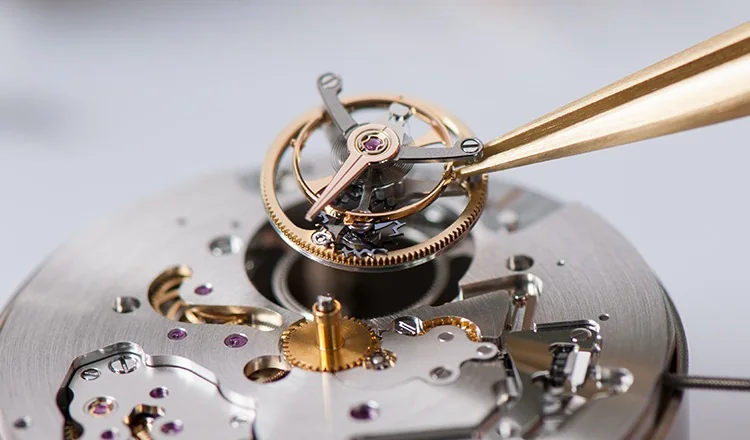
The hairspring no longer operates according to its intended geometry. Its active length decreases, the balance oscillates faster and the watch generally begins to gain significantly. In some cases, the coils remain intermittently in contact, causing erratic timekeeping. A watch may gain several minutes a day and then behave differently depending on its position on the wrist.
The problem therefore does not always look like an outright failure. The watch continues to run. That is precisely what makes the diagnosis deceptive.
Why does the phenomenon often go unnoticed?
Magnetisation produces no noise, smell or visible mark on the dial. The owner simply notices that the watch is gaining time. They often blame the movement for needing a service, a change in temperature, a recent drop or an unfavourable position overnight.
These explanations are sometimes correct. However, a major and sudden rate deviation, appearing without any other obvious event, should raise the possibility of magnetism. A well-regulated mechanical movement that goes from being a few seconds out per day to several minutes is not merely displaying a quirk of horological temperament.
The phenomenon can also be temporary. A strong magnetic field may disrupt a watch momentarily without leaving lasting magnetisation. Conversely, some alloys retain part of their magnetism after exposure. The watch may appear normal for weeks, then begin gaining time after repeated contact with a magnetic source.
Everyday objects that can magnetise a watch
The danger does not come only from large industrial magnets. In a contemporary home, potential sources are numerous and often much closer to the watch than one might imagine.
- Magnetic clasps on bags, pouches and cases.
- Speakers, earbuds and headphones fitted with loudspeakers.
- Car mounts and magnetic chargers.
- Tablets and laptops, which sometimes incorporate magnets for their sensors or closure systems.
- Induction hobs and certain household appliances.
- Power tools, motors, transformers and high-powered speakers.
- Medical imaging equipment, whose magnetic fields are incomparably stronger.
Smartphones require a little nuance. Their electronics are not, in themselves, a dangerous magnet for a watch worn on the wrist. However, certain mounting or charging accessories use magnets concentrated enough to create a significant field at very close range. The risk therefore depends on the strength of the field, but also on the distance and duration of exposure.
A low-powered magnet several centimetres away does not pose the same danger as a small, powerful magnet placed directly against the caseback for several hours. With magnetism, proximity changes everything.
How can you tell if a watch is magnetised?
The most classic symptom is a sudden gain in time. A mechanical watch that gains one or several minutes a day after having always kept steady time is a serious candidate for demagnetisation.
The most common signs are as follows:
- a sudden and significant gain, often more pronounced than a simple loss of time,
- a change in rate that appears overnight,
- a noticeable difference depending on the watch’s position,
- a visible hairspring whose coils appear to be touching, on certain movements,
- stopping or abnormal operation after exposure to a powerful field.
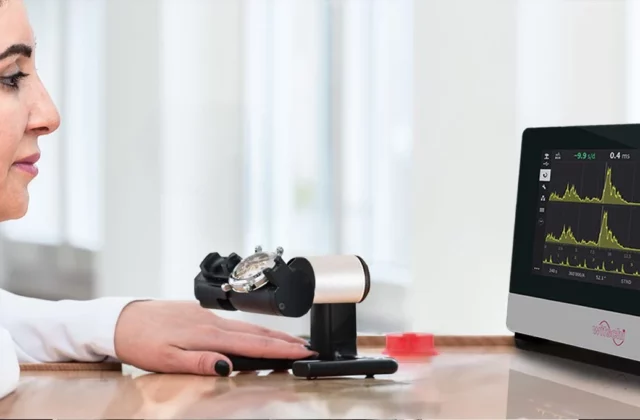
A timing machine can confirm the diagnosis by observing the rate in different positions. It measures the gain or loss, the balance amplitude and the beat error—that is, the regularity of the alternation. A watchmaker can also use a compass or magnetic-field detector, but a compass provides only a rudimentary indication. It may react to the movement without allowing the problem to be quantified precisely.
Why are modern mechanical watches more resistant?
Manufacturers have developed non-magnetic components to limit the risk. Silicon hairsprings, escapements using specific alloys, wheels made from composite materials and inner soft-iron cages significantly improve resistance to magnetic fields.
Silicon offers several advantages: it is light, stable, corrosion-resistant and virtually unaffected by the magnetic fields encountered in everyday life. It also makes it possible to produce complex geometries with great precision. But a silicon hairspring does not turn an entire watch into an invulnerable instrument. Other movement components may remain susceptible.
The soft-iron cage used in certain professional watches works differently. It redirects the magnetic field lines around the movement and protects its most vulnerable components. This is the historic principle behind so-called antimagnetic watches, of which the Rolex Milgauss has become the best-known example. The reference 116400GV, launched in 2007 and discontinued in 2023, was rated as resistant to fields of up to 1,000 gauss thanks to an internal magnetic shield.
Other brands have taken an even more ambitious approach. Omega subjects its Master Chronometer watches to fields of up to 15,000 gauss as part of the tests conducted by METAS. This resistance does not mean that the watch can be placed on an industrial magnet without consequence, but it provides considerable leeway in everyday life.
ISO 764: a useful but modest benchmark
The ISO 764 international standard defines a minimum level of magnetic resistance for watches. Among other requirements, it specifies exposure to a field of 4,800 amperes per metre, equivalent to approximately 60 gauss, with a limited rate tolerance after the test.
This level was suitable for many traditional applications. However, it represents only basic protection against the magnetic fields encountered today. Manufacturers’ internal standards and more demanding certifications, such as those issued by METAS, go considerably further.
It is also important to distinguish resistance to a magnetic field from complete immunity to disruption. A watch may withstand brief exposure to a powerful field while remaining vulnerable to prolonged or repeated exposure. The stated resistance is a technical specification, not permission to store the watch in a bag fitted with magnets.
How do you demagnetise a watch?
Demagnetisation is generally a quick procedure. The watchmaker uses a dedicated device that subjects the watch to an alternating field which is gradually reduced. The residual field disappears without opening the case or altering the movement’s regulation.
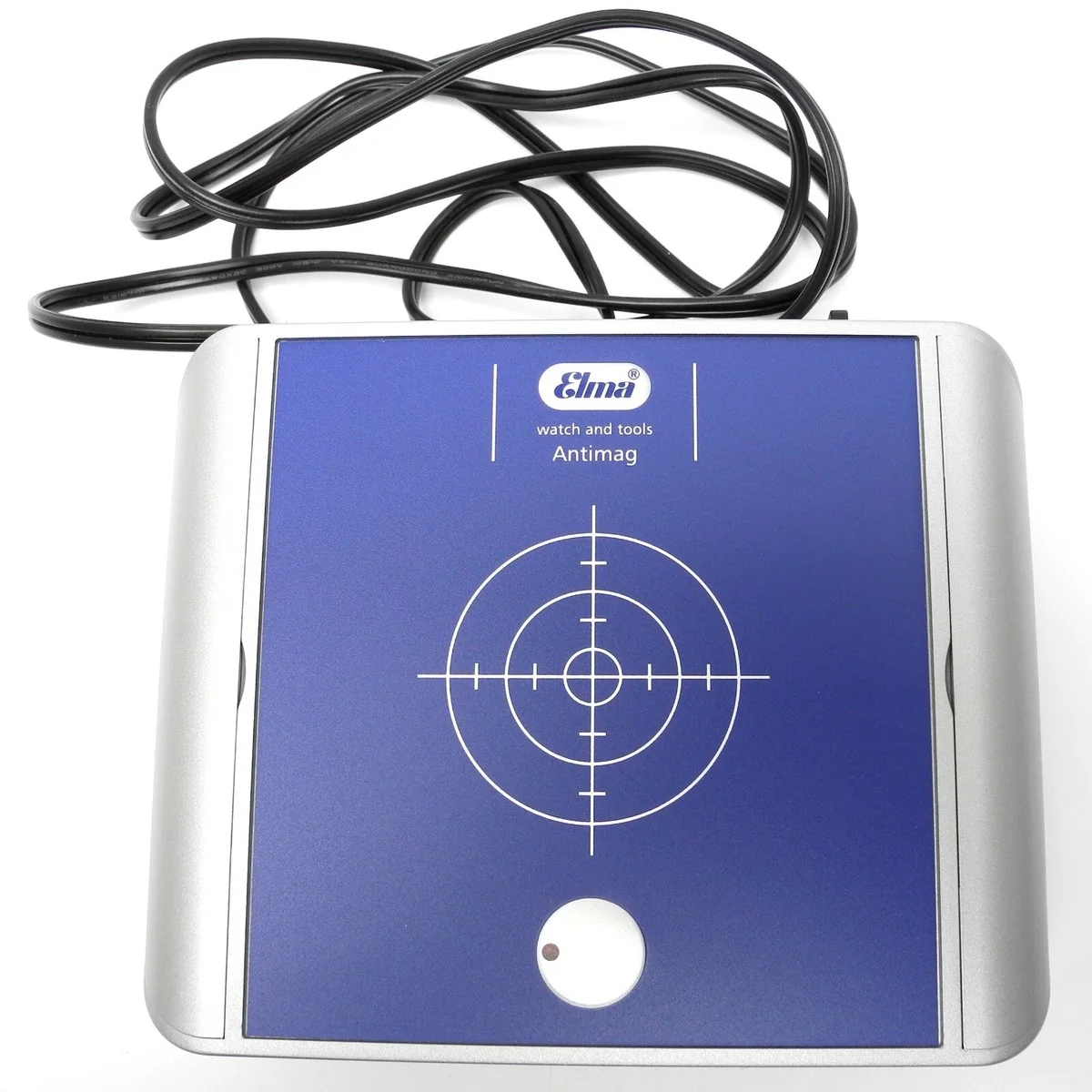
Inexpensive demagnetisers available online may work, but their quality varies considerably. Improper use, or the use of an unsuitable device, is not advisable on a valuable watch. The diagnosis must also be established before treatment: a watch that is gaining time because of a sticking hairspring, impact damage or a regulation fault will not be magically repaired.
After demagnetisation, the rate must be checked. If the gain disappears, the diagnosis is confirmed. If the watch continues to drift, a more thorough inspection is required, particularly of the hairspring, escapement and lubrication.
Good habits to prevent the problem
Prevention requires less antimagnetic paranoia than a few simple habits. It is best not to place your watch directly on a computer, speaker or magnetic charger. Bags and bracelets fitted with powerful clasps also deserve a little distance, especially when the watch remains pressed against them all day.
A watch that suddenly gains several minutes a day should not be adjusted blindly. Before discussing a complete overhaul, magnetism should be considered. A simple demagnetisation may be enough to restore its accuracy, which is far more elegant than unnecessarily replacing components.
Invisible, silent and perfectly commonplace, magnetism is one of mechanical watchmaking’s most insidious adversaries. It also serves as a reminder of an essential truth: in a watch, precision depends not only on the quality of its construction. It rests on a delicate balance between material, geometry, energy and environment—a balance that a small bag magnet can sometimes disrupt with disarming ease.