Sapphire Crystal Watch Cases: Taking Stock
Transparency as a manifesto
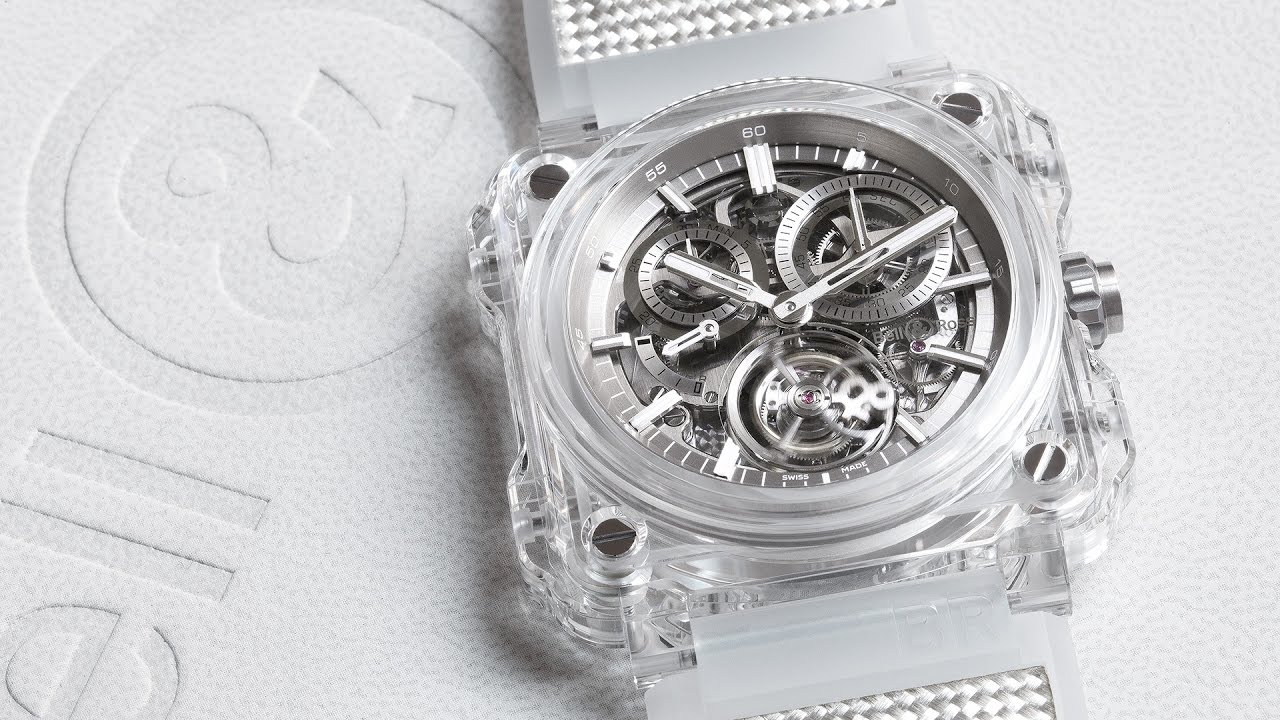
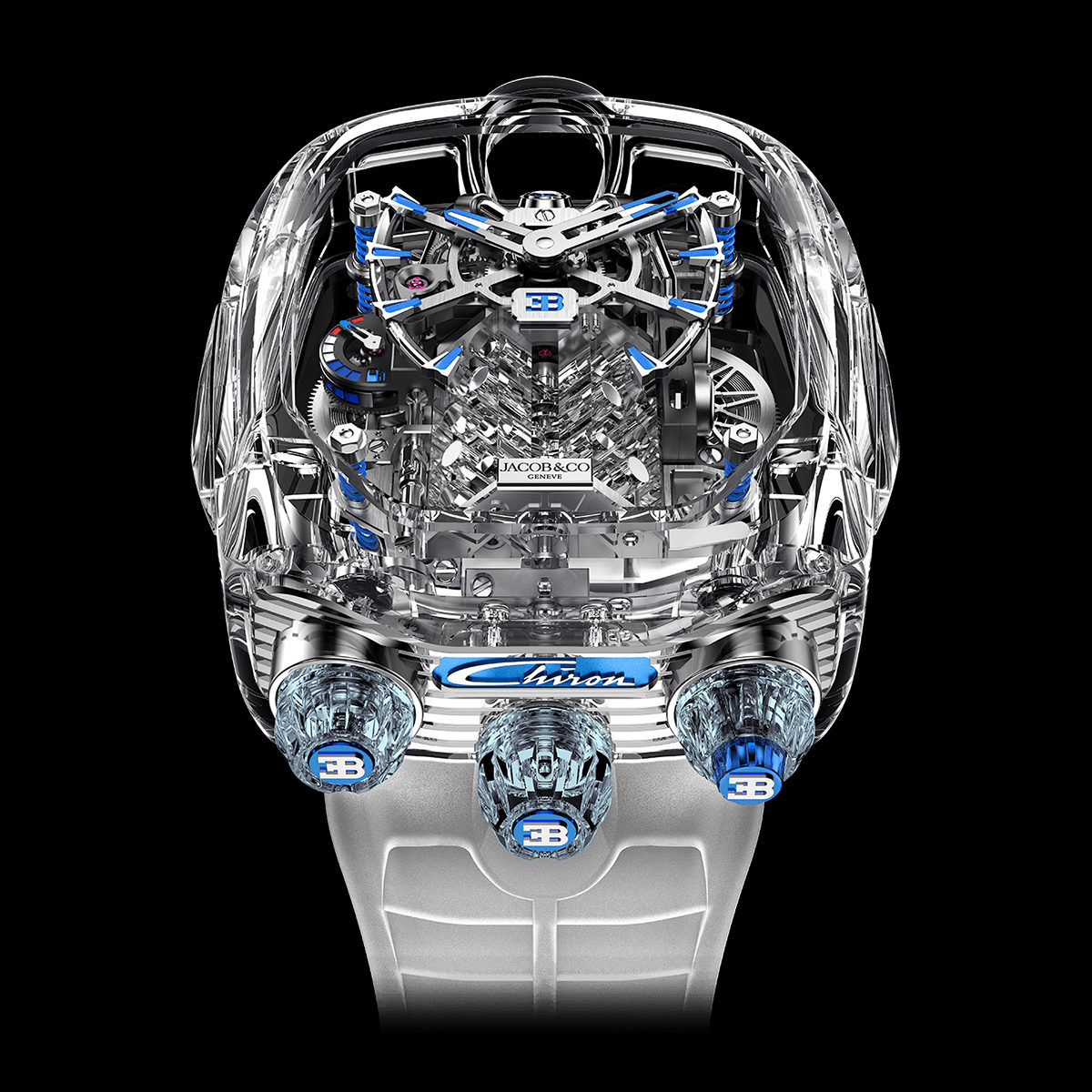
In an era when we like to see how things work, the sapphire crystal case has become the mouthpiece of contemporary haute horlogerie. No longer a simple crystal over the dial but a full-fledged showcase, it turns the watch into a theatre of mechanics. Nothing is hidden; everything is celebrated: gear trains, regulating organs, finishing, right down to gaskets and screws that become styling cues. From the lab to the wrist, transparency has moved from technical feat to unmistakable signature.
Sapphire: a “glass” that isn’t one
Watchmakers’ “sapphire crystal” is synthetic corundum (Al₂O₃), grown into a boule and then cut. With a hardness of 9 on the Mohs scale, a density close to titanium, and exemplary chemical stability, it has been the natural ally of watch crystals for decades. The difference today is ambition. No longer limited to the top: middle cases, bezels, casebacks and sometimes lugs are machined from blocks of sapphire, as if sculpting a compliant diamond. Compliant? Not really.
From crystal to case: the turning point
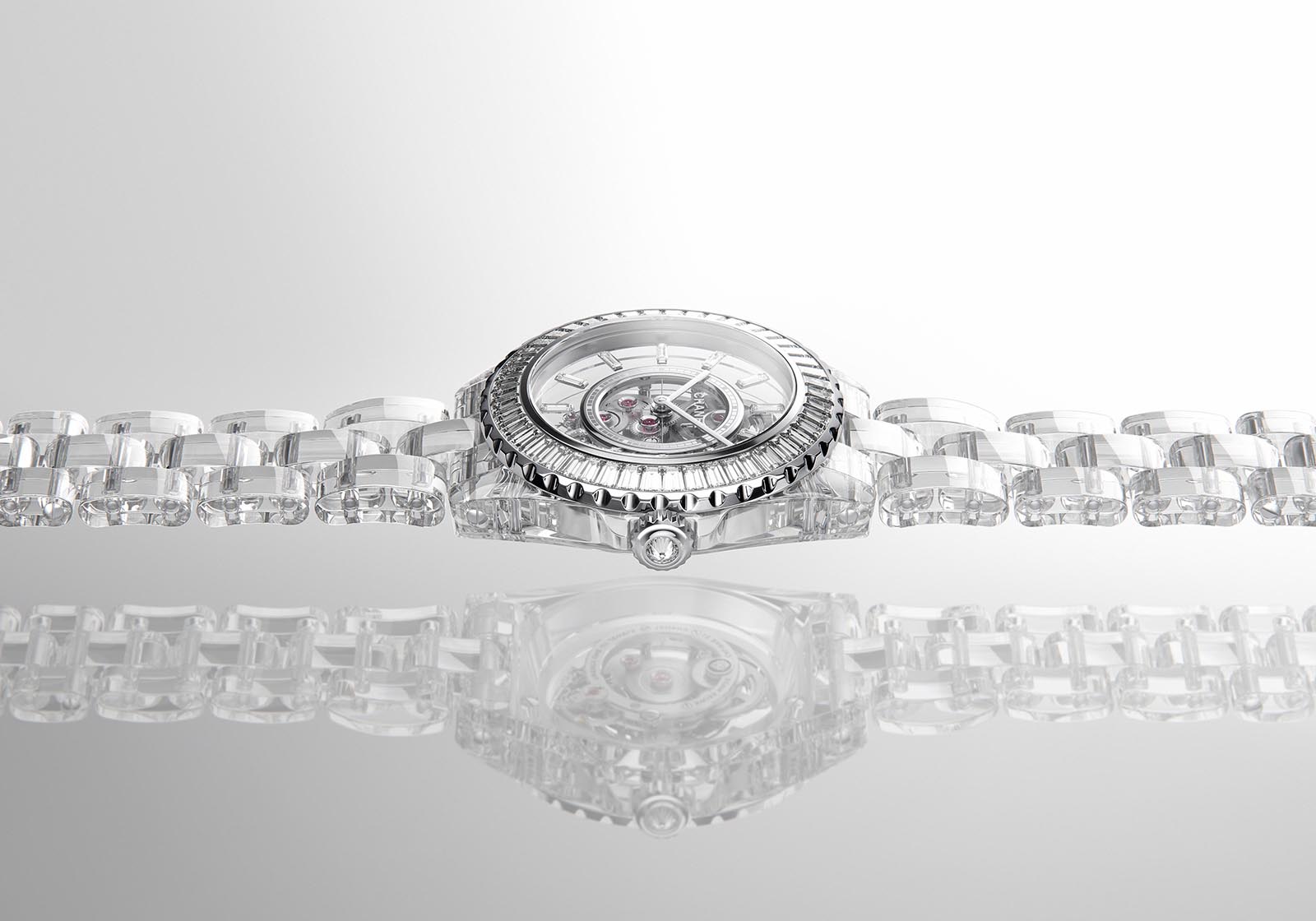
The first aesthetic shock dates back to the 2010s, when a few maisons dared to go fully cased in sapphire: Richard Mille (RM 056, 2011, then RM 56-02), Hublot (Big Bang Unico Sapphire, 2016), Bell & Ross (BR-X1 Tourbillon Sapphire), later Girard-Perregaux (Quasar, 2019) or Chanel (J12 X-Ray, 2020). The promise: to erase the boundary between watch and movement. The reality: hundreds of hours of machining, a dizzying rejection rate, and costs commensurate with the clarity.
Why sapphire fascinates
- Total transparency: the case becomes an immersive display. Bridge architecture, anglage and perlage finishing can be appreciated in 360°.
- Scratch resistance: 9 Mohs hardness. Sapphire shrugs off keys, café tables, office life. Only diamond and a few carbides can mark it.
- Controlled weight: lighter than steel and close to titanium, a sapphire case surprises with its presence without heaviness.
- Futuristic aesthetics: visible gaskets, screws, tourbillon cages seemingly weightless… a visual grammar that has become a symbol of avant-garde design.
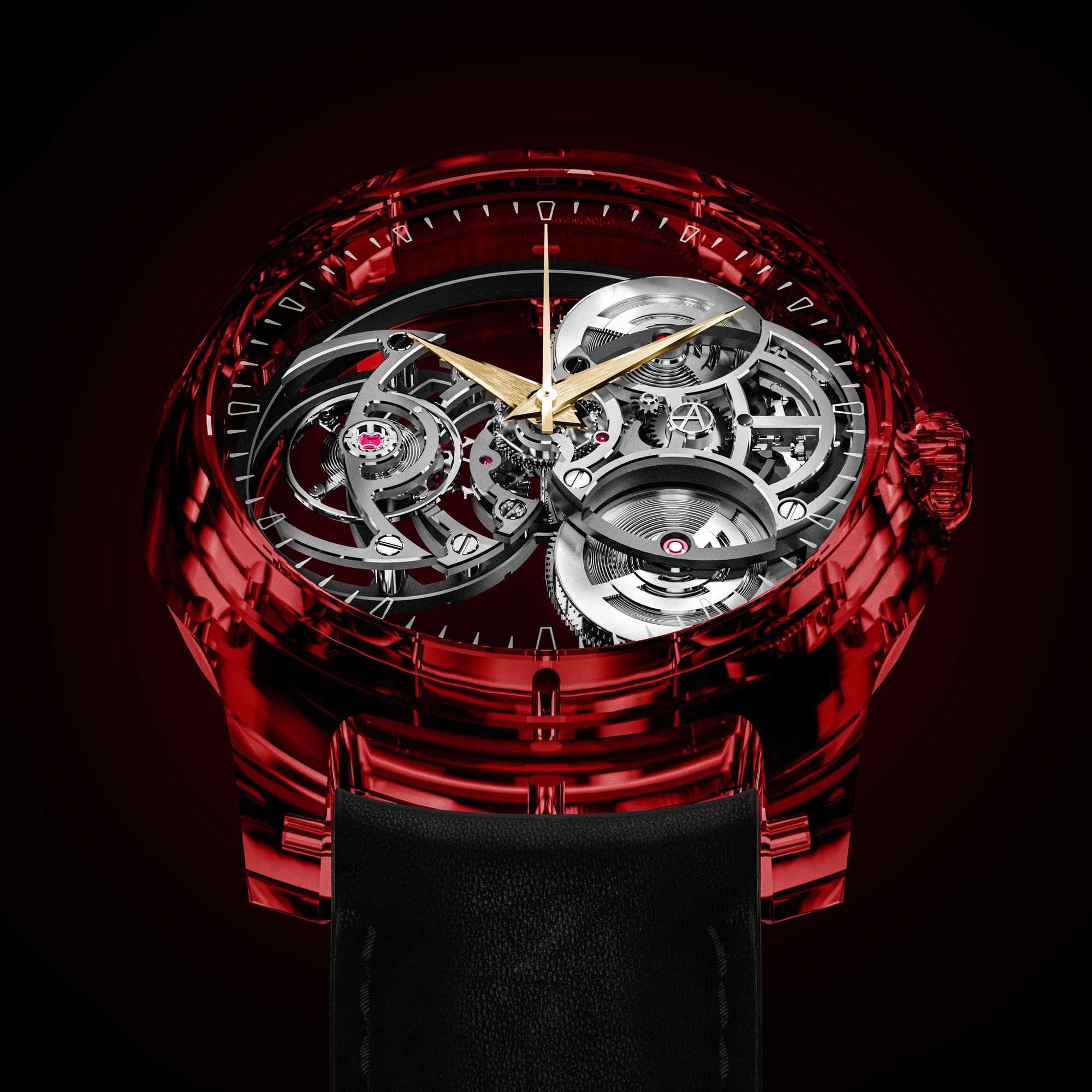
- A play of colour: from “icy” clear to blue, smoked, honey or ruby tones, sapphire doped with oxides tints the light without turning opaque.
Behind the scenes: a demanding material
A sapphire case begins with a flawless crystal. Slow growth methods (HEM, Kyropoulos) are favoured to obtain large volumes without internal stresses. Then comes machining: diamond discs, controlled-speed drilling, multi-stage polishing. Sharp angles? Risk of cracking. Drilled lugs? Stresses to be managed. Every operation is a negotiation with the material.
During assembly, everything shows. Monobloc cases demand micrometric tolerances, crisp gaskets, and clean-room assembly to avoid dust trapped forever. Water resistance? Perfectly achievable, but it calls for metal interfaces and sophisticated seals—hence hybrid architectures (spacers, modular middle cases) that preserve visual purity.
Finally, hardness is not toughness. Under a violent impact or a sharp, angled knock, sapphire can chip. You live with a sapphire case the way you live with a collector car: you take it out, you savour it, you respect it.
Colours and alchemy: beyond transparent
Sapphire is coloured through doping: iron, chromium, titanium… Brands can thus orchestrate glacier blues, smoky pinks, solar yellows. Hublot has pushed the exercise to the extreme with multicoloured series and a close cousin, SAXEM, a transparent material doped with rare-earth elements for an intense green. This chromatic language extends to screws, rotors and coloured bridges, creating contrasts that steel would visually saturate. Light becomes an additional material—captured, then returned to the eye.
Key models: six pieces to understand
- Richard Mille RM 56-02 Sapphire (2014): full sapphire case, suspension cables—a laboratory watch turned icon, produced in a trickle.
- Hublot Big Bang Unico Sapphire (2016): the relative democratisation of the sapphire case; in-house chronograph; first in transparent, then in colours.
- Bell & Ross BR-X1 Tourbillon Sapphire (2016): the square shape under a crystalline bell jar, technical graphics and exposed architecture.
- Girard-Perregaux Quasar (2019): airy skeletonisation on three bridges, with a sapphire case that makes the mechanics appear to float above the wrist.
- Chanel J12 X-Ray (2020): minimalist legibility, a bracelet with sapphire links—an invisible luxury that draws the informed eye.
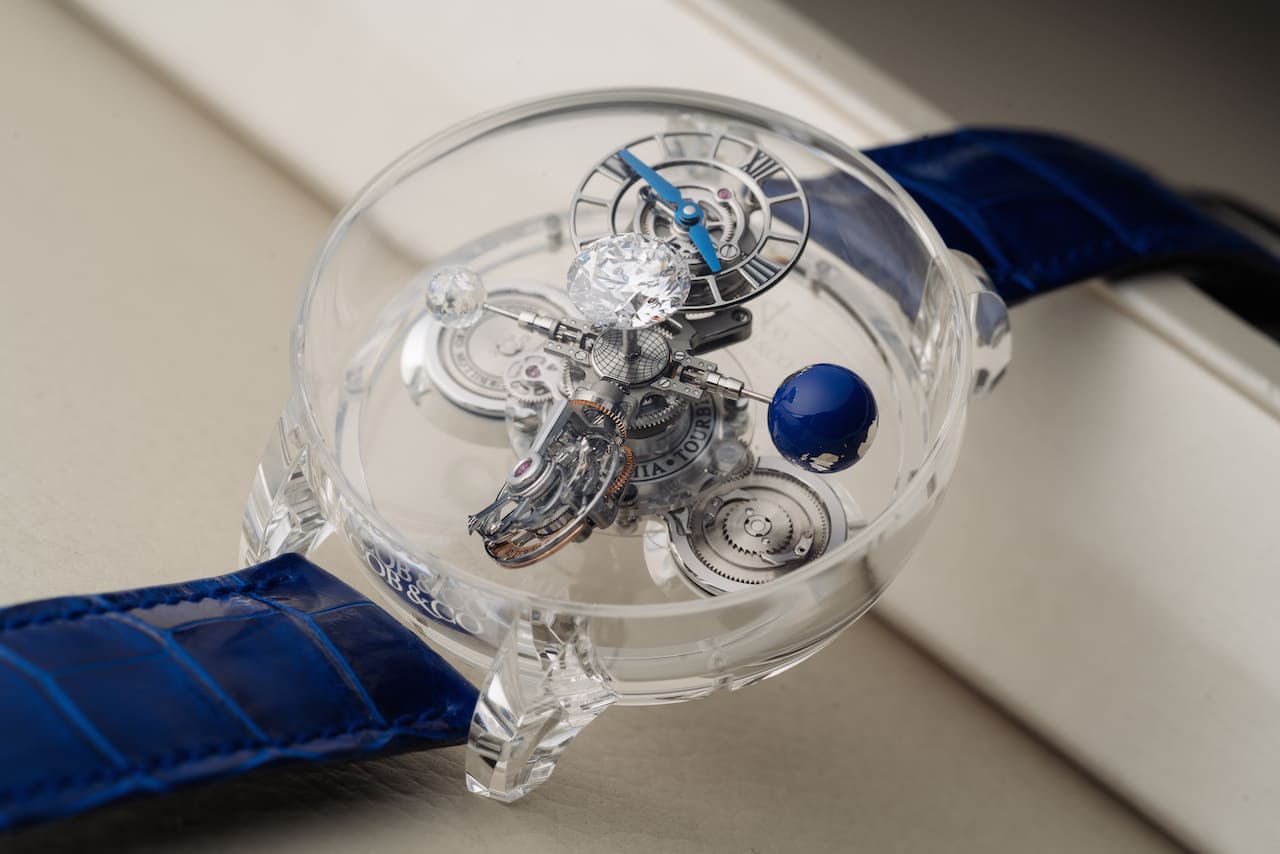
- Jacob & Co. Astronomia (various versions): sapphire domes and cages, a cosmic ballet under open sky—total spectacle.
Price, wear, maintenance: what to expect
Full sapphire remains the preserve of the high end. Entry tickets in the established market sit in rarified territory you don’t approach without intent: several tens of thousands of euros, rising to six- or seven-figure heights for extreme pieces. More accessible propositions are emerging from a few independent players, often with partial sapphire middle cases or more compact volumes.
The time required to grow the material—and above all the machining time—explains the price. That said, it’s well known that some watchmakers make major savings on this line item by outsourcing case production to suppliers far to the east of the globe. That doesn’t stop them from applying a healthy margin all the same.
In daily wear, the experience is unique: the watch catches the light, shifts mood with the day, and invites questions. For care, a microfibre cloth is usually enough. Avoid sharp impacts, entrust strap changes to a professional if the lugs are sapphire, and plan servicing with the brand: assembly expertise and specific gaskets are not something you improvise.
Should you go for a sapphire case?
If you love mechanics laid bare, transparency as an attitude, and the thrill of wearing micro-architecture, the answer is yes. Sapphire is not an indestructible tool watch; it’s a statement—an aesthetic gesture backed by rare technical mastery. For the curious, alternatives exist: sapphire casebacks, bezels or partial middle cases, wide-open skeletons, or the use of related translucent materials. But when it’s full sapphire, it changes your relationship with the object. You’re no longer wearing a watch: you’re wearing the light that passes through it.