Lederer Einstein Dial: The Mathematical Pattern That Makes Every Dial Unique
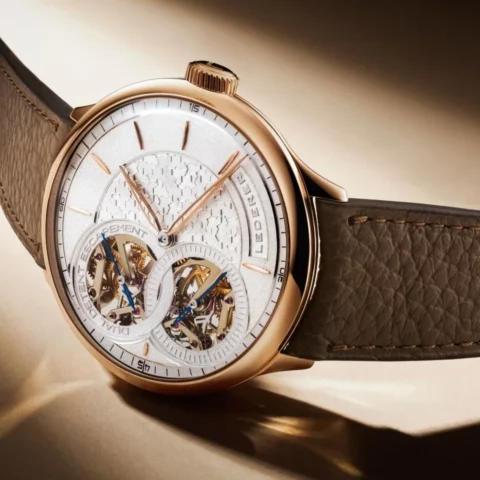
Lederer is tackling a highly unusual subject in watchmaking: a mathematical problem that occupied researchers for several decades. With the Einstein Dial, the independent Neuchâtel manufacture transposes onto the dial of its Central Impulse Chronometer a geometric tiling capable of extending indefinitely without ever repeating exactly the same arrangement.
The idea is not merely decorative. Lederer directly exploits this mathematical property to create dials whose composition differs from one watch to the next. No two Einstein Dials can therefore display exactly the same pattern.
An “Einstein” with nothing to do with Albert
The name could cause some confusion. This is not a tribute to Albert Einstein, but rather a reference to what mathematicians call an “einstein”—a unique shape capable of tiling a surface aperiodically.
For more than sixty years, mathematicians had been trying to determine whether it was possible to cover an infinite surface with a single geometric shape without its arrangement eventually repeating.
Research gradually reduced the number of shapes required. Roger Penrose’s work, in particular, had made it possible to create aperiodic tilings from several geometric elements.
The breakthrough referred to by Lederer came from David Smith, a British former printing technician with a passion for mathematics, who discovered a shape that took this research a step further.
Bernhard Lederer became interested in the subject after discovering this work. Rather than simply printing the pattern onto a dial, the watchmaker chose to make it an integral part of the watch’s aesthetic construction.
A different dial on every Lederer Einstein Dial
This is probably the most interesting aspect of the project.
Lederer does not work from a fixed design that is then reproduced throughout the production. Instead, the manufacture generates a continuous sequence of the Einstein pattern, then selects a different section for each dial.
The overall geometry therefore remains recognisable, but its arrangement changes with every example.
This enables Lederer to claim that each dial is genuinely unique, without having to artificially alter a colour, finish or detail from one watch to the next.
The uniqueness follows directly from the mathematical structure used.
Three levels of relief bring the pattern to life
Turning a mathematical design into a haute horlogerie dial was, naturally, another matter altogether.
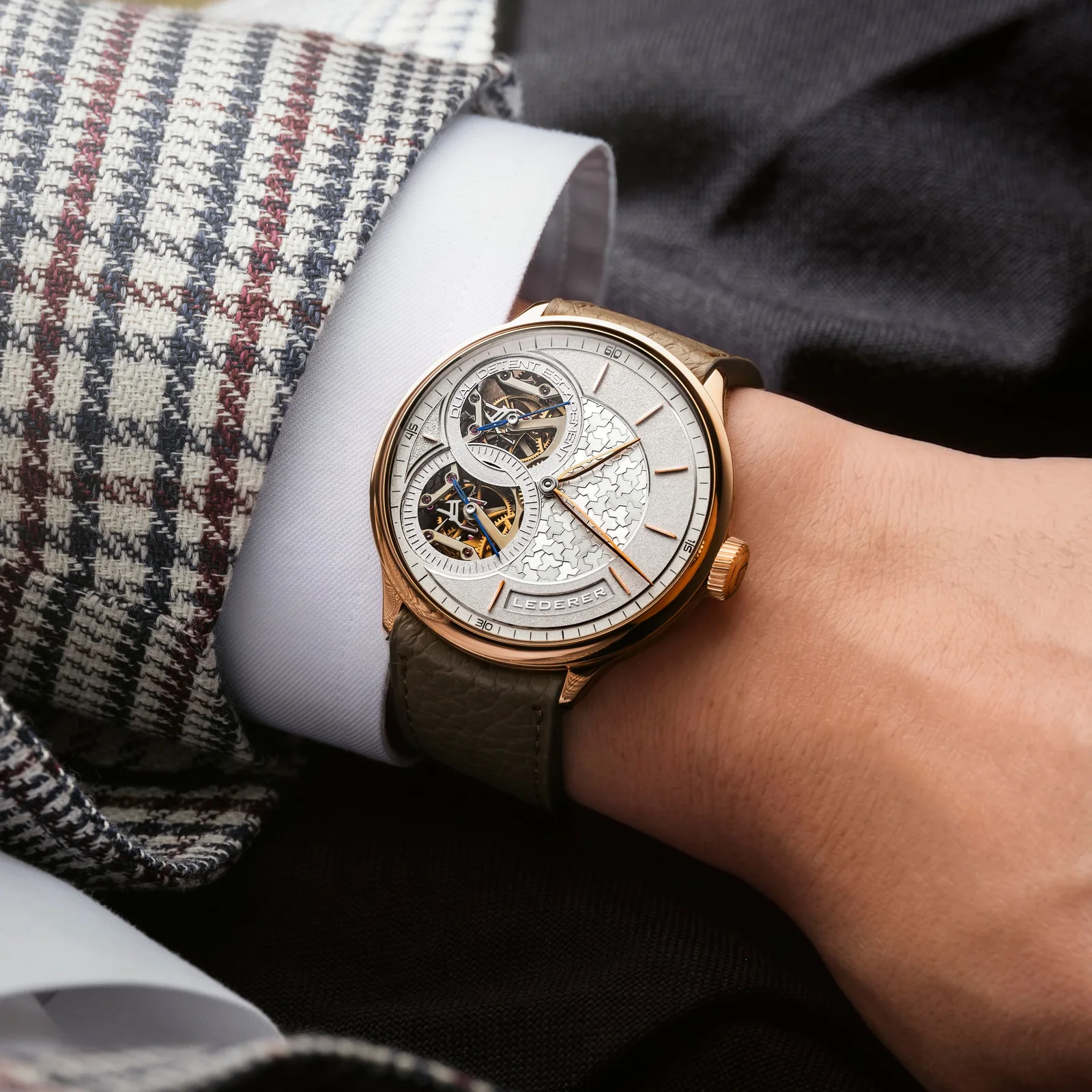
Lederer says it carried out several trials before arriving at the final construction. Each geometric element is separated by a fine wall to preserve the pattern’s legibility.
The dial is then worked across three levels of relief.
This construction creates depth and changes the way the pattern is perceived as the light shifts. In photographs of the watch, the Einstein area occupies most of the right-hand side and centre of the dial, while two circular apertures interrupt the composition between 8 and 11 o’clock.
These two apertures are not merely graphic elements, either.
Two open small-seconds displays over calibre 9012
The Lederer Einstein Dial retains the particularly recognisable architecture of the Central Impulse Chronometer.
Two small-seconds displays are positioned at 8 and 11 o’clock. The sub-dials are open-worked, revealing part of the movement and its components in action.
At the centre, the hours and minutes remain much more traditional, with slender applied hour markers and hands that allow the dial to retain a degree of legibility despite the technical richness of the whole.
The case is made of 18-carat 5N rose gold. Measuring 44 mm in diameter and 12.2 mm thick, the watch embraces fairly generous proportions.
The Lederer 9012 calibre and its dual escapement
Behind this new dial lies the Lederer 9012 calibre, a hand-wound mechanical movement comprising 219 components and 45 jewels.
Its architecture is considerably more original than a simple construction with two small-seconds displays.
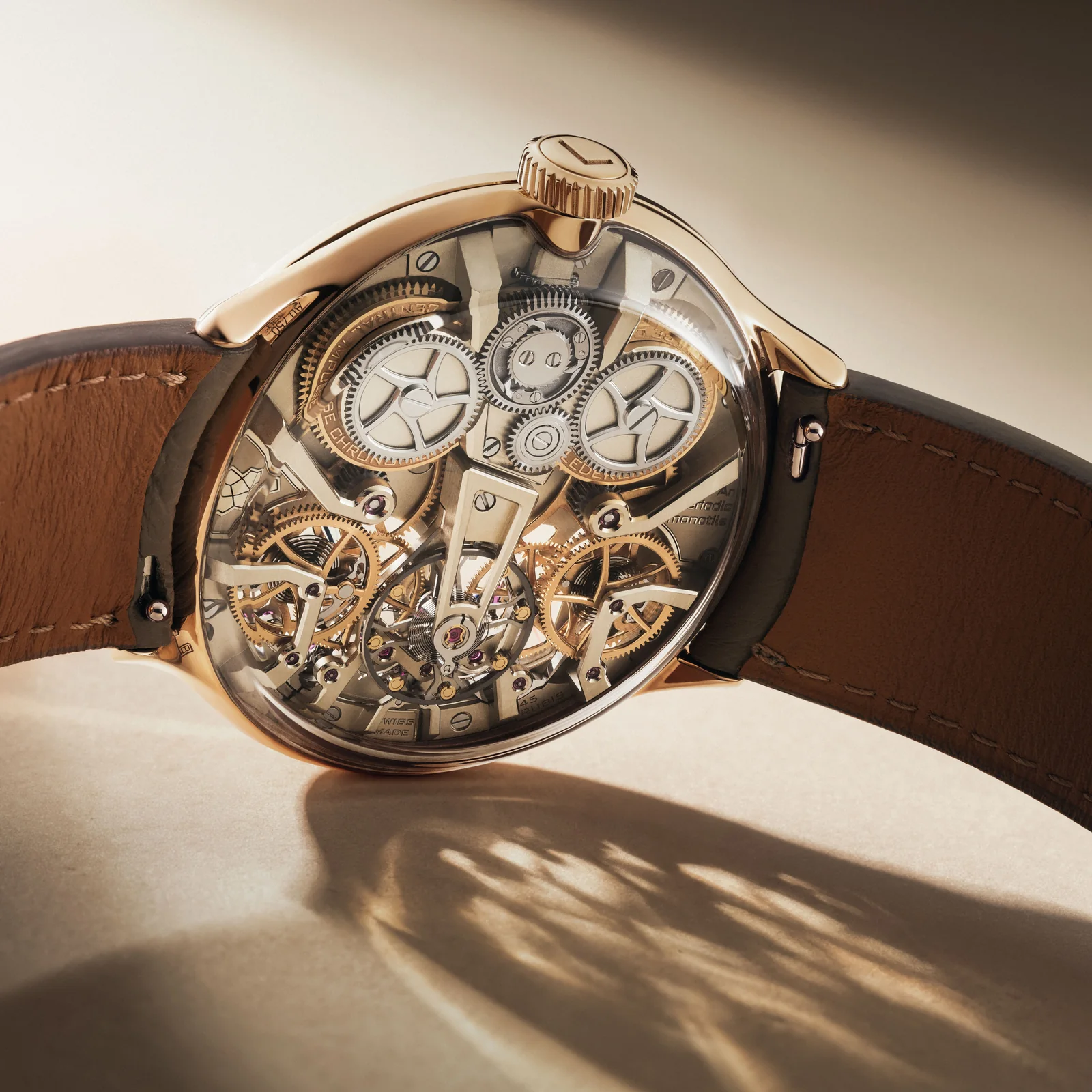
The movement uses two independent barrels, two independent gear trains and two escape wheels. Lederer combines these with its Dual Detent Escapement and two remontoirs d’égalité operating on ten-second cycles.
The purpose of this construction is notably to deliver energy to the regulating organs in a consistent manner.
The calibre operates at 21,600 vibrations per hour, or 3 Hz, and offers a stated power reserve of 38 hours.
The entire movement is visible through the anti-reflective sapphire-crystal caseback.
Finishing entirely in the tradition of independent haute horlogerie
Lederer states that much of the movement’s finishing is carried out by hand.
This includes satin-brushed surfaces, graining, microblasting, bevelled edges and mirror-polished steel components.
Production is largely carried out at the Neuchâtel manufacture. Bernhard Lederer is also one of the longstanding members of the Académie Horlogère des Créateurs Indépendants (AHCI).
His work on escapements had already earned him significant recognition in 2021, when the Central Impulse Chronometer received the Innovation Prize at the Grand Prix d’Horlogerie de Genève.
The new Einstein dial is therefore being integrated into a watch whose mechanical credentials were already firmly established.
The Einstein dial gives the Central Impulse Chronometer a distinctive identity
Collaborations between mathematics and watchmaking can easily become somewhat artificial intellectual exercises. Here, the interest is more tangible.
The pattern’s properties directly influence the manufacture of the dial and allow each watch to receive a different composition.
Lederer has also succeeded in incorporating this geometry without concealing the two characteristic apertures of the Central Impulse Chronometer or turning the watch into a graphic demonstration that is difficult to read.
The result is, naturally, highly distinctive, but it is entirely consistent with Bernhard Lederer’s output: extremely technical independent watchmaking, produced in small quantities and in which the movement always occupies centre stage.
With the Einstein Dial, the dial now has an equally singular point of distinction.
Technical specifications of the Lederer Einstein Dial
| Specification | Lederer Einstein Dial |
|---|---|
| Reference | CIC9012.50.806 |
| Movement | Lederer 9012 hand-wound mechanical calibre |
| Escapement | Dual Detent Escapement with dual impulse |
| Components | 219 |
| Jewels | 45 |
| Frequency | 21,600 vibrations/hour, 3 Hz |
| Power reserve | 38 hours |
| Functions | Hours, minutes, two small seconds |
| Small seconds | At 8 and 11 o’clock |
| Features | Two ten-second remontoirs d’égalité, two barrels, two gear trains and two independent escape wheels |
| Dial | Silver, unique Einstein pattern, manufactured in-house |
| Case | 18K 5N rose gold |
| Diameter | 44 mm |
| Thickness | 12.2 mm |
| Caseback | Sapphire crystal with anti-reflective treatment |
| Water resistance | 3 ATM / 30 metres |
| Strap | Saddle-stitched calfskin |