How the Lange 1 Became a Benchmark Watch in Germany
A watch born in a country that had to be rebuilt
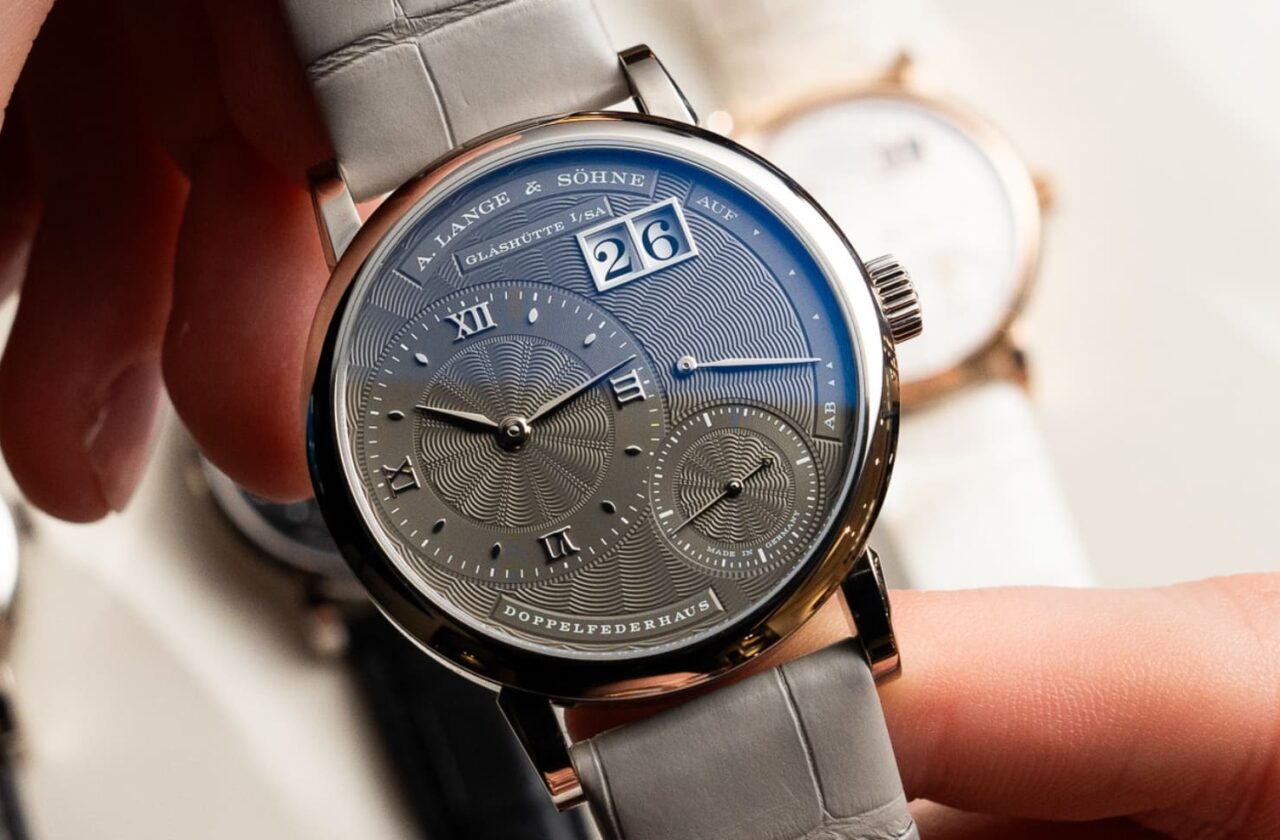
When we talk about benchmark watches, the conversation often turns to Switzerland, its valleys and its dynasties. Yet in the heart of Saxony, another story is unfolding: that of a return. The Lange 1 is not merely a remarkable watch; it is a cultural symbol, a mechanical manifesto born in a context of industrial and identity reconstruction. Thirty years after its debut, this iconic timepiece continues to captivate enthusiasts, as A. Lange & Söhne celebrates its legacy with four new limited editions, underscoring its enduring impact on horological innovation.
In the early 1990s, a reunified Germany rediscovered a part of its heritage that the war, and then the planned economy of the GDR, had frozen in place. Glashütte, a small historic watchmaking town, still bore the traces of a former greatness: that of Ferdinand Adolph Lange, who in 1845 founded a tradition of Saxon precision. When Walter Lange, the founder’s great-grandson, relaunched A. Lange & Söhne in 1990, the ambition was clear: not to copy Switzerland, but to revive a German school—both strict and inventive.
1994: the Lange 1, the founding act of a renaissance
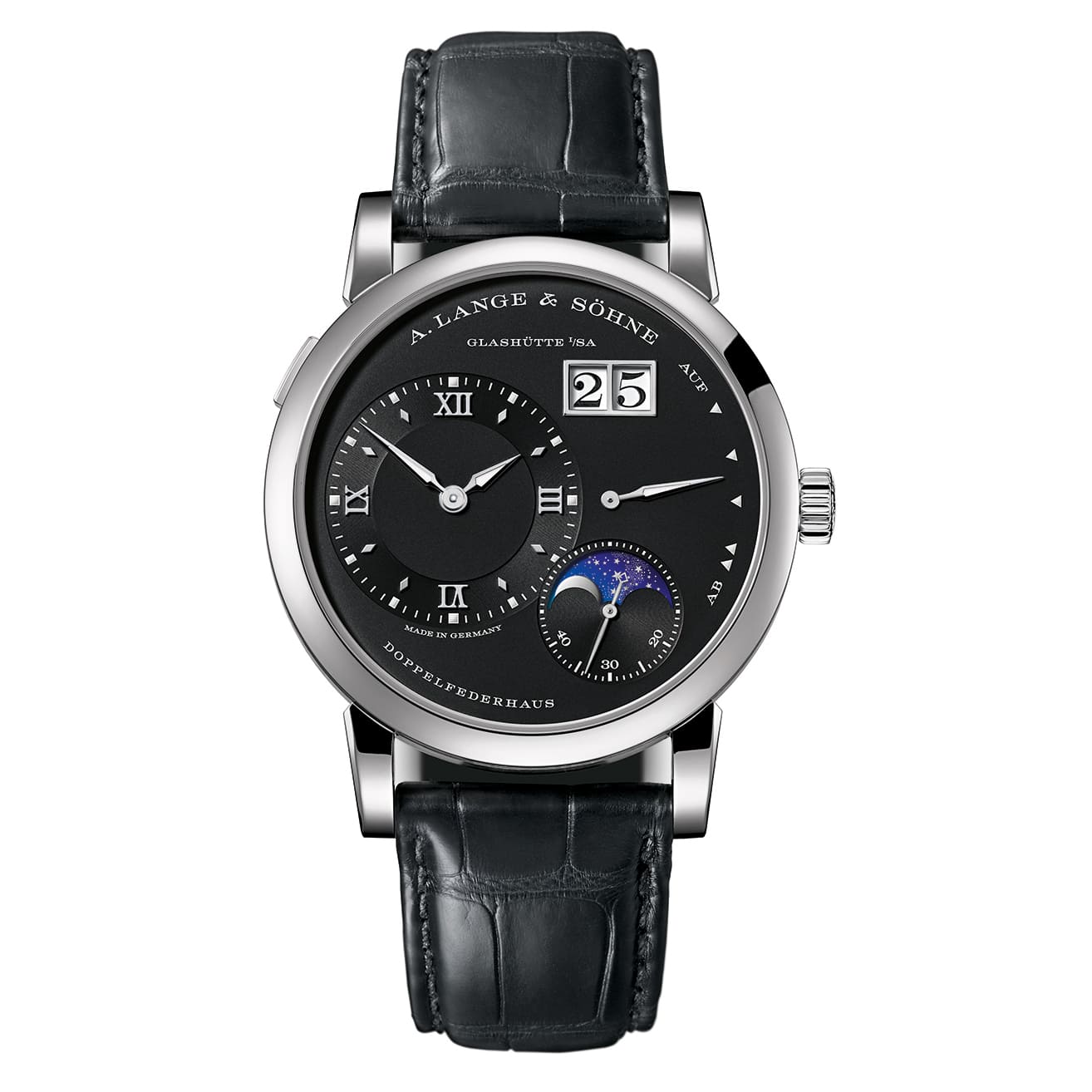
On 24 October 1994, A. Lange & Söhne unveiled its first modern collection. Among the pieces, the Lange 1 immediately stood out as something apart. It looked like nothing else, yet carried an obvious visual logic: an off-centre dial, an outsize date, a subsidiary seconds display set away from the centre, and a power-reserve indicator inscribed like a reminder of time’s discipline.
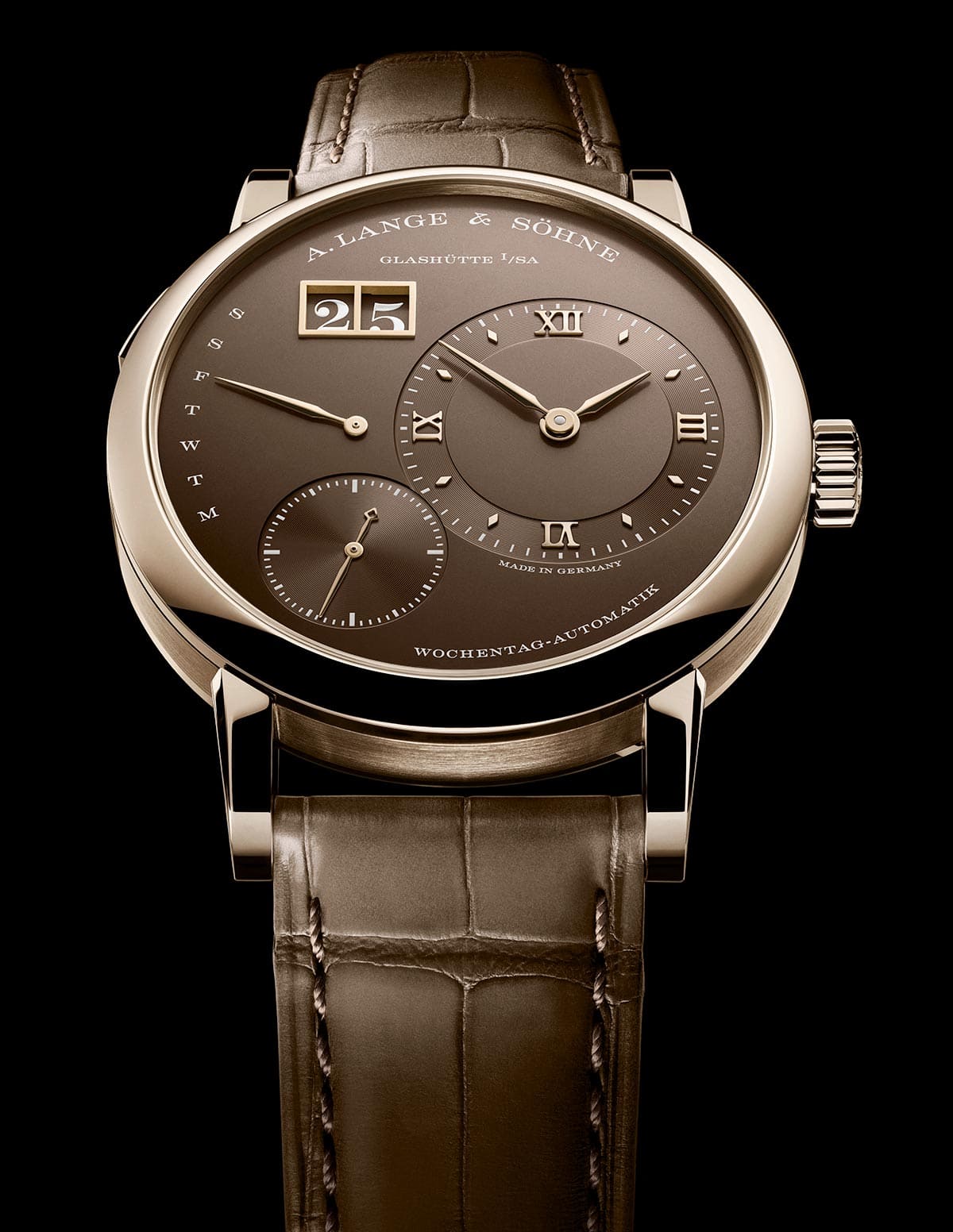
What fascinates is the confidence. Where many revivals begin with cautious imitation, Lange chose singularity. The Lange 1 is not a nostalgic tribute; it is a contemporary proposition, built on German codes: rigorous legibility, rational architecture, obsessive finishing.
The detail that changes everything: the Outsize Date
The Outsize Date (outsize date) became one of the manufacture’s most recognisable hallmarks. Inspired by a device at Dresden’s Semperoper, it gives the watch a cultural, local signature. In the 1990s, it was also a technical statement: displaying two large date discs, perfectly aligned, without sacrificing the harmony of the dial.
Why its “asymmetrical” dial is, in fact, mathematically precise
The Lange 1 dial is often described as an exercise in asymmetry. In reality, it is a hidden symmetry—a meticulously geometric balance. The sub-dials and the date are positioned according to studied axes and proportions, creating an almost architectural visual stability.
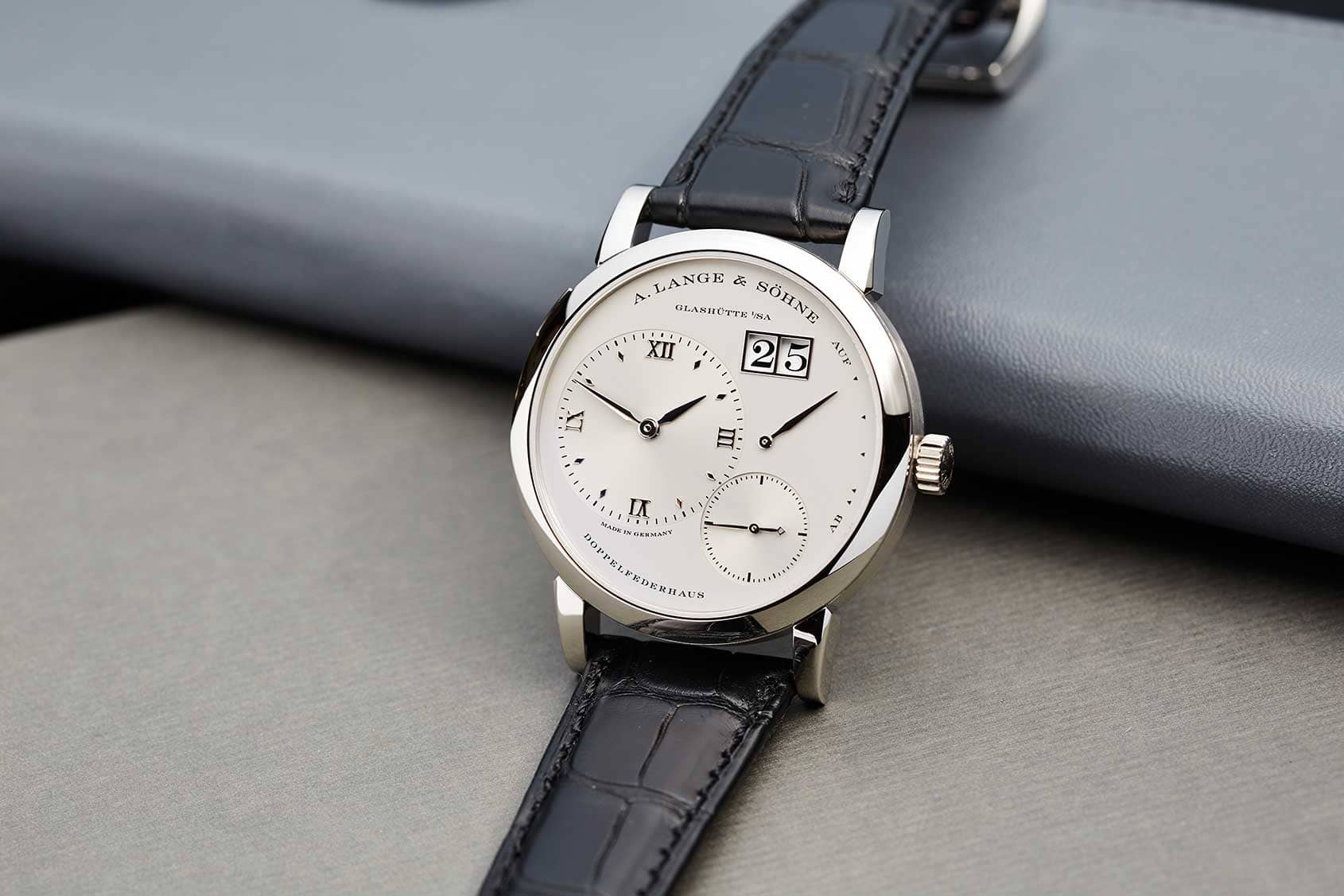
This sense of order is no accident: it reflects a German design philosophy—more Bauhaus in spirit than baroque in intent. No gratuitous ornament. Every element has a role, a function, a justification.
- Instant legibility: the key information is clearly prioritised.
- Immediate identity: one glance is enough to recognise a Lange 1.
- Emotional balance: the eye moves around, then settles—like in front of a well-drawn plan.
The movement: proof on the reverse
If the Lange 1 won over enthusiasts, it is also thanks to what it hides—or rather, what it reveals once the watch is turned over. From the outset, A. Lange & Söhne bet on a level of finishing that has nothing to envy in Swiss haute horlogerie, expressed in an aesthetic language unique to Glashütte.
Saxon codes: an engineer’s kind of luxury
The Lange 1 movement displays signatures that have become cult: the three-quarter plate (a local heritage), screwed gold chatons, blued screws, and above all the hand-engraved balance cock—a true human imprint at the heart of the mechanics. This blend of rigour and craftsmanship hits home: it is not decoration for decoration’s sake, but an aesthetic born of construction.
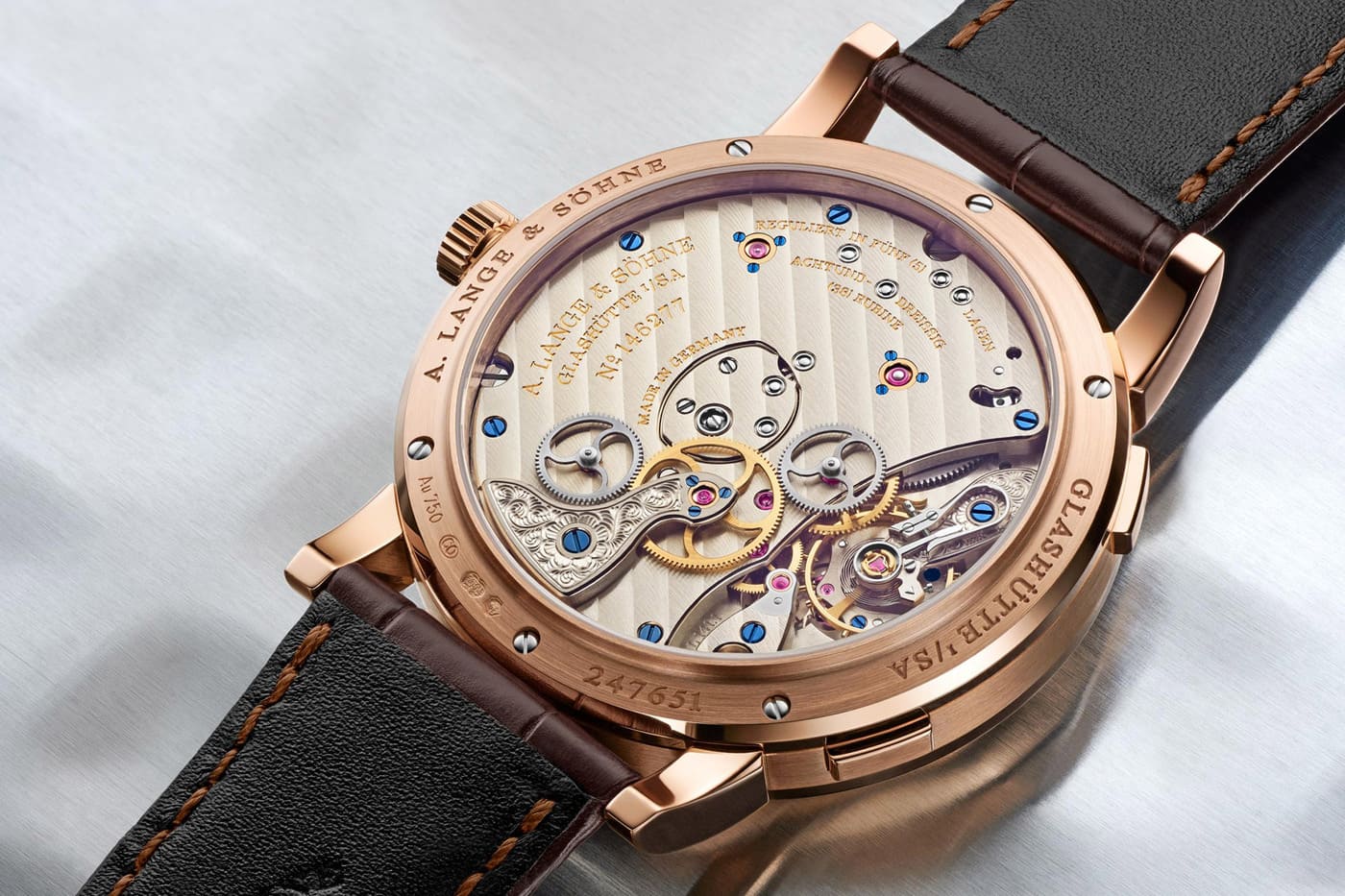
And then there is that rare feeling: a watch conceived as a precision instrument, yet finished like a work of art. The Lange 1 reminds us that Germany can produce a different kind of luxury—less talkative, more inward-looking.
From legitimacy to icon: how it becomes a “reference”
Becoming a reference watch does not depend solely on a successful design. It has to endure, evolve without betraying itself, and create a grammar collectors can recognise. The Lange 1 achieves this in several ways.
1) It establishes a standard for German watchmaking
In the collective imagination, German watchmaking long remained a footnote next to Switzerland. The Lange 1 flips the perspective: it proves another centre of gravity exists—not through imitation, but through an alternative path: technical, cultural, aesthetic.
2) It imposes a brand signature as strong as a logo
Lange’s great achievement was turning a dial architecture into an absolute identity. Where other maisons rely on a bezel, a case shape, or a colour, Lange anchors recognition in the very layout of time. It is harder to replicate, and therefore more enduring.
3) It evolves, but never gets diluted
Over the years, the Lange 1 has been interpreted in multiple variations: different materials, additional complications, revisited dimensions. But the essence remains: that feeling of off-centre order, that outsize date, that quiet nobility.
- Lange 1 Moon Phase: poetry without giving up rigour.
- Little Lange 1: more compact proportions, without losing the DNA.
- Lange 1 Time Zone: the usefulness of travel treated with the same graphic discipline.
A watch that tells the story of contemporary Germany
What makes the Lange 1 a reference is also the symbolic weight it carries. It embodies reunification not as political rhetoric, but as a cultural renaissance: a brand returning from history, rebuilt to modern standards.
In a world where many luxury products try to seduce through noise, the Lange 1 asserts itself through silence: that of unquestionable quality, considered design, impeccable execution. It appeals to enthusiasts who like prestige not as a spectacle, but as a consequence.
Why it remains essential today
Thirty years after its debut, the Lange 1 has not aged. It belongs to that rare category: objects that defined their era and, through the force of their coherence, end up crossing decades without going out of style. Its dial, once audacious, has become classic; its outsize date, once surprising, has become a standard; its finishes, once a statement of intent, have become proof of established know-how.
The Lange 1 became a reference in Germany because it did more than relaunch a manufacture: it restored a watchmaking pride. And because it showed, with an elegance that is almost philosophical, that there is more than one way to reach excellence. In Saxony, that means precision, restraint, and the magnificent idea that time deserves an architecture.