How Does a Moon Phase Complication Work?
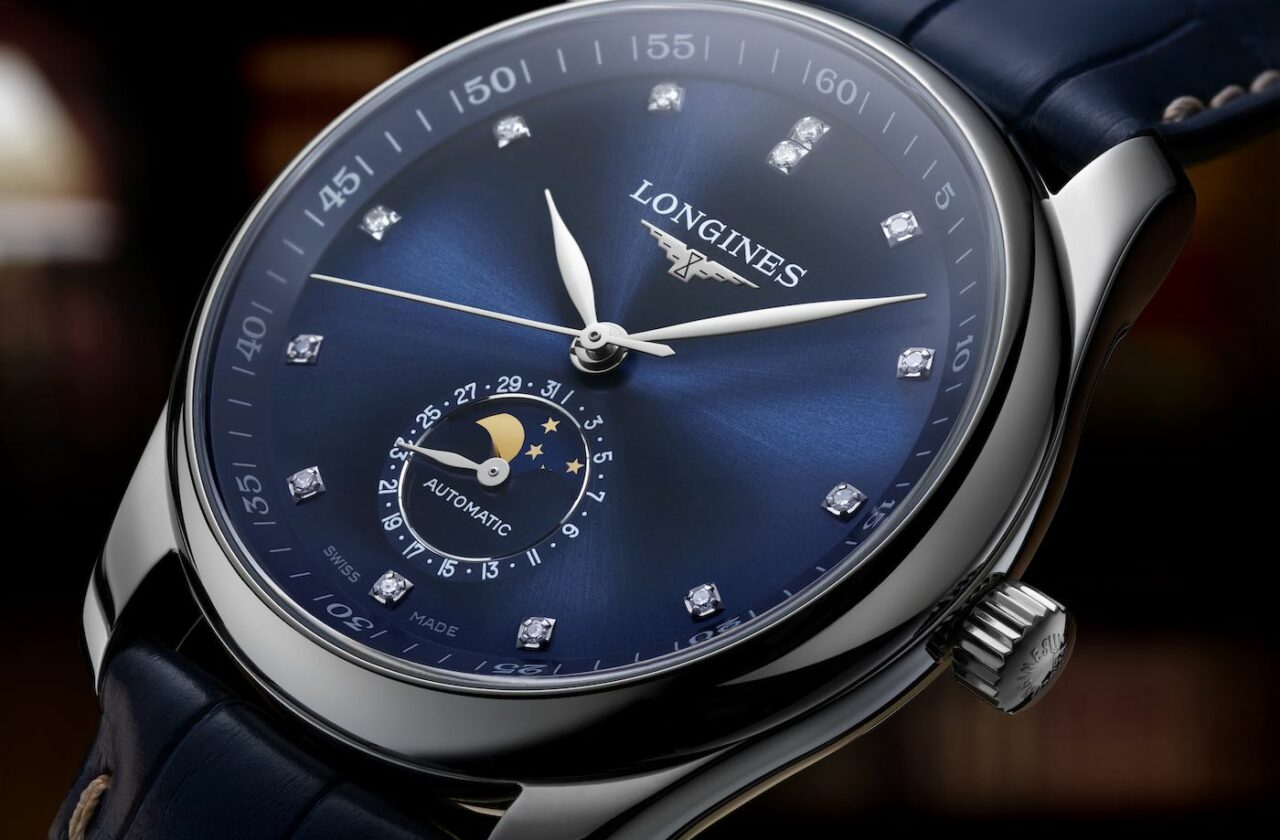
On a dial, the moon is not merely a romantic motif. It is slow mechanics, a millimetre-perfect ballet between steel and sky. The moonphase complication tells the story of the lunation over 29 and a half days, chisels the nights, and reminds us that time sometimes moves not to the beat of a chronograph, but to that of the tides. Here is how this poetry becomes precision.
An appointment between sky and gearwheel
The moonphase is one of watchmaking’s oldest complications. Long before universal time and the jumping second, people watched the moon to navigate, sow, fast, or celebrate. Church tower clocks already displayed it; pocket watches followed; wristwatches reinterpreted it with an elegance that has travelled through the ages. Its strength lies in this double language: an indication that is instantly understood, and a subtle mechanism hidden beneath the dial.
The principle, simply
The disc and its 59 teeth
At the heart of the complication sits a disc decorated with two identical moons, rotating beneath a crescent-shaped aperture. This disc is driven by a small 59-tooth wheel. Why 59? Because two average lunar cycles (2 x 29.5 days) make 59. Each day, a finger advances this wheel by one tooth, shifting the image visible in the aperture ever so slightly.
- The going train (linked to the hour hand) drives the calendar mechanism.
- A lever or finger pushes the 59-tooth wheel forward by one step once every 24 hours.
- The disc thus turns progressively, showing the waxing moon, full moon, waning moon, then new moon.
The real synodic month lasts 29.53059 days. The 59-tooth system, set to 29.5 days, therefore introduces a slight discrepancy of around 44 minutes per lunation. The result: after roughly two and a half years, the displayed phase drifts by one day and needs correcting.
From high precision to lunar records
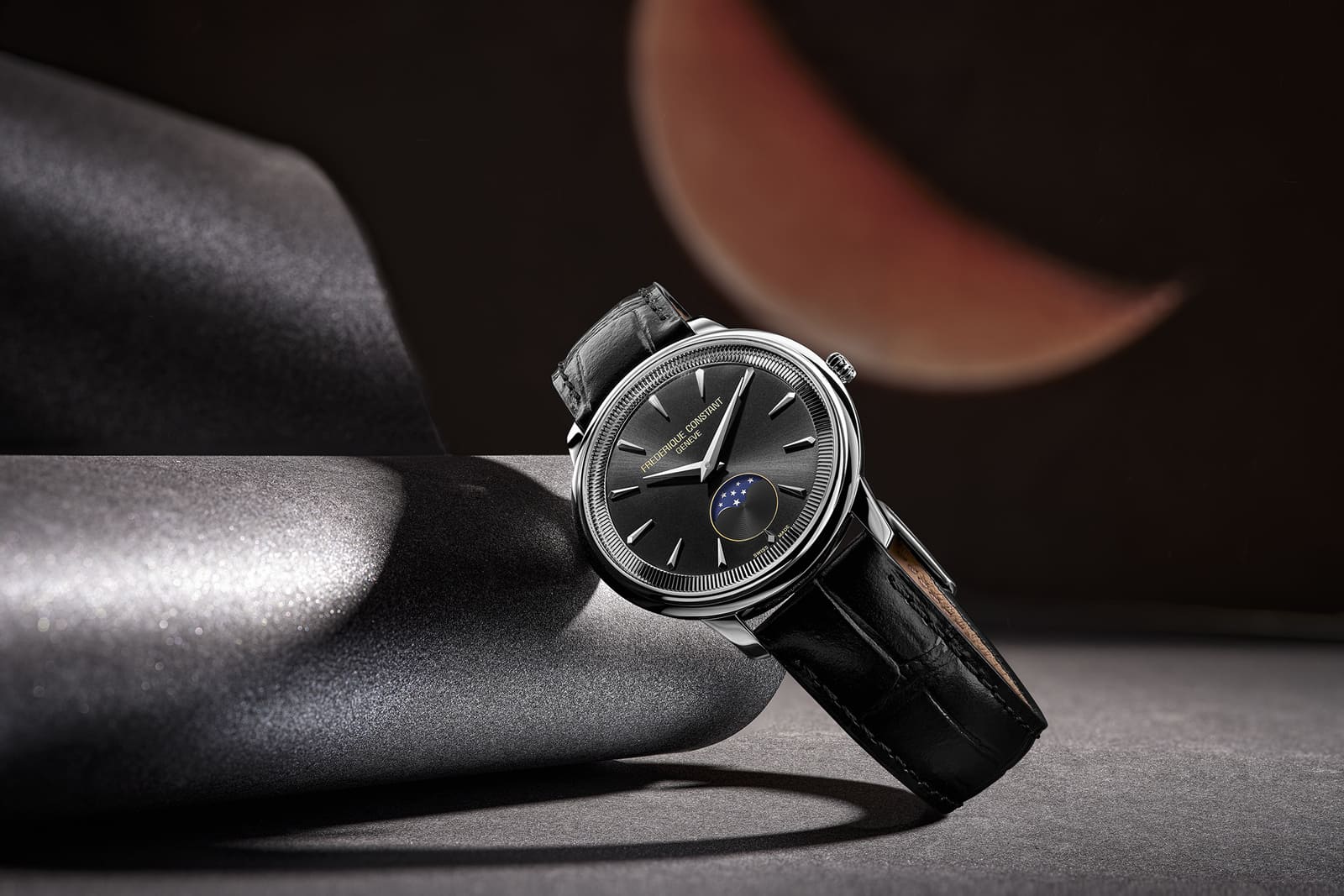
To refine the display, some maisons replace the 59-tooth wheel with more sophisticated gear trains that come extremely close to 29.53059 days. These are known as high-precision moonphases: a drift of just one day in 122 years has become an ambitious benchmark (A. Lange & Sohne, Patek Philippe, Jaeger-LeCoultre, among others). Others go further: H. Moser & Cie claims a drift of one day in around 1,027 years; Ochs und Junior, one day in 3,478 years; Andreas Strehler, the poetic record-holder, speaks of more than two million years. The principle remains the same, but the multiplication of wheels corrects the length of the lunation more finely.
Reading and setting a moonphase
Reading it is intuitive: on the left, the moon waxes; on the right, it wanes (on most watches intended for the Northern Hemisphere). A round aperture may show a domed moon in relief; an arched window reveals a crescent that expands and contracts. Some watches display the moon’s age (from 0 to 29), useful for setting a moonphase watch to the exact day.
Quick-start instructions
- Find the date of the last full moon (ephemeris websites or a weather app).
- Move the time outside the calendar danger zone (avoid 8 p.m. – 2 a.m.) to prevent damaging the mechanism.
- Using the dedicated corrector (a small pusher in the caseband) or via the crown depending on the watch, position the disc on the exact full moon.
- Count the number of days elapsed since the real full moon, then advance by the same number of clicks.
- Then set the time and date. A small seasonal correction will be enough every two to three years on a 59-tooth system; virtually never on a high-precision one.
Style variations: from window to sculpted moon
For the Southern Hemisphere, some maisons invert the display so that waxing and waning align with your sky. Others offer dual-hemisphere versions, superb on a large dial.
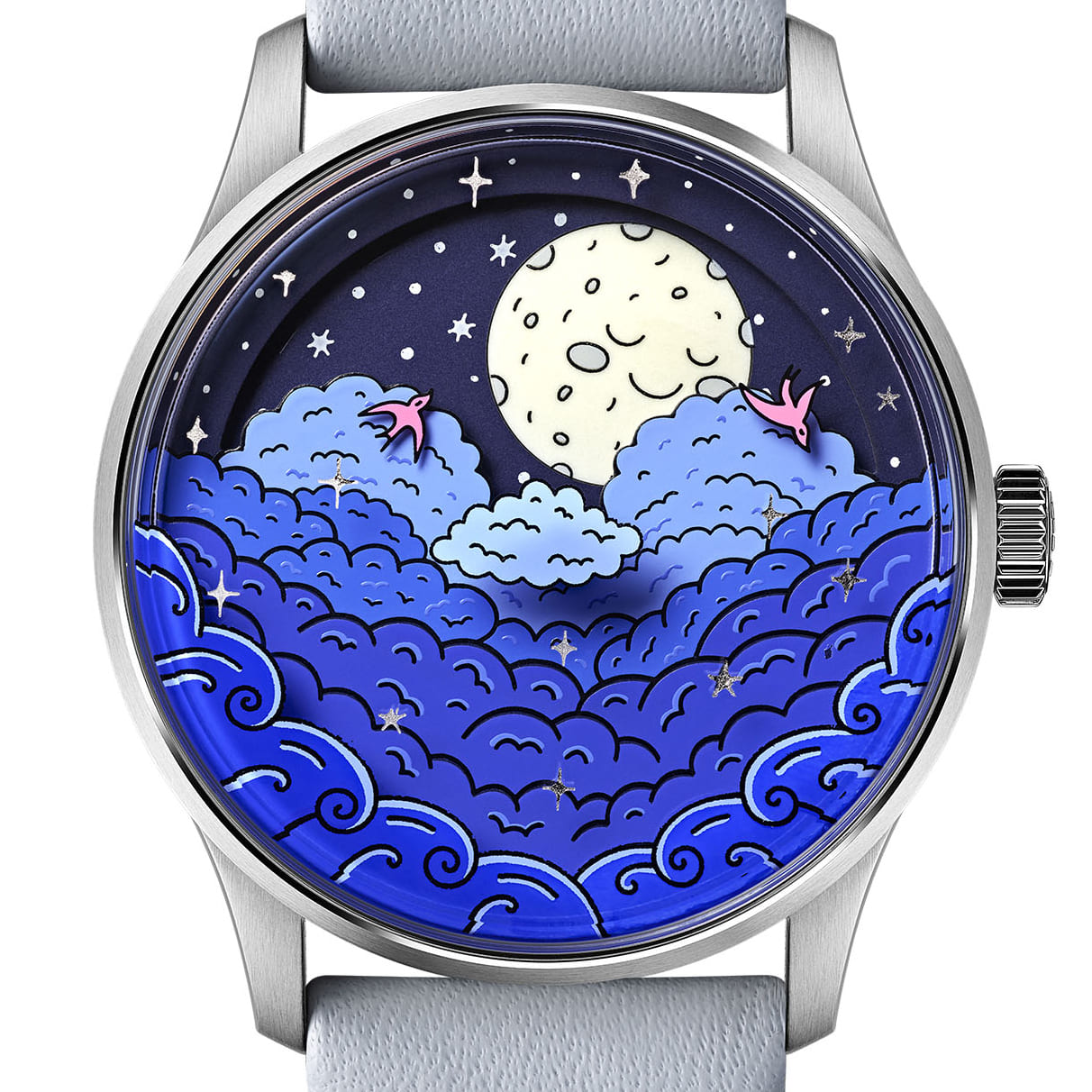
The appeal of the moonphase also lies in its aesthetics. Different schools answer one another:
- Classic window: two moons on a matte disc, midnight-blue sky; legible and discreet.
- Domed moon: a polished, textured dome—sometimes in gold—that catches the light like a real crescent.
- Oversized moons: dials devoted almost entirely to the firmament (Arnold & Son, for example), for a hypnotic presence.
- Poetic materials: sparkling aventurine, grand feu enamel, deep lacquer, engraved meteorite for a textured lunar surface.
- Paired complications: combined with a complete or perpetual calendar, the moon becomes the breathing space within a more complex architecture.
Each maison signs its own night: Patek Philippe and its cosmic restraint, Jaeger-LeCoultre and graphic rigour, A. Lange & Sohne and its grained skies, De Bethune and its bluish vaults anodised in titanium. On the wrist, it is an invitation to look up.
Why it still fascinates us
Because it humanises the watch. Where the chronograph captures the instant, the moonphase captures waiting. It introduces a controlled slowness, a measured drift that you return to from time to time, the way you place a bookmark back on the right page. It speaks to sailors, poets, and collectors who like their mechanics to tell a story larger than the minute slipping by.
Key takeaways
- The heart of the classic system: a 59-tooth wheel advances by one step per day.
- Standard accuracy: correction of about one day every 2.5 years; high precision: 1 day in 122 years and beyond.
- Ideal setting: outside the date-change window, starting from a reference full moon.
- Multiple styles: discreet window, relief moon, dual hemisphere, poetic materials.
At heart, the moonphase achieves what watchmaking does best: turning a celestial phenomenon into intimate mechanics. A fragment of night fixed to your wrist, set not to the nearest second, but to the nearest beauty.