AKRIVIA, the Architecture of Time
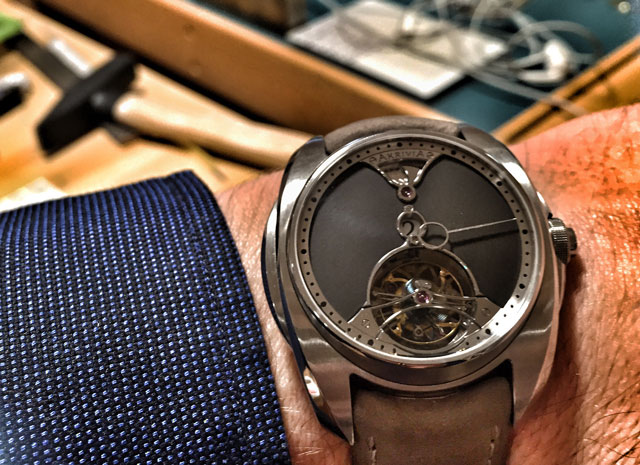
It’s hard to wander around Geneva’s watchmaking sphere without having heard of Akrivia and its young founder Rexhep Rexhepi. Whether you’re a lover of fine watchmaking or a devotee of design and clean lines, Akrivia works to strike that balance between watchmaking tradition and modern design.
Still a small, “under-the-radar” artisanal brand, Akrivia is targeting a production of 25 watches for the coming year.
Singular timepieces of impeccable quality that more than deserve a closer look.
It was in 2012 that Rexhep took the plunge and founded his own company; the desire to become independent came to him quickly. At 11, he arrived in Switzerland with his family from Kosovo, where he was born. Hired as an apprentice at Patek Philippe at the age of 14, Rexhep would draw strength and tenacity from his atypical path.
Even back then, in the first years of his apprenticeship, he had the urge to express his own vision of watchmaking. What better place to learn fine watchmaking than the “school” of Patek Phillipe?

He spent five years there before going on to consolidate his experience in complications at BNB for three years. Then he joined the FP Journe team (two years). In short, Rexhep was trained at the most demanding schools—and it naturally shows in his work.

When you step into No. 1 Avenue Krieg in the Champel district of Geneva, the space can feel almost imposing. A huge showroom paired with an equally large workshop area. Here, the showroom isn’t really separated from the workshop—by Rexhep’s choice. An old-school workshop in a very contemporary space: a mindset that runs right through the brand’s timepieces.

When I use the adjective “old” to describe Akrivia’s workshop, don’t read it as any kind of negative judgement—quite the opposite. Here, there’s no pretence: everything is there on the benches, and the various machines used to finish components are scattered throughout this large space.
His brother, Xhevdet, is at the bench, beveling a barrel bridge with boxwood. Quietly, Xhevdet Rexhepi is an integral part of Akrivia. Following in his older brother’s footsteps—apprenticeship at Patek, a CFC from the école d’horlogerie de Genève—Swiss watchmaking traditions have become a family story for the Rexhepi brothers.
At Akrivia, they love tourbillons: all three models in the current range are fitted with one. The tourbillon, a regulating organ replacing the traditional balance spring, is already a complication in itself, intended to improve the watch’s precision. In fact, the name Akrivia comes from Ancient Greek meaning “precision”—the tone is set.
TOURBILLON MONOPUSHER CHRONOGRAPH

The first model produced by Akrivia is a tourbillon monopusher chronograph. A single pusher starts, stops and resets the chronograph.
The case is decidedly modern, with a fluid design. This strongly characterful case would become one of Akrivia’s signatures; all three current models are housed in it. Although very modern, the case retains a timeless quality thanks to its restraint and slenderness.
As for the dial, the approach remains modern and personal for a chronograph. You can’t say, “Oh, that looks like a …” No. Here, inspiration is drawn from elements outside watchmaking—and it works beautifully.
That’s what gives this brand a distinct, assertive identity.
The dial is skilfully skeletonised, revealing the tourbillon, of course, but also the chronograph’s column wheel at 12 o’clock and one of the chronograph wheels. The two counters are also openworked, allowing you to admire the mechanism. A gauge-shaped power reserve is also present on this dial—certainly busy, but very well balanced, and still pleasant and easy to read.
Rexhep’s pursuit of a unique design extends right down to the brand’s signature “Glaive” hands.

As for the movement of this monopusher tourbillon chronograph, it is based on a BNB calibre, entirely finished, hand-decorated and assembled at Akrivia.
At a time when, unfortunately, the crafts and traditions of watch decoration tend to be lost, Akrivia perpetuates these centuries-old skills by hand, using tools that have not—or have barely—changed since the beginnings of watchmaking, while still integrating its own personal touch.
On this calibre, as on the others, the decorative work is simply breathtaking—and it will also become one of their signatures.
The shaping of the wheel spokes and arms, giving them a fine, tapered look, is specific to the brand. The chronograph wheels are bevelled by hand; all steel components feature inward angles, filed, polished and satin-finished by hand.
Plates and bridges are also beautifully bevelled and perlage-finished (on the back) by hand, as are the Geneva stripes on the front of the bridges.
In steel or rose gold, with four dial colours available, this monopusher tourbillon chronograph is truly a magnificent and innovative piece—a nicely accomplished concentration of tradition and creativity.
TOURBILLON HOUR MINUTE

Let’s move on to the second model in the Akrivia range, the Tourbillon Hour Minute—my favourite for its timeless look. No offence to a certain watchmaker; for me, it’s the watch Captain Nemo could have worn in his bathyscaphe. Still using the same case base, this watch is an ode to the tourbillon. You see only it, and the beautiful pair of “Glaive” hands. The sobriety of the case and dial further reinforces this “focus” effect on the tourbillon. Your eyes don’t get lost in futile details; it goes straight to the essentials—and it works brilliantly. A screwed-on plaque bearing the brand name (hand-engraved) dresses the dial at 12 o’clock.

As for the movement, it is based on a similar architecture to that of the chronograph. The level of decoration—entirely hand-executed in the Akrivia workshop—is identical to the previous model: inward angles, Geneva stripes, black polishing. In short, a very high level of finishing found only in the very top tier of Swiss timepieces.
TOURBILLON CHIMING JUMP HOUR
A new step for Akrivia

The third model symbolises a turning point for the brand: their first movement entirely designed in-house. Conceived, drawn and prototyped by Rexhep and Xhevdet. Where some would have opted for a simple three-hander, Akrivia comes out swinging with a movement featuring three complications.
It sets the tone—and the level of ambition of these guys. The Tourbillon Chiming Jump Hour, as its name indicates, is a tourbillon with jumping hours (a disc in an aperture at the centre of the watch) with a chime on the hour.

Still the same case, with a design fairly similar to that of the Tourbillon Hour Minute—sober and pared back. An aperture at 12 o’clock allows you to admire the striking hammer.
A magnificent minute hand, adapted to the hour aperture and born of a personal design, looks superb. The tourbillon is impressive for its fineness (0.36g) and its level of finishing.
This movement, born of a personal design, is truly magnificent. The bridges leave you all the pleasure of admiring the gear train on the back of the watch, in a symmetry that somewhat recalls early-century movements.

It’s also worth noting that Akrivia was selected for the GPHG (Grand Prix d’Horlogerie de Genève), which, for a first in-house creation, is pretty good—especially in the striking watches category.
In terms of finishing and decoration on this movement, it’s the same Akrivia “standards”: everything is done by hand, down to the smallest detail—black-polished inward angles, Geneva stripes, manual perlage on the backs of bridges, satin-finishing, two-tone rhodium plating, circling, hand engraving.
The hour chime can be deactivated directly via the watch’s crown. A silence indicator comes to rest against the hammer visible in an aperture at 12 o’clock.
A rich, deep tone, but which unfortunately, to my taste, lacks a little power. Mind you, the only comparisons I can make are with Patek Philippe or Audemars Piguet, who have excelled in these complications for more than a century.
So it has to be put into perspective: even on the chiming front, this piece is a success. It would be quite something if Akrivia managed, from its very first chiming model, to match the acoustic quality of the specialists in the field. It’s certain that, in the years to come, Rexhep and Xhevdet will get there.
Throughout this article, I’ve tried to highlight the mindset and direction followed by the brand.
In the niche of ultra-high-end artisanal watchmaking, Akrivia has already made a name for itself in the small Swiss watch world.
What did the workshop of Voutilainen or FP Journe look like at the beginning of their adventure? Probably like that of the Rexhepi brothers—overflowing with ideas, creativity and passion.
Their first models have impressed more than a few, and what comes next looks just as exciting for lovers of fine mechanics.