Why the Santos de Cartier Is Considered the First Modern Watch

A watch born of a very real problem: telling the time mid-flight
Before it becomes an object of desire, a watch is first and foremost a solution. And the Santos de Cartier is one of the rare icons that can claim such a utilitarian birth without losing any of its aura. It is the very beginning of the 20th century. Elegant men draw their punctuality from a pocket watch, tucked into a waistcoat pocket and attached to a chain. Perfect for a dinner in town—far less so for an open cockpit, leather gloves, and mechanical vibrations.
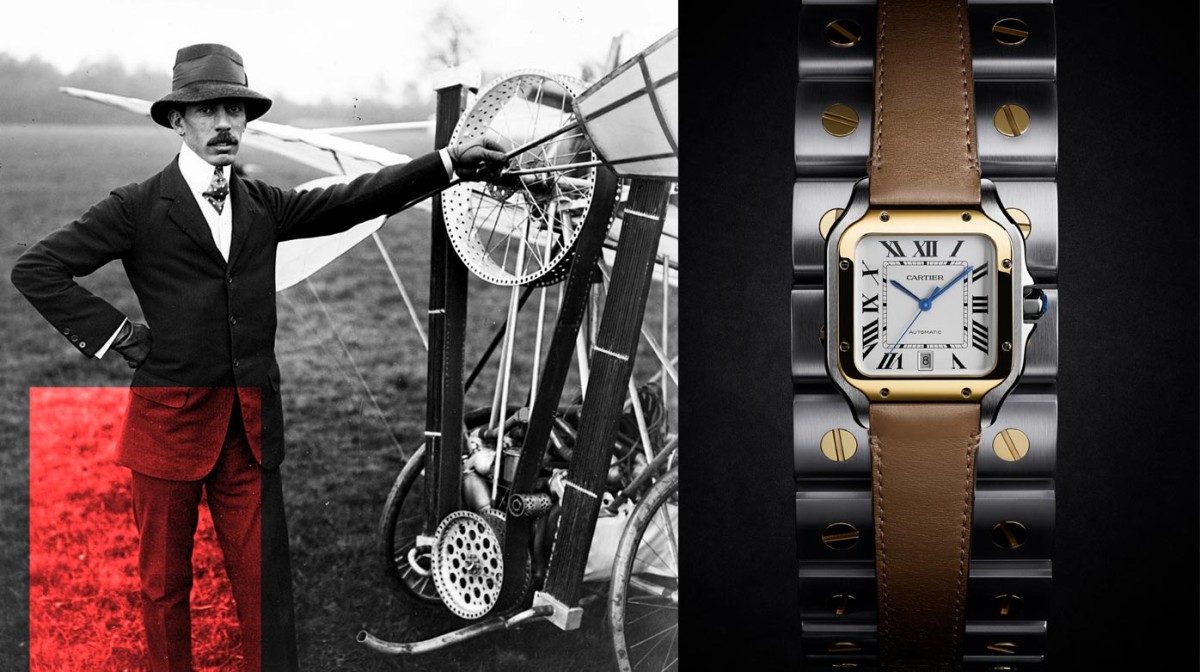
In Paris, Louis Cartier moves among the cultural and technical elite of his time. Among them: Alberto Santos-Dumont, a Brazilian dandy, aviation pioneer, and media figure before the term existed. The legend—solid, and extensively documented in the Maison’s history—has it that the aviator complains to Louis Cartier that he cannot easily check the time while flying. The idea is crystal clear: move time-reading from the bottom of the pocket to the wrist. Not a whim, but a demand of modernity.
1904–1911: Cartier’s intuition becomes a production piece
The first Santos is often associated with 1904, the year Louis Cartier designs a wristwatch for Santos-Dumont. But what truly changes the game is the shift from private anecdote to commercial model. In 1911, Cartier offers the Santos to the public. And this is where the story turns: a watch conceived for a specific use, with an instantly recognisable design, becomes a product aimed at a clientele beyond the inner circle of connoisseurs.
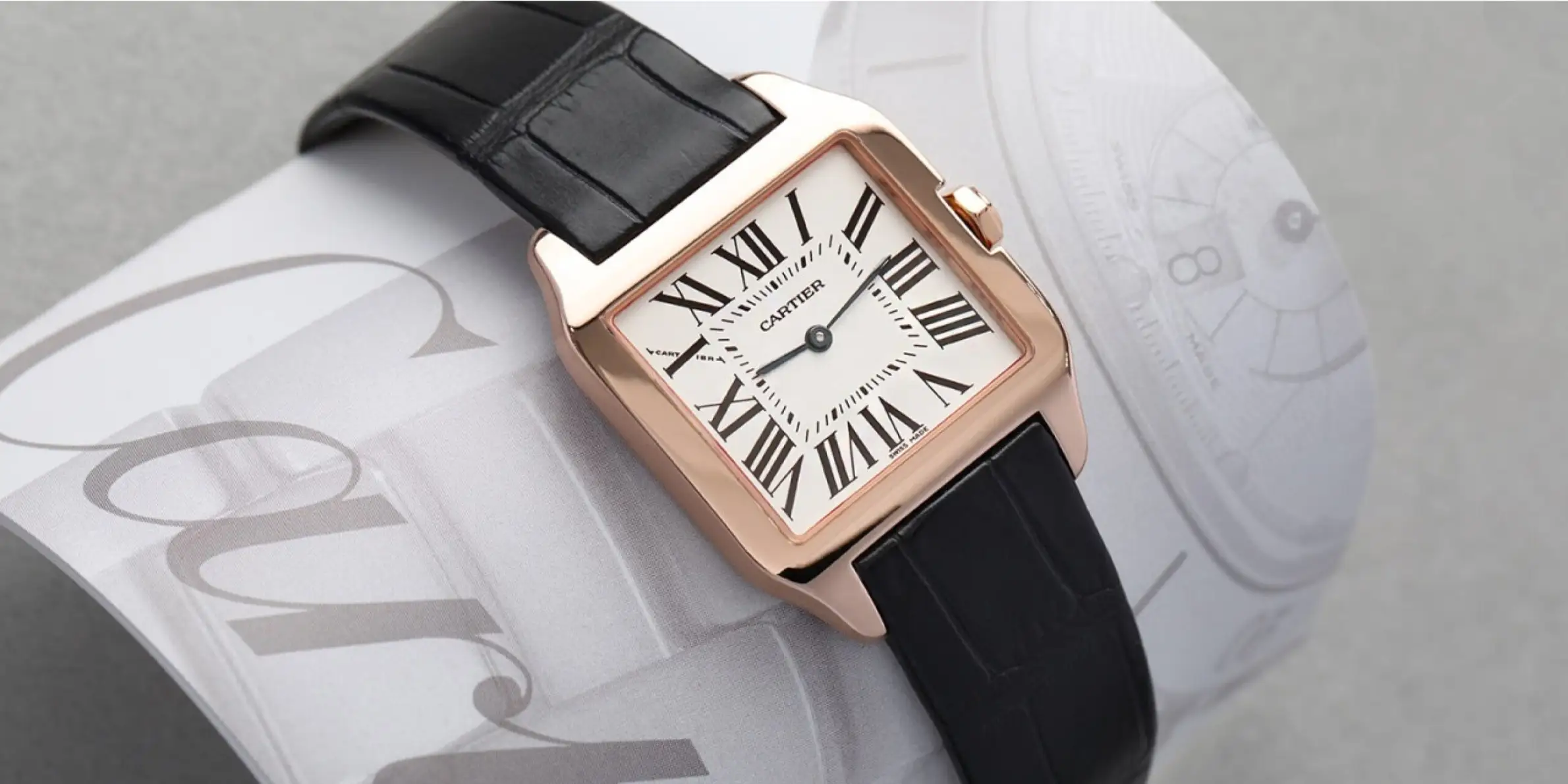
To say it is “the first modern watch” does not mean it was the very first wristwatch. Other attempts existed, notably in military or jewellery contexts. But the Santos has something rare: from the outset it brings together a function (ergonomics), a form (a new aesthetic language), and a distribution (a market launch) that foreshadow our contemporary relationship with the wristwatch.
Design: when the square becomes architecture
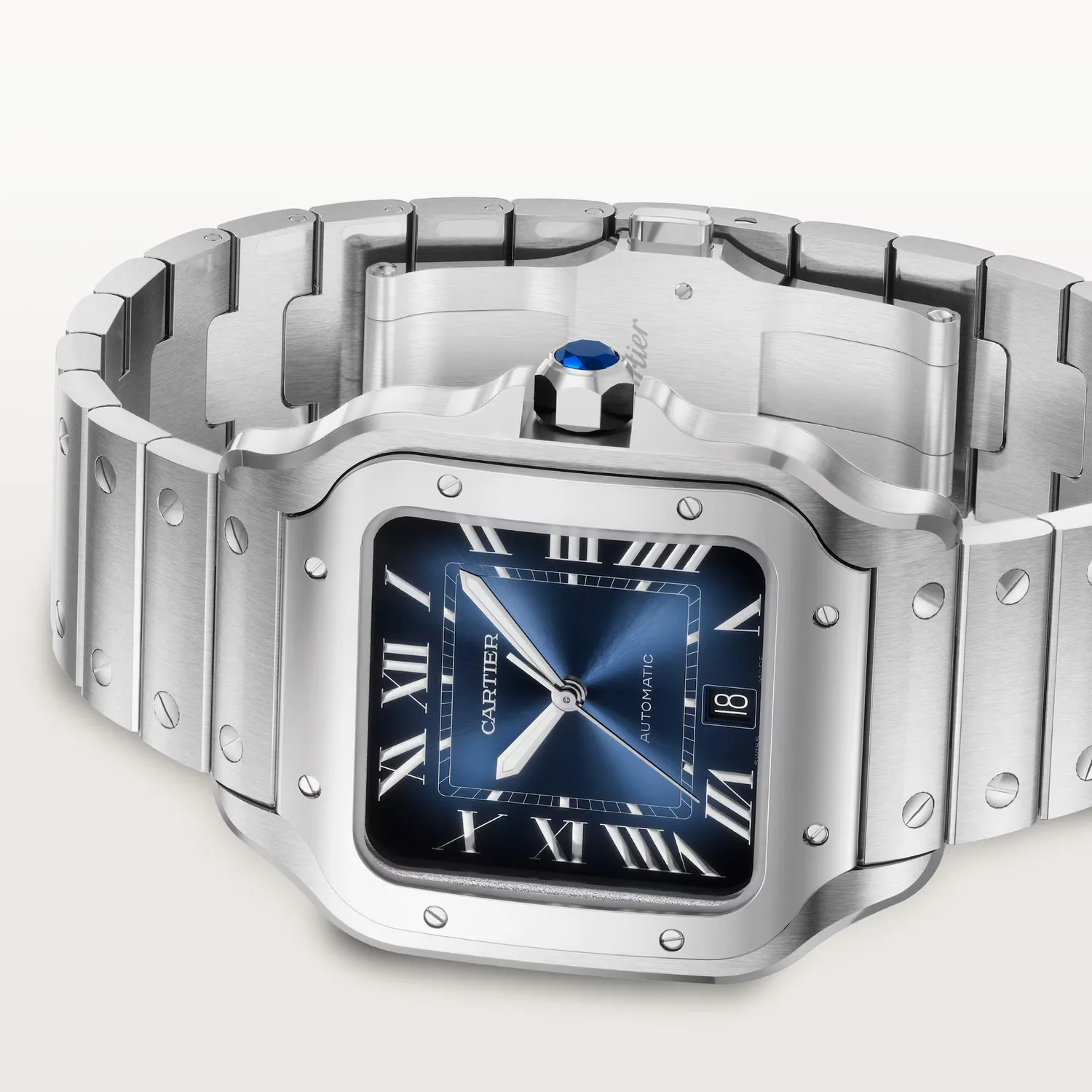
At the time, wristwatchmaking is still finding its feet. Many watches borrow the round silhouette of pocket watches, simply adding lugs. Cartier does the opposite: it redesigns the object as a whole. The Santos asserts a square case with softened corners, a clean dial, and a bracelet integration that is anything but incidental. Visually, we are no longer in ornament—we are in construction.
Exposed screws: an industrial gesture turned signature
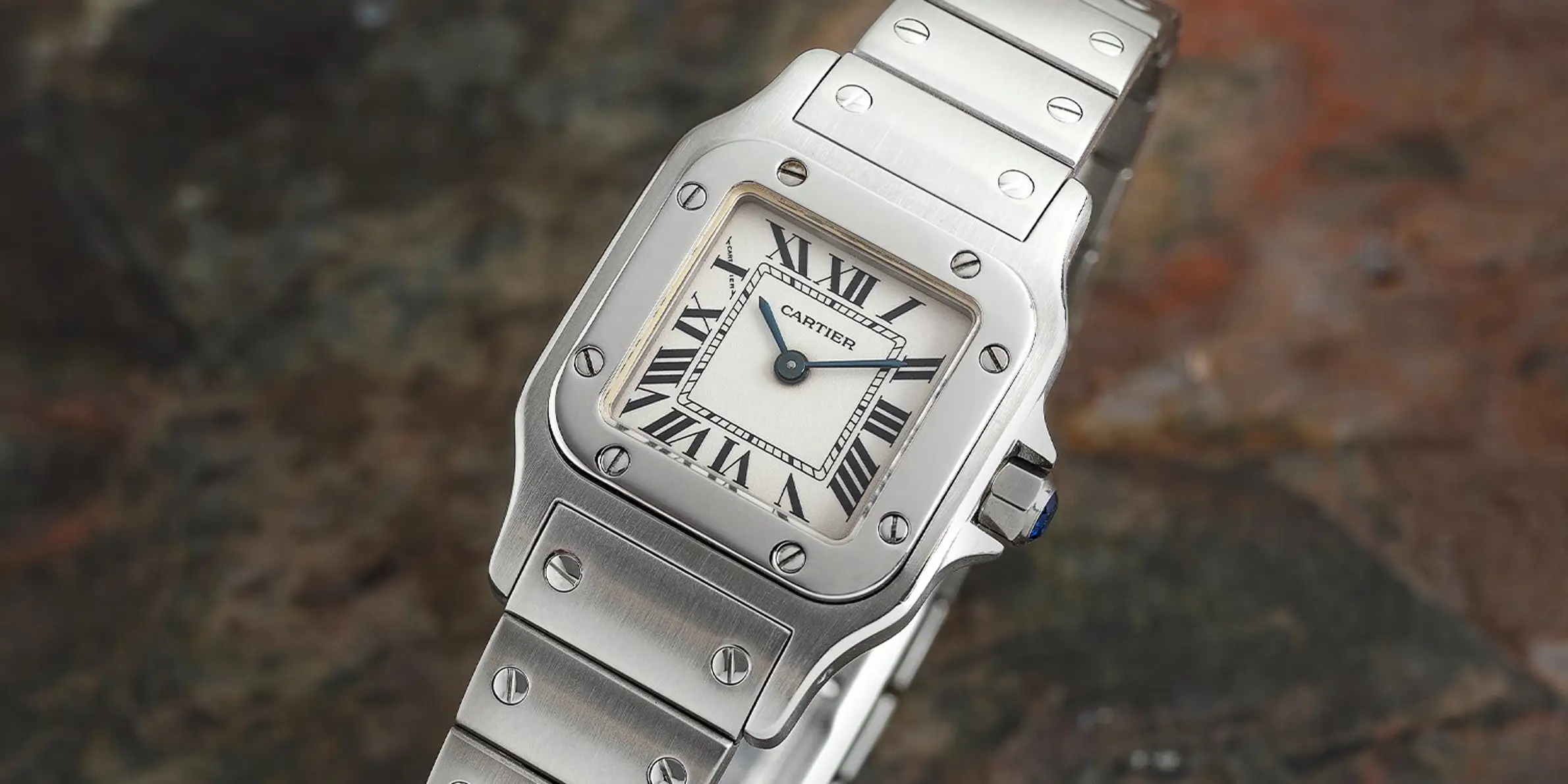
Another essential break: the screws on the bezel. Today they are seen as a style element, a Cartier signature. At the time, it is a statement. To show the fastening, to embrace the idea of structure and functionality, is to bring an industrial vocabulary into a luxury object. This technical candour anticipates a strand of modern design: beauty is no longer merely decorative—it is also mechanical, logical, almost honest.
A dial designed to be read fast
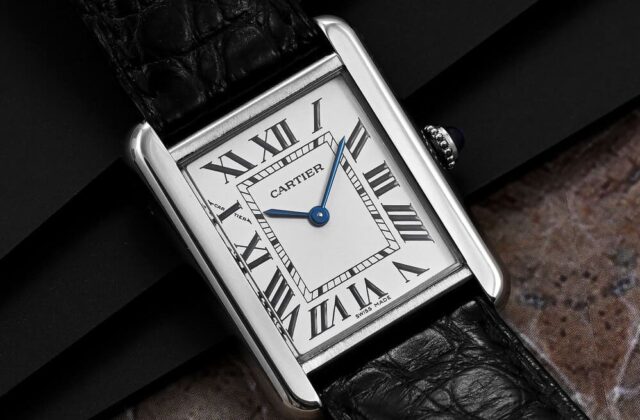
The Santos is not a “mysterious” watch. It wants to be legible. Roman numerals, the railway minute track, blued hands: all codes that establish a Cartier grammar and, above all, immediate readability. In a cockpit or on a Parisian street, the information must land at a glance. It is a very modern idea: the watch as an instrument for quick reading, not as a complex jewel to be deciphered.
Ergonomics ahead of its time: a watch designed for the wrist
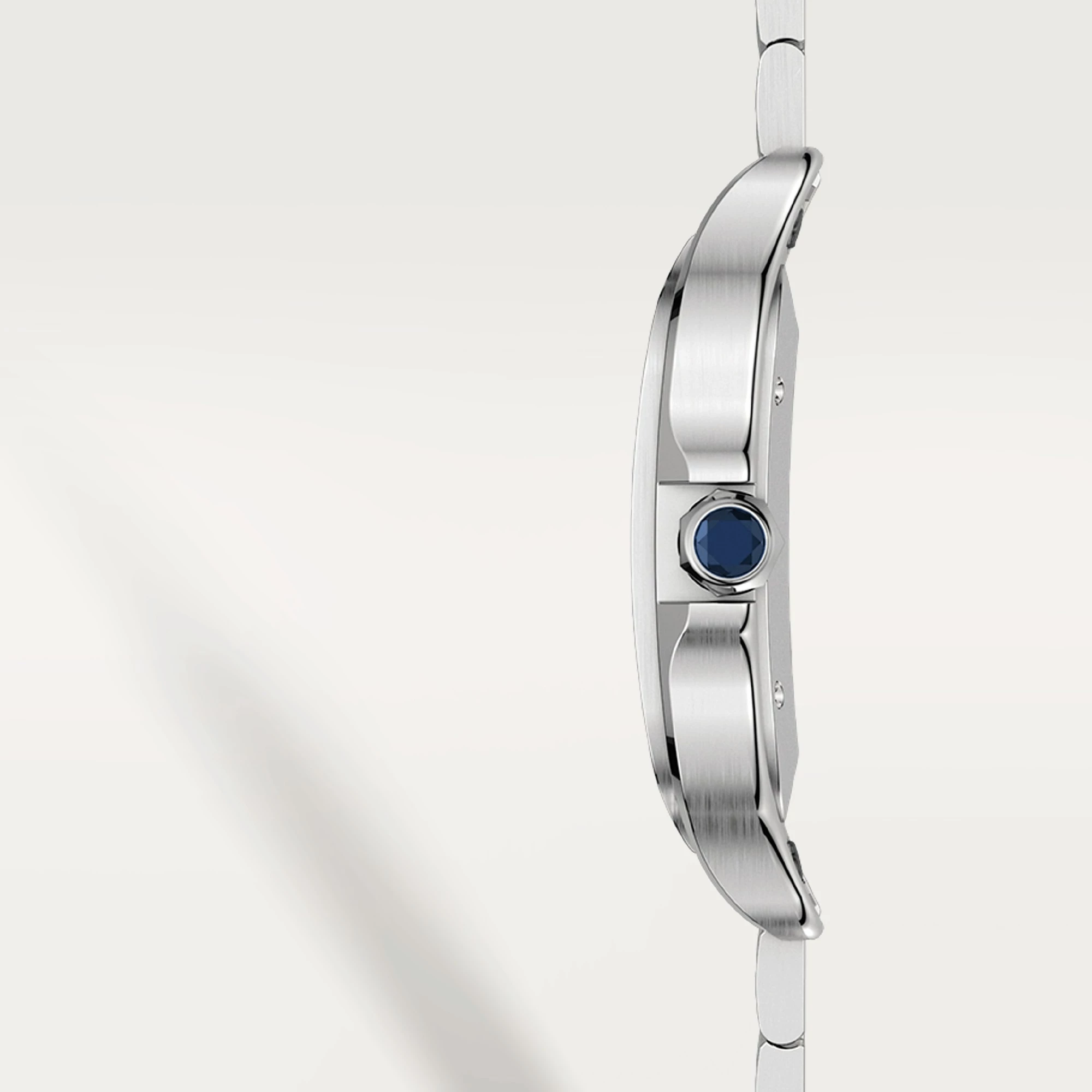
It is often underestimated just how much the Santos inaugurates a reflection on comfort. Moving from pocket to wrist brings constraints: stability, solidity, daily wear, resistance to movement. The wristwatch is no longer a “small portable clock”; it is an object attached to the body, exposed to real life, often paired with a metal bracelet.
The Santos, through its shape and proportions, presents itself as a coherent accessory: a case that hugs the wrist, integrated bracelet, controlled presence. It heralds a fundamental principle of the modern watch: you wear it as much as you consult it. It has to live with you, not merely show itself off.

Between aviation and elegance: the founding myth of the chic tool watch
There is a tension in the Santos that makes it timeless: its utilitarian origin and its luxurious execution. Aeronautics then represents the absolute avant-garde. To wear a Santos is to wear a fragment of technological modernity, transposed into the world of Parisian style. The object is not military, not rustic: it is civilised. It is precisely this synthesis that foreshadows the 20th-century notion of the sporty-chic watch.
One could say the Santos invents, ahead of its time, a category: watches capable of moving from a functional context to a social one without changing identity. It does not need to dress up. It is, by nature, hybrid.
A design icon, not merely a watchmaking reference
“Modern” watches are not modern only because of their mechanism. They are modern because of their place in culture. And the Santos reads like a design object in the same way as a legendary pen or an iconic armchair: a clear form, reproducible, memorable, and immediately associated with a brand.
This is also a key point: Cartier does not sell only a watch; Cartier sells a silhouette. The Santos is recognisable from a distance. This ability to become a sign is part of modernity. You are not buying only a complication or a calibre: you are buying a visual identity, a language.
Why “the first modern watch”: the criteria that really matter
If we set aside the sterile battle of “who was first,” the modernity of the Santos lies in a coherent cluster of innovations. It ticks boxes that have become our contemporary expectations.
A real need: telling the time quickly, in action, without having to access a pocket watch.
Functional design: shape, legibility, overall coherence—no makeshift adaptation.
An unapologetically industrial aesthetic: exposed screws, case architecture, visual modernity.
An object meant to be worn every day: comfort, presence on the wrist, robustness.
Commercial distribution: a creation that exists beyond the prototype or a private gift.
The Santos today: living proof that modern design ages well
What is fascinating about the Santos is that its language does not need to be reinvented every decade. Variations exist, sizes evolve, movements are modernised, but the essentials remain legible: the softened square, the screwed bezel, the spirit of an “elegant instrument.” In that sense, it resembles the best objects of the 20th century: they endure because they were designed around a strong idea, not a trend.
In a world where many contemporary watches pile on effects—garish colours, excessive volumes, artificial storytelling—the Santos reminds us of a simple truth: the future sometimes begins with a conversation between two men, a concrete need, and a well-judged stroke of the pencil.
The Santos de Cartier is considered the first modern watch because it does more than move time from the waistcoat pocket to the wrist. It invents a way of thinking about the watch: an object that is legible, structured, wearable, recognisable, and elegant enough to become a symbol. It links the technological audacity of the pioneers of the air with the aesthetic exactingness of the great Parisian Maison.
And perhaps that is, in the end, the most credible definition of horological modernity: when a watch is not only beautiful, but perfectly adapted to the life that is coming.