What Are Jewels Used for in Watch Movements?

The red secret at the heart of calibres
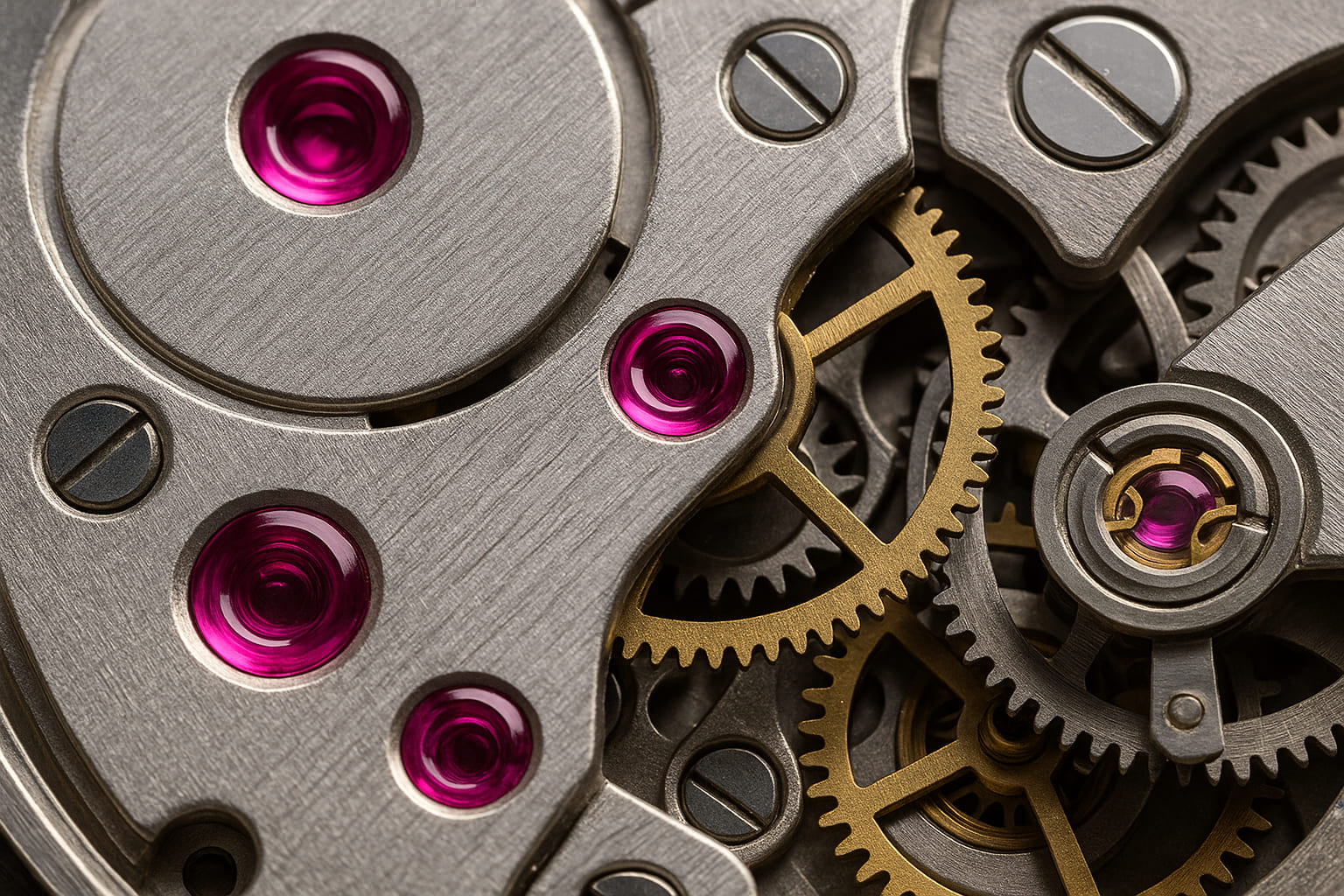
They barely glint, set like cold stars beneath a movement’s bridge. You often catch them through a sapphire caseback, engraved with a line that has become almost mythical: “17 jewels”. Rubies aren’t there to charm, but to endure. In a world of micro-forces and infinitesimal friction, these precious stones—synthetic, most of the time—are the invisible guardians of precision, durability, and watchmaking style.
Why rubies? The science behind the poetry
Reducing friction, preserving energy
A mechanical watch is nothing but a ballet of surfaces in contact. With every rotation of a pinion, every back-and-forth of the escapement, steel against steel would wear, heat up, and consume the mainspring’s energy. Ruby (corundum), with a hardness of 9 on the Mohs scale, offers an extremely smooth, highly resistant surface. Polished into “olive holes” and paired with a drop of watch oil, the stone reduces the contact area, stabilises the lubricating film, and cuts friction losses. The result: more amplitude, greater consistency, and more usable power reserve.
Rate stability and longevity
Beyond efficiency, rubies stabilise the arbors of the wheels, guide the pivots, and limit their wear. Less play means less rate drift over the years. In watchmaking, precision is never a flash of brilliance: it’s a balance maintained over time. Rubies are that quiet foundation.
Where do they hide? Mapping the stones
You’ll find them wherever pressure is high, speed is elevated, or regularity is critical. A few reference points to visualise their role:
- In the gear train: ruby holes guide the pivots of the wheels (barrel, centre, third, seconds, escape).
- At the escapement: the two pallet stones of the lever are rubies; they receive and return the impulse. On the balance, the tiny impulse jewel (ellipse) is also a ruby.
- On the balance: hole jewels and cap jewels reduce axial friction and stabilise the oil through capillary action.
- In the automatic winding system: rubies support intermediate wheels and reversing wheels, where alternating loads are constant.
The “classic” allocation for a well-born manual calibre: 17 rubies. It covers the gear train, the escapement, and the balance’s cap jewels. Beyond that, each complication or system (date, automatic winding, indirect seconds) adds stones where it makes mechanical sense.
More rubies = a better watch? Not so simple
In the 1950s and 60s, the race for “jewels” flirted with the absurd: 30, 40, sometimes 100 rubies displayed on the bridge, with no real benefit. A well-designed watch doesn’t need a forest of stones. It needs rubies in the right places, properly sized, properly polished, properly oiled. A thoughtfully engineered 17-jewel movement will easily outclass a gratuitous 30-jewel one. The number reassures; relevance convinces.
Rubies, sapphires: same family, different story
Watchmaking rubies aren’t gems torn from a mine: they are synthetic corundum, often colourless (sapphire) or tinted pink/red for tradition. Since the Verneuil process at the start of the 20th century, the industry has mastered a stone that is pure, homogeneous, economical, and ideal for micrometric machining. The choice isn’t aesthetic: it’s about stability, hardness, and a consistent supply.
A mechanics of details: the stones’ shapes and functions
- “Olive” hole jewels: a rounded profile that concentrates contact, retains oil, and limits friction.
- Cap jewels: placed above the hole jewels, they control the pivot’s endshake and hold the oil in place through capillary action.
- Pallet stones: in ruby, they take the impact of each tooth of the escape wheel, with an angle and finish that dictate the efficiency of the impulse.
- Ellipse (impulse jewel): small but crucial, it transmits energy from the lever to the balance.
Add to that shock-protection systems (Incabloc, Kif types): a lyre spring protects the balance’s cap jewels in the event of a drop, allowing the pivot to re-centre after impact. Without rubies, these protections would lose their finesse and precision.
Bench anecdotes: what the watchmaker sees, what you feel
When servicing a watch, the watchmaker first scrutinises the jewels of the going train and the balance: are they clean, intact, free of a stray hair of oil that has wandered off? A cracked hole jewel is rare but audible: amplitude collapses, the tick-tock fades. A pallet stone that’s poorly polished or poorly oiled translates into a nervous, power-hungry watch that gains erratically. Conversely, crisp jewels, fresh and well-centred oil, and the whole watch breathes: stable amplitude, a silky sound, drift kept in check.
External signs of refinement
Beyond the number, certain cues betray a true culture of the jewel: mirror-polished chamfers around the holes, rubies sitting flush with no burrs, perfectly aligned pallet stones, oil forming a neat, round meniscus under the loupe. Details invisible on the wrist, yet ones you unconsciously rediscover in the sensation of regularity and quality.
Misconceptions: untangling the myths
- “Rubies make the watch precious.” — False: they are inexpensive synthetic stones; it’s the execution that creates value.
- “The more there are, the better.” — Not necessarily: mechanical coherence comes first.
- “Quartz doesn’t need them.” — Some quartz movements use them too, on the stepper motor pivots, for longevity.
In a word: the elegance of the invisible
Rubies are the hidden elegance of fine watchmaking: a simple, almost archaic solution to an eternal problem—mastering friction to tame time. In their discreet sparkle, you can read a philosophy: better to polish a surface than to force a mechanism. And if your next watch delights you with its steadiness, thank those little red sparks. They don’t seek the spotlight; they create longevity.