The Strong Comeback of Vintage Quartz Watches
A quiet revenge
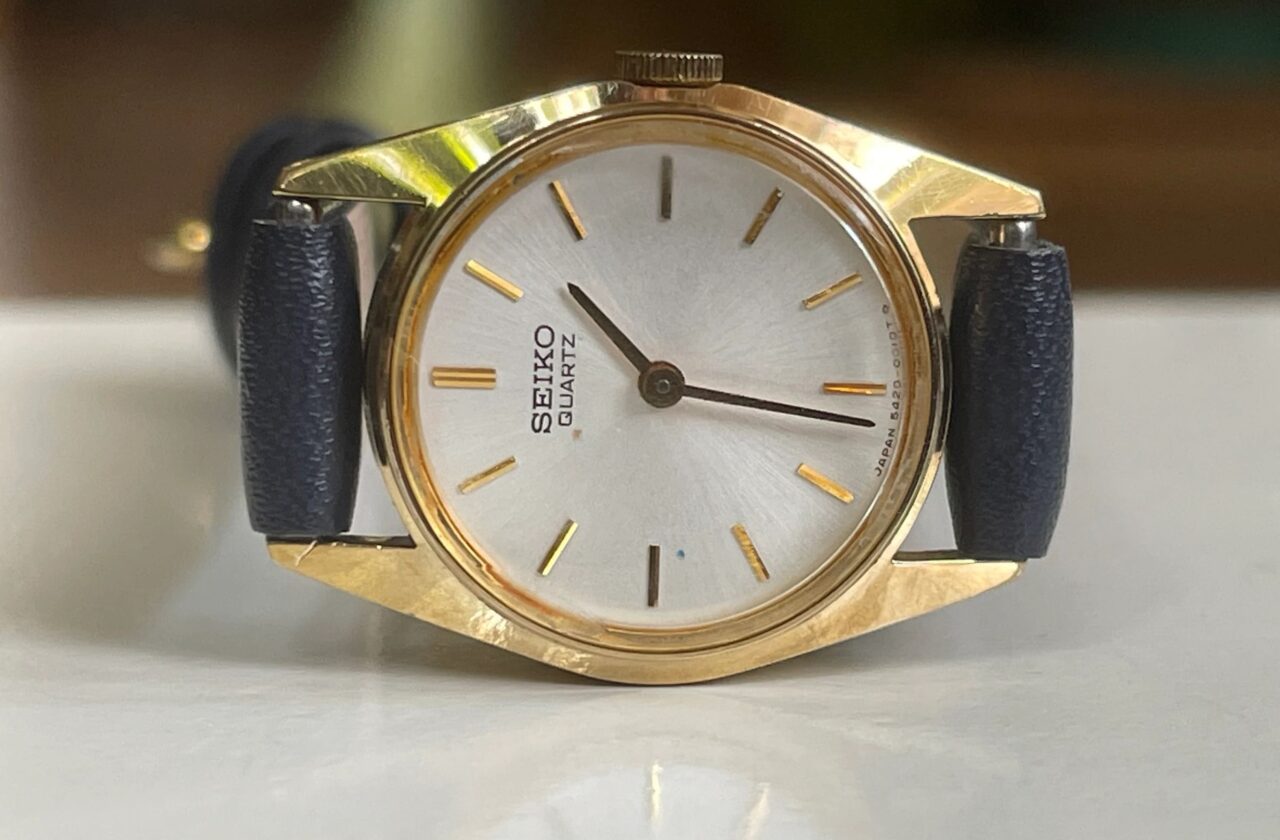
For a long time they were relegated to supporting roles, blamed for having triggered the mechanical crisis. Yet vintage quartz watches are back in favour, carried by a generation that prefers style, accuracy and history to speculation. Slim cases, integrated bracelets, dials with 1980s graphics, and that seconds hand that keeps time without showiness: the discreet chic of quartz is asserting itself once again, with a cultural aura we’d forgotten.
From the 1969 revolution to 1980s icons
On 25 December 1969, Seiko unveils the Astron, the first quartz wristwatch: an earthquake for watchmaking. The Swiss strike back with the Beta 21 project, adopted by Omega, Patek Philippe and IWC. This rivalry throws into relief the differences between a quartz and a mechanical movement, two approaches that shape the industry’s evolution. Very quickly, the 1980s turn this technological breakthrough into an aesthetic in its own right. The era is sport-chic, taut lines, angular bezels, high-tech optimism.
At Rolex, the Oysterquartz (1977–2001) reinterprets the Oyster with crisp edges and an integrated bracelet that has nothing to envy the brand’s mechanical signatures. Omega delivers the Constellation “Manhattan” (1982) with its famous claws—often in quartz guise—while Cartier democratises elegance with the Tank Must, slim, urban and relentlessly precise. In parallel, G-Shock (1983) invents radical toughness, Swatch (1983) rekindles Swiss creativity with pop capsules, and Seiko multiplies technical masterpieces, from the 7A28 analogue quartz chronograph (1983) to the “Tuna” 7549 divers.
This decade stamped out a visual language: tapestry or sunburst-brushed dials, futuristic typography, “TV” cases, bracelets with rounded links. A vintage vocabulary that is now returning to dress wrists with an almost insolent freshness.
Why collectors are coming back to quartz
- Unfiltered design: the formal freedom of the 1980s—flat cases, sharp angles, integrated bracelets—pairs beautifully with a contemporary wardrobe.
- Accuracy and practicality: quartz’s promise remains unbeatable day to day, with no winding and no regrets.
- Access and authenticity: faced with soaring prices for mechanical icons, vintage quartz offers a more honest playground, often still within reasonable budgets.
- Pop nostalgia: from 1970s LEDs to 1980s LCDs, the pre-internet techno imagination appeals to a generation drawn to pocket-size analogue.
- Culture, not snobbery: rediscovering quartz means rereading watch history beyond the usual narratives.
Models to watch
- Rolex Oysterquartz 17000/17013: crisp architecture, a forthright tick, Rolex finishing and a quietly iconic aura. A milestone in integrated design.
- Omega Constellation “Manhattan” quartz (1980s): the “claws” designed by Carol Didisheim, silvered, gilt or tapestry dials, and irresistible office chic.
- Cartier Tank Must quartz: Parisian minimalism, lacquered dials, Roman numerals—a classic of urban elegance.
- Seiko 7A28 Chronograph (from 1983): the first analogue quartz chrono, an all-metal movement, and Giugiaro-signed variants—including the one worn by Ripley in Aliens (1986).
- Seiko “Tuna” 7549 quartz: the technical diver that owns its bulk and reliability, a 1980s tool-watch icon.
- Casio G-Shock DW-5000C / DW-5600: G-Shock’s original DNA—indestructible rectangles, streetwear before its time.
- Citizen Ana-Digi Temp (1980): dual displays, an onboard thermometer, cockpit looks—the ultimate chic gadget.
- Ebel Sport Classic quartz: wave bracelet, slim case, very 80s sport-chic refinement.
- Swatch Originals (from 1983): early years, graphic design, the manifesto of a creative Switzerland setting out to conquer the world again.
Buying well: habits to adopt
- Movement condition: ask for photos of the module; check for any oxidation from battery leakage. A clean circuit is essential.
- Parts availability: modules, circuits, coils, pushers, gaskets. Favour references that are still supported, or repairable by a watchmaker who’s comfortable with quartz.
- Originality: an original dial, hands, bracelet and clasp significantly enhance the piece. Beware of dubious mix-and-match builds.
- Water resistance: never assume a vintage watch is waterproof. If needed, replace gaskets and pushers, then have it tested.
- Screens and polarisers (digital): check display uniformity; a ghosting or segmented LCD can be difficult to rescue.
- Dimensions: many 1980s quartz watches are slim and wear larger thanks to integrated bracelets. Try one on, or ask for a wrist-shot photo.
Style: getting it right in 2025
Vintage quartz is worn against the grain, with ease. An Oysterquartz under a cool wool blazer; a Constellation Manhattan with a white shirt and raw denim; a Tank Must on black leather peeking from a corduroy jacket; a patinated square G-Shock paired with a well-cut hoodie: the clash of registers creates balance. Compact formats slip under a cuff; digital pieces sharpen the street vibe. You can even dare the double act—mechanical at the office, quartz after hours—to tell two chapters of the same passion.
A new idea of luxury
Rediscovering quartz means accepting that luxury isn’t measured by the complexity of an escapement, but by the rightness of a design and the emotion of an era. The 1980s knew how to make quartz an aesthetic manifesto: graphic, functional, modern. Today, as authenticity takes precedence over speculation, these vintage watches are finding their place again—on the wrist, of course, but also in the grand history of watchmaking. A history in which the crisp tick of a jumping seconds hand reminds us that precision, too, can be devastatingly stylish.