Royal Oak Concept GMT Tourbillon by Audemars Piguet
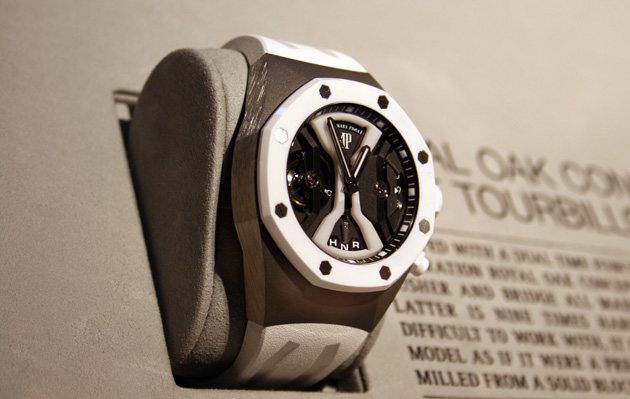
Sur paper, the new Audemars Piguet Royal Oak Concept GMT Tourbillon didn’t win me over. And yet, once I was face to face with this watch, I changed my mind completely. Like Puss in Boots, it seemed to whisper to me, “Give me a chance …”.

It was a watchmaker at the Audemars Piguet booth at SIHH who presented it to me. First, it was the movement. The Audemars Piguet calibre 2930 displays a pleasing symmetry between the tourbillon bridges at 9 o’clock and the GMT display at 3 o’clock, with, at the centre, an upper bridge in white ceramic, satin-brushed and hand-polished.
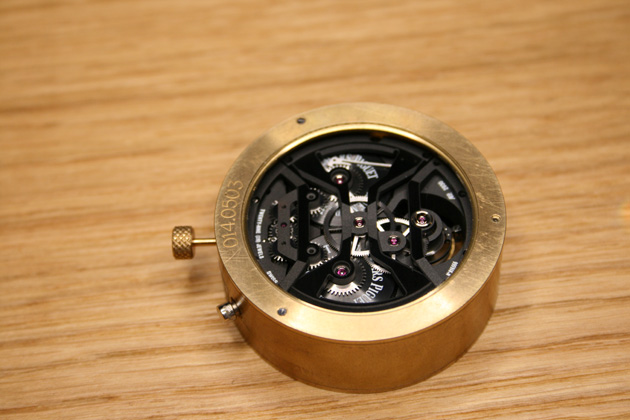
The hand-wound movement, with its tourbillon and twin barrels, delivers a 10-day power reserve. 85 components make up the tourbillon cage for a mere 0.45 grams, yet it takes the watchmaker three days of work.
The GMT function, displayed at 3 o’clock, is read on a twelve-hour scale. Night and day are indicated by one black disc and one white disc.
The titanium middle case of the 44 mm case ensures a harmonious link between the white rubber strap, the bezel, the pushers and the upper bridge in white ceramic. On that note, by the admission of a member of the AP team, the ceramic used is of far better quality than what you can see on watches whose name is made up of a letter followed by a lucky number from which 1 has been subtracted (have you guessed?).

Ceramic is 9 times harder than steel and virtually scratch-proof. It requires diamond-disc machining. The bezel alone takes 8 hours of work, whereas only 45 minutes are needed for a steel bezel.
Some will say that the difference from the 2011 version is too slight to warrant amazement. Yet sometimes a single detail is enough to transform a watch. Here, it’s the white ceramic for the bezel, but also on the upper bridge.
The crown-position indicator at 6 o’clock shows the current position of the winding stem (H, N or R): time-setting, Neutral and Winding.