How to Set an Automatic Watch Without Damaging It

The setting ritual: a gesture of watchmaking culture
Setting an automatic watch is not merely a technical operation: it’s a ritual. The discreet click of the crown, the silky feel of a manual wind, the elegance of a seconds hand restarting exactly on the hour… Done properly, these gestures extend the life of the movement, preserve water resistance, and prevent damage that can sometimes be costly. Here is a clear, elegant and safe guide to setting your watch without missteps (and if you’re hesitating in your choice of a first automatic watch, consult my guide).
Preparing your watch (and your space)
Settle somewhere quiet, on a soft cloth to prevent scratches and slips. If your watch has a screw-down crown, unscrew it gently (counter-clockwise) until the “click” that releases the stem.
Give the movement some energy
An automatic is never as cooperative as when it has a bit of power reserve. Before any adjustment, give it 20 to 30 turns of the crown in the neutral position (crown unscrewed but not pulled out). Reassuringly, on most automatic movements a slipping bridle prevents overwinding. No need to be abrupt; the quality of a good gesture lies in its consistency.
Setting the time without stress or wear
A movement’s fragility shows itself most clearly around the date. That’s where the classic mistakes are made.
The date’s danger zone
Avoid any date adjustment between roughly 8 pm and 4 am: in that window, the date-change cams and levers are engaged. To work safely, first place the hands around 6:30. This simple reflex protects you from unpleasant surprises.
Synchronise cleanly
- Time reference: have an official time source ready (smartphone, atomic clock, time.is).
- Crown: pull it out to the last position (time). On a movement with “stop seconds” (hacking), the seconds hand stops—ideal for hitting the exact minute.
- Direction of rotation: favour moving the hands forward. A brief backward correction isn’t an issue on many modern movements, but the best habit is to progress clockwise.
- AM/PM: to know whether you’re in the morning or afternoon, advance the hands until the date jumps: you’ve just passed midnight.
- Final adjustment: align the minute hand a few seconds before the signal, then push the crown in on the cue. Screw it down if necessary, without forcing the threads.
Setting the date (and other complications) without damage
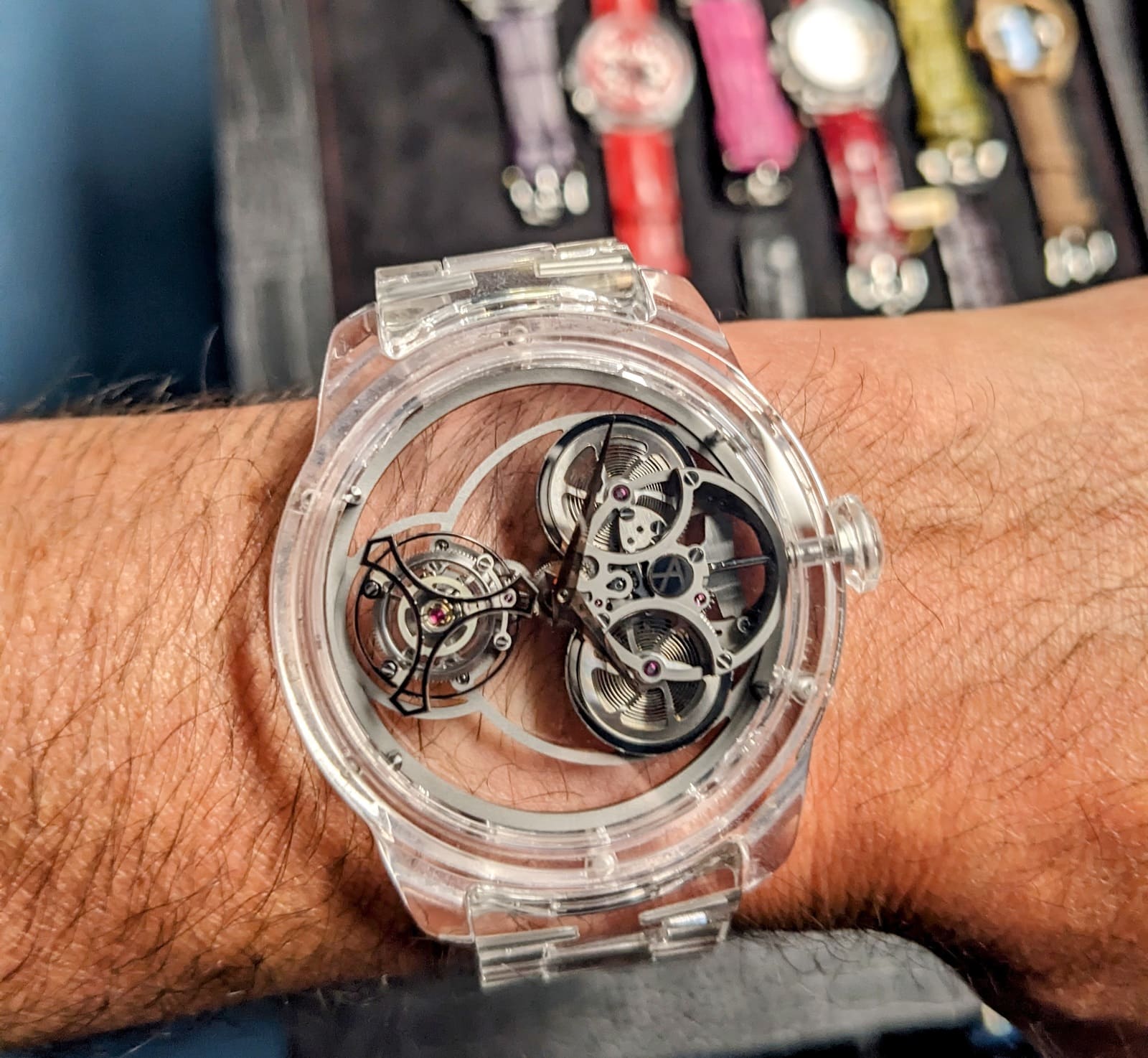
Quickset date
- Safety: first set the time to around 6:30.
- Crown: first position (date). Turn gently until the desired date appears. Avoid running the date backwards if your manual doesn’t allow it.
- Then return to the time-setting position to set the time precisely, taking AM/PM into account.
Date without quickset
On certain vintage calibres or rugged, military-inspired movements, there is no quickset date. The safest method is to advance the hands in 24-hour cycles until you reach the correct date. It’s longer, certainly, but kinder to the mechanism. Avoid aggressive back-and-forth around midnight: it can stress the calendar levers.
Day-date, moonphase, GMT
- Day-date: same protocol as the date. Break it into steps: first set the day and date in the first position, well away from the 8 pm–4 am danger zone, then set the time.
- Moonphase: always set the time outside the risk zone (6:30), then use the correctors with a suitable pusher (never a pen). Follow the manual: some moonphase mechanisms don’t like nighttime adjustments.
- GMT/jumping hour: if your watch allows local time to be set by jumping the hour hand in the first position, use it to cross time zones without stopping the movement. Otherwise, treat it like a classic three-hander.
After setting: water resistance, accuracy, peace of mind
Nothing is more trivial—and more expensive—than a neglected gasket. Push the crown back in firmly, then screw it down without forcing: feel the threads engage before tightening. Before any contact with water, check that the crown and any screw-down pushers are properly locked.
Check the rate
- Simple measurement: compare the daily drift over 48 hours (worn during the day, resting at night). A well-maintained modern automatic often runs between −10 and +20 s/day, depending on the calibre and position.
- Resting positions: at night, leaving the watch dial up, dial down, or on its side can slightly influence drift. Find the position that compensates best.
- Warning signs: sudden variations, gaining several minutes, unexpected stopping, or strong magnetisation (a seconds hand that stutters) call for a visit to the watchmaker for fine regulation or demagnetisation.
Maintenance: good habits that save you from servicing
- Cleaning: a quick pass with a microfibre cloth over the case and under the crown after use; mild soap and lukewarm water for water-resistant watches, strap removed if leather.
- Magnetism: avoid speakers, magnetic clasps, iPad cases; a strong magnet can throw regulation off.
- Shocks: better to take the watch off for tennis or DIY work.
- Watch winder: useful if you rotate several pieces with a calendar; speed and direction matched to the calibre, never running continuously 24/7.
- Service: an overhaul every 5 to 7 years on average, depending on use and environment; gaskets and water resistance should be checked more often if the watch sees water.
Common mistakes to avoid
- Changing the date between 8 pm and 4 am.
- Forcing a screw-down crown that catches: reposition it to engage the threads.
- Turning the hands backwards for a long time, especially around midnight.
- Setting or pulling/pushing the crown under water.
- Shaking the watch to “get it going”: a gentle wind is enough.
- Ignoring signs of magnetisation or abnormal drift and carrying on for weeks without checking.
The elegance of the right gesture
The great workshops have always known it: a movement’s longevity depends as much on the architecture of the calibre as on the finesse of the wearer’s touch. Methodical setting, respect for the mechanics, and measured maintenance: that’s the formula. Your automatic watch will repay you with calm, steady running—this balance wheel breathing in time with you—and that subtle punctuality that says, without a word, that you have an eye for detail.