How to Read a Tachymeter on a Sports Watch?
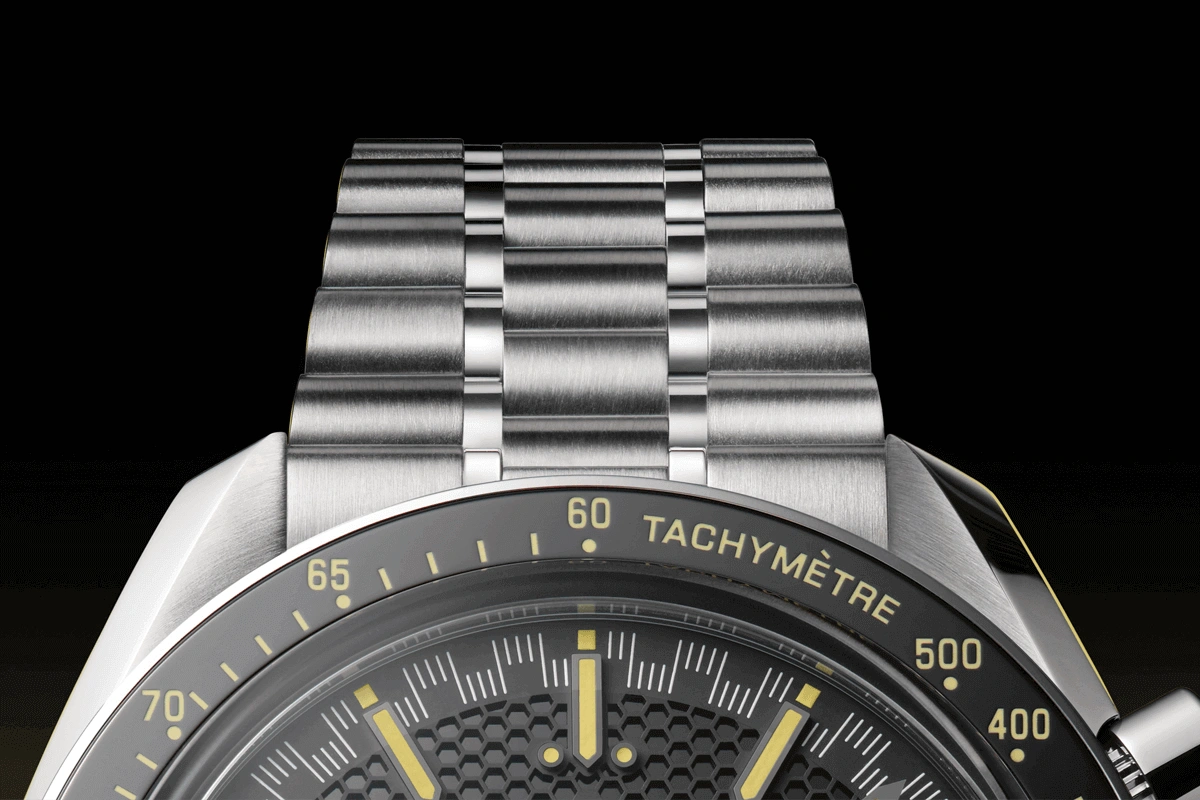
The tachymeter: from practical function to identity marker
On a sports watch, the tachymeter is that detail that catches your eye even before you’ve started the chronograph: a numbered scale on the bezel or the rehaut, often graduated from 60 to 500 (sometimes more). Halfway between onboard instrument and aesthetic signature, it tells the story of an era when speed was measured by the sound of engines, the long straights of race tracks, and records logged on paper. Before GPS and apps, you needed tools that were simple, reliable, and immediate. The tachymeter was born of that culture: that of engineers, drivers, timekeepers, and enthusiasts for whom a second is never “just” a second.
You’ll find it on icons of sporty watchmaking, from certain chronographs created for motor racing to pilots’ watches. But beyond the legend, it serves a very concrete purpose: calculating an average speed from a measured time. And it’s much simpler than it looks.
As a kid, in the school playground, it was considered good form to “show off” (or “flex,” as today’s youngsters say, with haircuts that make them look like alpacas) by thrusting out your wrist to show your “tachimeter” (yes, we didn’t know how to pronounce it in my circle of friends) … Proof, if ever it were needed, of the value of learning Latin and Ancient Greek: we would have known, ignorant children that we were, that tachymeter comes from the Greek takhýs meaning “fast,” and that it should therefore be pronounced “takimeter”!
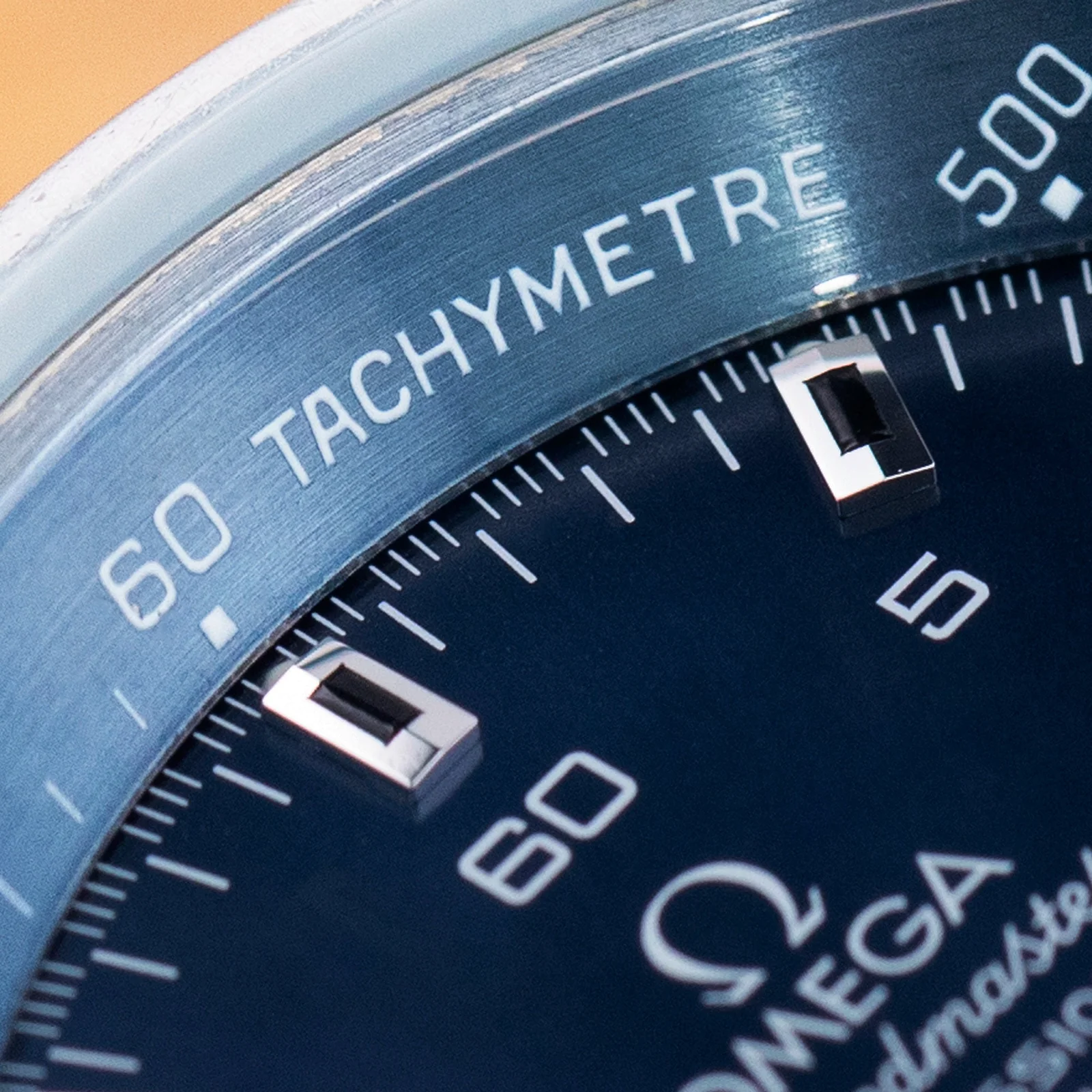
A tachymeter doesn’t “measure” speed live. It converts a duration into an average speed over a known distance. In the vast majority of cases, the scale is calibrated for a distance of 1 kilometre or 1 mile. The logic is as follows:
- You measure the time needed to cover a given distance (for example, 1 km).
- The tachymeter converts that time into an average speed expressed in km/h (or mph).
The formula is the one you learn at school, made elegant by watchmaking: speed = distance / time. Since the scale is built on a one-hour basis, the most commonly used conversion becomes:
Speed (per hour) = 3600 / time (in seconds) for a distance of 1 unit.
The tachymeter prints that conversion directly on the bezel. The result: no need to reach for a calculator—just read the number aligned with the chronograph seconds hand.
Where the tachymeter scale sits on a watch
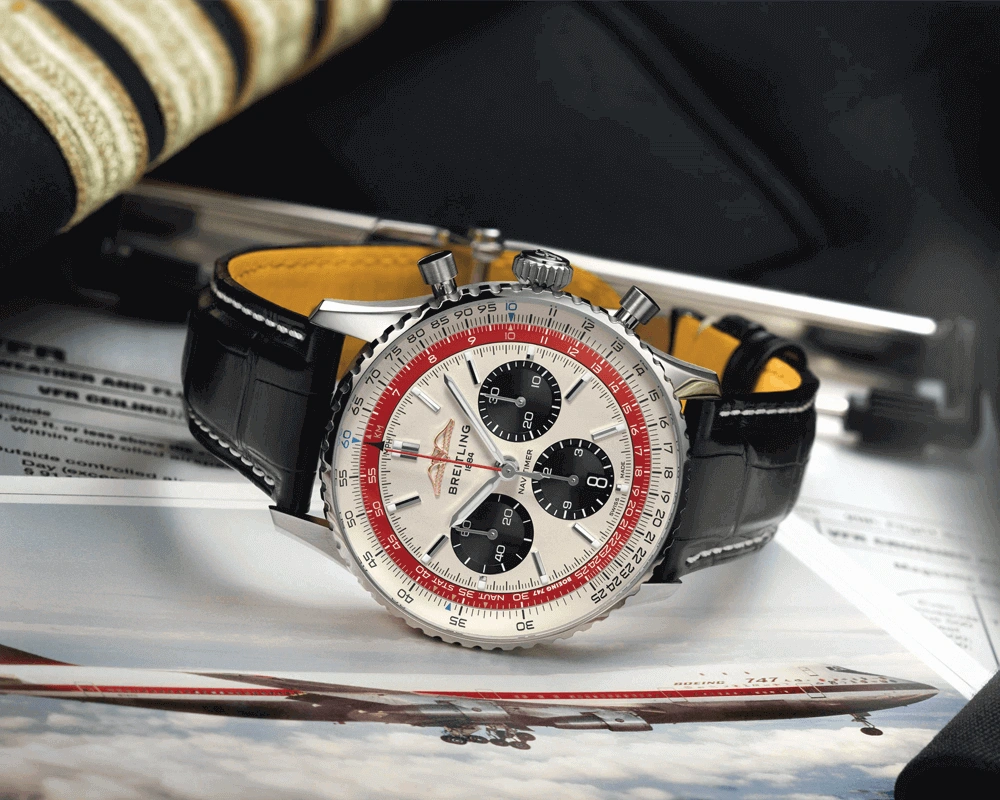
Depending on the model, the tachymeter may be located:
- On the bezel: highly legible, “outdoor,” and very much in the motor-racing vein.
- On the rehaut (the inner ring): more discreet, often found on chronographs with a dressier aesthetic.
- On the dial: sometimes as a peripheral scale, when the bezel is already dedicated to another function.
In every case, the function remains the same—on one condition: the watch must have a chronograph (at minimum, a central chronograph seconds hand).
How to read a tachymeter: step by step
1) Choose a reference distance
The standard tachymeter is designed for one unit: 1 km or 1 mile. The first step is therefore to choose a route whose distance you know precisely: a kilometre marker, a section of track, roadside reference points, or even a measured distance on an athletics track (adapting the reading afterwards—we’ll come back to that).
2) Start the chronograph at the starting point
At the exact moment you pass the “zero” point (the start of the kilometre), start the chronograph. On most watches, that’s the upper pusher.
3) Stop the chronograph at the finish point
At the end of the kilometre (or mile), stop the chronograph. The chronograph seconds hand will then indicate an elapsed time.
4) Read the speed on the scale
Look at where the chronograph seconds hand points on the tachymeter scale. The number shown corresponds to the average speed over the distance travelled.
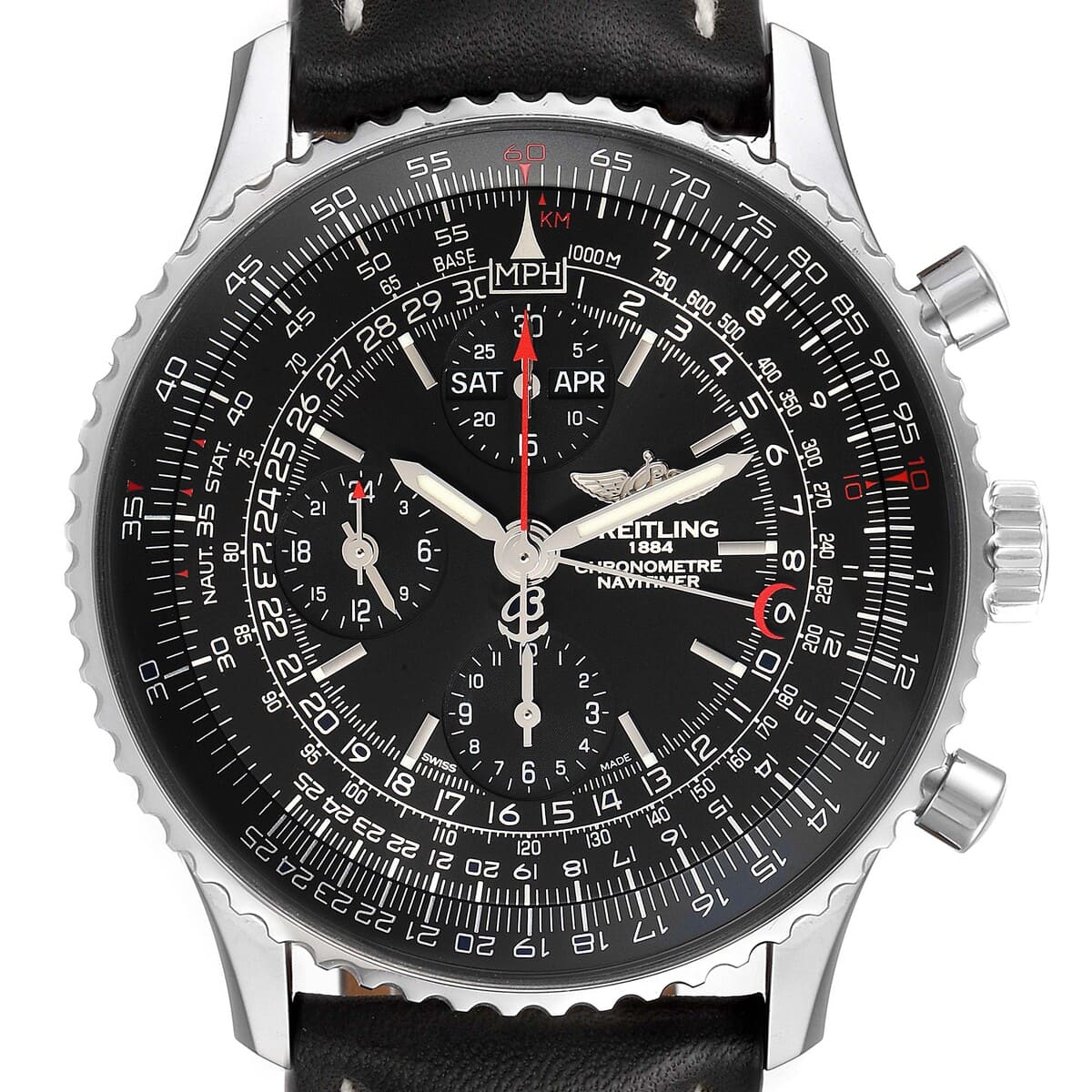
Concrete (and easy) examples to make it click
Example 1: 1 km covered in 30 seconds
You start at the beginning and stop at the next kilometre marker. The hand stops at 30 seconds. On a tachymeter bezel, that generally corresponds to 120. The reading is immediate: 120 km/h.
Example 2: 1 km covered in 45 seconds
At 45 seconds, the scale will give you around 80. So 80 km/h on average over that kilometre.
Example 3: 1 mile in 36 seconds
If your tachymeter is intended for miles (or if you’re using it in that context), 36 seconds corresponds to 100. You therefore get 100 mph. In practice, many watches don’t specify “km/h” or “mph”: it’s your reference distance that sets the unit.
What is a tachymeter really for today?
The honest answer: rarely “out of necessity.” You can measure speed more easily with a phone. But watchmaking has never been purely utilitarian. The tachymeter remains a cultural bridge to a very specific world: night rallies, European circuits, cockpit instruments, and the mechanical precision that turns a gesture into information.
In modern use, it can still be relevant:
- On the road, to estimate an average speed between two kilometre markers (as a passenger, obviously).
- On track or at automotive events, to time a segment and infer a speed.
- In sport (cycling, running), provided you adapt the distance and interpret the reading correctly.
Adapting the tachymeter to another distance: the rule of multiples
The standard tachymeter assumes 1 unit. But you can use it over 0.5 km, 200 m, and so on, by applying a simple logic: if the distance is different, the reading must be corrected proportionally.
Practical case: 0.5 km (500 m)
If you measure the time over 0.5 km, the real speed will be half the value read (since you’ve covered only half the reference distance). Example: you read 120 on the bezel after 15 seconds over 500 m; the average speed over 1 km would be 240 km/h, but your speed over 500 m corresponds to 120 km/h if you’ve mentally calibrated the exercise to 0.5 km. In practice, it’s better to use a full 1 km whenever possible to avoid confusion.
Practical case: 100 m
A tachymeter can theoretically give a pace or speed over a short distance, but the correction becomes less intuitive. Over 100 m (0.1 km), the real speed is one tenth of the value read if the scale is in km/h. It’s doable, but it’s not the tool’s most “natural” use.
The most common mistakes to avoid
- Forgetting it’s an average: the tachymeter doesn’t give an instantaneous speed, but an average speed over the measured distance.
- Using an imprecise distance: if your “kilometre” is actually 900 m, the result will be off.
- Reading beyond one minute: most standard tachymeters remain legible as long as the measured time is under 60 seconds (otherwise, the speed drops below 60 units per hour and the scale is no longer suited).
- Confusing km/h and mph: the scale doesn’t change; it’s the reference distance that determines the unit.
The tachymeter as a style signature
Why do so many watches keep a tachymeter scale, even when their owner will never use it? Because it “dresses” the watch like a whitewall stripe on a vintage tyre: it’s a code. It imposes a peripheral reading, adds density to the chronograph’s face, and underlines its sporting DNA. On a bezel, it brings that graphic presence that recalls the measuring instruments of another era, when elegance also meant the ability to quantify the world.
Understanding how to read a tachymeter, then, is more than learning a trick: it’s stepping into a culture. A way of reconnecting, for the length of a kilometre, with the idea that speed isn’t just a number, but a story—of a hand that races, an engine climbing through the revs, and a watch that, too, deserves to be “driven”.