This article is a modest introduction to creating a watch brand—a broad overview. I won’t go into every detail, but it can give you a sense of the road ahead, the questions you need to ask yourself, and the prerequisites for starting a watch brand.
The first step is undoubtedly to create the brand concept: its essence, its positioning, its reason for being.
What are you going to bring that’s new? Innovation is essential, but it doesn’t necessarily have to be technical—it can come from design, pricing, distribution, or even communication.
Even if you’re an enthusiast with a brilliant concept, fabulous know-how and an ambitious distribution model, you still need to define a solid business plan.
There are many watch brands of all sizes, so you need to prepare properly and stack the odds in your favour to carve out a place for yourself.
The Brand
Finding your brand name is no small task. You can use your own name, or choose a name related to your concept.
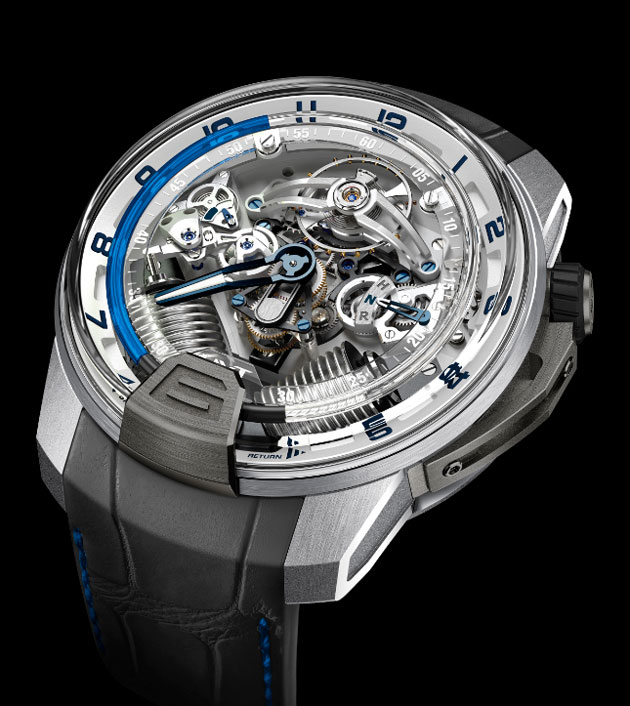
For example, the brand HYT stands for Hydro Technology, because the distinctive feature of HYT watches is that they tell the time using fluids rather than hands.
People have been talking about “swissness” since 1 January 2017. It’s up to you to determine whether the label is an advantage, or whether you can do without it depending on your positioning and target market.
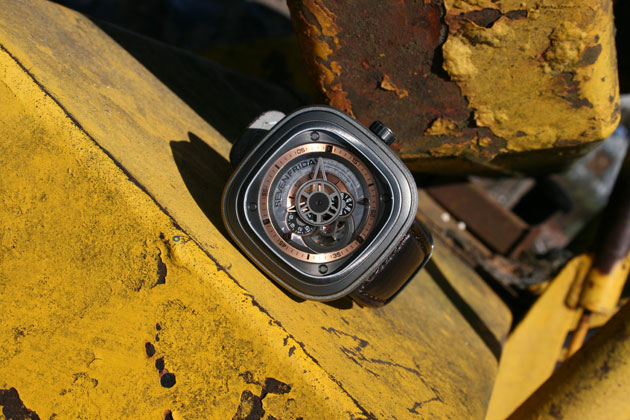
Brands such as Sevenfriday have managed to position their watches at €1,000 on wrists accustomed to wearing Patek Philippe or Rolex, without being adorned with the precious “Swiss Made” seal—thanks to Swiss design paired with a robust Japanese movement.
SevenFriday P2-1
Design
Once you’ve found the brand concept, you need to design a watch that embodies it—and that can be developed into collections that are just as relevant. If your “collection” consists of applying rose-gold, yellow-gold or black PVD, the concept is a bit thin, isn’t it?
You’ll need a designer or a company capable of designing the watch in a way that reflects your concept.
Obviously, the design will have to contend with two essential points:
The feasibility of physically producing the design.
Respecting the brand’s price positioning. That lovely tourbillon the designer drew at 6 o’clock on the dial doesn’t necessarily match your specifications, which called for an automatic mechanical movement whose cost could not exceed a certain threshold.
The prototype
Once the design is done, you need to go in search of suppliers to produce the prototype. In reality, it’s better to already be in contact with suppliers so you can create a design that’s close to reality—particularly with regard to the technical specifications of movements.
There’s no point designing an ultra-thin watch if the movement available at your price positioning won’t allow you to fit such a calibre. Same goes for the case: if it’s too complex to manufacture, you won’t hit your costs or you’ll drift out of your positioning. So you have to make choices.
Visualising your watch on a computer screen has its limits. Technology has given us a very practical new tool: 3D printing. It’s particularly useful for understanding your product physically—putting it on your wrist and examining it from every angle.
Here are the main areas for which you’ll need to find the right suppliers.
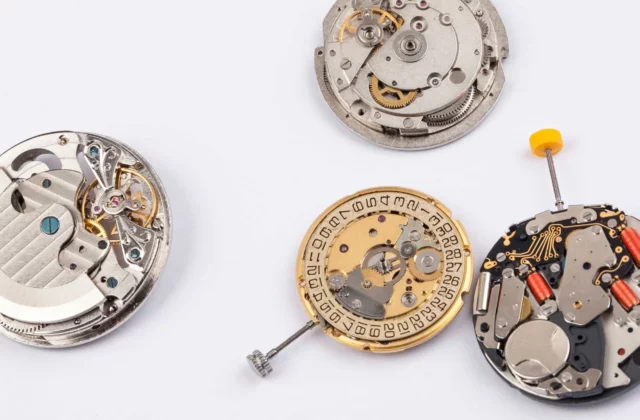
Movement
Many companies produce movements. You’ll be spoiled for choice—and for complications.
Which movement family does your positioning lead you to prioritise: quartz or mechanical?
Which complications? Chronograph? Date? Moon phases? Day? Perpetual calendar? GMT?
Most entry-level watches—and even mid-range luxury—house similar movements; that’s even more true for quartz watches.
If you’re getting into haute horlogerie, specialists can offer you movements or develop them for you, but it will take several years and cost you a small fortune.
Case
Which material? 316L steel? Gold? Ceramic? A special alloy?
Hands
Which material? Steel? Brass? Titanium? Aluminium?
Which finish? Bluing = black oxidation? Galvanic treatment? With luminous material applied?
Dial
Skeletonised to reveal the movement? Openworked? Multi-layer? Smoked? Sunburst brushed? Carbon?
Strap
Metal bracelet? Leather? Rubber? NATO?
With a pin buckle?
Other possible subcontracting:
Engraving
Polishing
Gem-setting
Distribution
To win over wrists likely to wear your watches, you need to find distribution channels. The first channel can be your own website, but you’ll have to make major efforts in traffic acquisition and brand awareness to manage to sell your entire stock. This solution is hard to envisage unless you play on scarcity, have raised millions for promotion, or benefit from incredible public enthusiasm for your watches.
That said, working with distributors will allow you—at the cost of part of your margin—to reach points of sale more quickly and potentially ensure after-sales service.
Do the trade-show circuit to find good partners!
Communication
The issue is often budget. Investment efforts are substantial at launch. So you need to be smart, prioritise digital, and carefully calculate the return on investment of each communication channel.
Stick to the essentials: focus only on your targets and reach them solely via tools that allow you to track performance, so you maintain a positive return on investment.
There’s a lot of talk about influencers at the moment, but this galaxy is full of fraudsters who buy their likes and followers.
So steer clear—unless you’re sure you’ve found good ones, ideally those who run a website and will include links to your site to send you visitors and boost your organic search ranking.
You’ll obviously track all your links to measure their performance.
Draw up a list of indicators (KPIs) that will allow you to estimate the effectiveness of your investment (in product or in cash): site visits, online purchases via their personalised promo code, follower growth, estimated awareness gains (questions asked by their community in the comments, incoming phone calls, leads, etc.). Everything else belongs in the “bullshit” category.
Press relations
Press relations are only supposed to cost time, but you can always bring in a PR agency if you don’t have the in-house resources to send press kits and follow up.
Advertising
Try to secure articles in the press through your PR efforts, and go big with advertising on Facebook, Instagram and Google—without forgetting to use the tools offered by digital: retargeting, CRM, etc.
Social media
Keep your community alive.
Publish posts related to your universe; social media is not a product catalogue.
After-sales
Selling isn’t everything—you need to provide your customers with quality service and ensure after-sales support.
Many aspects haven’t been mentioned, or only skimmed over (legal, SEO, incentives, point-of-sale promotion, trade shows, sponsorship, etc.), but if you’d like to discuss the topic and share ideas, get in touch! 🙂