How Does an Escapement Work in a Mechanical Watch?

Why the escapement is time’s beating heart
In a mechanical watch, everything begins with a mainspring housed in the barrel. It unwinds, powers a gear train… and would, unchecked, run all the way to a freewheeling frenzy. The escapement steps in like a conductor: it releases energy in small, regular doses and keeps the balance and hairspring oscillating. It is the point of contact—the fragile rendezvous—between raw force and the measurement of time. And it is that crisp sound, that tick-tock, that reminds us that here, each second is a victory won again and again.
Anatomy of a Swiss lever escapement
The most widespread today, the Swiss lever escapement, is made up of three main players: the escape wheel, the pallet fork, and the balance and hairspring. The wheel, with its sharp teeth, pushes. The fork, topped with two jewels (the entry and exit pallets), locks and then releases. The balance, fitted with a hairspring, oscillates and—via a small impulse jewel set on its roller—controls the fork. Between them: a precisely choreographed ballet of impulses, lockings, and rests.
One beat, three acts
- Locking: a tooth of the escape wheel comes to rest on the entry pallet. Energy is momentarily held back.
- Unlocking: the balance’s impulse jewel pushes the fork; the pallet releases the tooth, which escapes.
- Impulse: the tooth slides along the pallet’s impulse face and delivers a shot of energy to the balance, sustaining its oscillation.
- End of travel: the fork tips; the other pallet (exit) receives a new tooth and locks in turn. The cycle reverses for the next half-swing.
- Safety: a guard pin and safety roller prevent any accidental unlocking in the event of a shock.
This interplay of engagements and sliding repeats thousands of times per hour. At 4 Hz (28,800 vibrations per hour), the escapement delivers eight impulses per second. The regularity of this cycle—famed isochronism—is what makes for precision.
Frequency, amplitude, isochronism: the winning trio
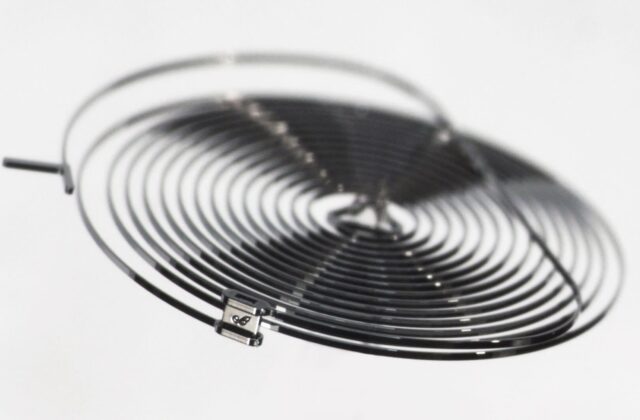
Frequency, expressed in Hz or vibrations per hour, indicates the number of oscillations of the balance. 3 Hz (21,600 vph) or 4 Hz (28,800 vph) have become standards; 5 Hz (36,000 vph) remains the preserve of sporty or historically oriented calibres. Amplitude (often 270° to 310° at full wind) measures the oscillation angle. Too low, it betrays friction or a lack of energy; too high, it can cause rebanking. Isochronism, finally, is the ability of the balance and hairspring to keep the same period regardless of angle and the mainspring’s remaining force. It owes as much to hairspring design (surprise: a Breguet overcoil terminal curve plays a role) as it does to the purity of the escapement’s impulse.
Friction, jewels and lubrication: the delicate art of sliding
In a Swiss lever escapement, the impulse faces of the pallets and the escape-wheel teeth work in sliding friction. Jewels (or synthetic sapphires) reduce wear, and a micro-drop of oil, applied with a fine oiler, ensures smooth, consistent sliding. But oil ages: it thickens, spreads, and alters the rate. That is why so many innovations aim to reduce lubricated surfaces or replace materials with low-friction alternatives.
Daniels, Omega and the lure of zero sliding
In 1974, George Daniels devised the Co-Axial escapement: a geometry that turns part of the sliding into rolling. The result: less lubrication on the pallets, a “purer” impulse delivered to the balance, and improved chronometric stability over time. Commercialised by Omega from 1999, it set a precedent—proving that the lever could be modernised without betraying watchmaking aesthetics.
Optimised geometries and silicon
Rolex rethought the Swiss lever with its Chronergy: a paramagnetic nickel-phosphorus escape wheel, and reworked angles for an efficiency gain measured at around 15%. Patek Philippe, with Pulsomax, pushed silicon logic all the way into the fork and wheel, combining lightness, hardness, and the absence of lubrication. Ulysse Nardin dared direct impulse with the Dual Direct Escapement in silicon as early as 2001, while Girard-Perregaux explored constant force with its Constant Escapement. So many contemporary paths toward the same question: how to give the balance a regular, clean, durable impulse.
A story of inventors and audacity
The history of the escapement is an epic. The verge of pocket watches—crude but foundational; the anchor escapement of clocks (17th century) that tamed the pendulum; then Thomas Mudge, in 1755, inventing the lever escapement, ancestor of the modern Swiss lever. In the 19th century, industrialisation refined angles, standardised jewels, codified “lift angles”. In the 20th, losses were hunted down; “draw” was understood—the force that pulls the fork back against its banking; shock safety was improved. And at the end of the century, Daniels reinvented impulse. The escapement is like that: an ancient art, endlessly renewed.
What you hear when you bring your ear close
The tick-tock is more than sonic charm. It tells the story of the movement’s symmetry. A tick more pronounced than the tock? It may be a beat error: the impulse jewel is not perfectly centred relative to the banking, and the balance does not spend the same amount of time on either side of zero. On a timing machine, you can then read beat symmetry, amplitude, and rate. The health of an escapement depends as much on its geometry as on its cleanliness—dried oil can be guessed from the sound, a poorly absorbed shock from the trace.

On the wrist: the signs of a well-born escapement
- Stability over time: little drift between full wind and the end of the power reserve, a hallmark of isochronism.
- Resilience: better resistance to shocks and magnetic fields (non-ferromagnetic materials, silicon, nickel-phosphorus).
- Reasonable service intervals: fewer lubricated surfaces, less noticeable ageing.
- Living precision: seconds that flow without stutter, a crisp tick-tock, healthy amplitude measured at the bench.
At the scale of a watch, the escapement is a handshake renewed between energy and time. A tiny gesture, repeated millions of times, that gives mechanics their humanity: the imperfect yet faithful cadence of a beating heart.