Difference Between a Quartz Watch and a Mechanical Watch
What’s the difference between a quartz watch and a mechanical watch?
The answer may seem obvious to those in the know, but I’m asked this question frequently—and it’s a reminder that there’s no need to slip into elitism.
One of the aims of this blog is to make the world of watchmaking more accessible, and it has to be said that a large part of the population doesn’t know the difference between a quartz movement and a mechanical movement—and there’s absolutely no reason to be embarrassed about it.
Let’s try to answer as simply and briefly as possible. You’re then welcome to subscribe to Montres-Passion.fr’s free newsletter to learn more about the fascinating world of watches by clicking here.
Quartz watches
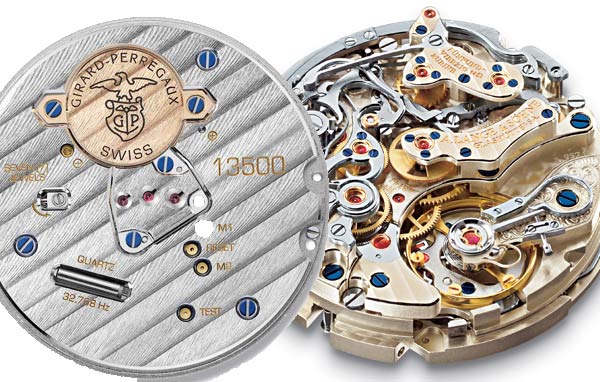
A quartz watch runs on a battery. A thin quartz crystal oscillates at a stable frequency under the electrical impulse from the battery, bringing the watch to life. See my article on how a quartz watch works.
Advantages:
- Accuracy: formidable
- Maintenance: limited to changing the battery about every two years.
- Display: analogue (hands) but also digital (numeric).
- Functions: backlight, altimeter, barometer, compass… The range of available functions is extensive.
- Thickness: thinner movements (definition of a movement in watchmaking)
- Price: more affordable pricing.
Disadvantages:
- Durability: a shorter lifespan due to wear of electronic components.
Mechanical watches
There are two types of mechanical watches: manual-wind and automatic. Unlike quartz watches, they don’t draw their energy from a battery. An automatic watch is therefore, by definition, mechanical.
- Manual-wind mechanical watch: the watch needs to be wound regularly by hand by turning the crown.
- Automatic mechanical watch: the watch winds itself thanks to the movements of its owner’s wrist. A rotor or “oscillating weight” (half-disc) turns on its axis with each movement and winds the timepiece (a rotor in action in the video below). It is still possible to wind it manually.
Advantages
- Case: Mechanical watches often reveal their inner workings through a transparent caseback… a feast for the eyes.
- Display : Watch in the video below how smoothly the seconds hand of a mechanical watch moves compared with a quartz watch. The difference in frequency explains this phenomenon.
- Durability: a well-maintained watch will last longer than a quartz watch.
- … It’s a mechanical watch!
Disadvantages
- Maintenance : servicing every 5 years is necessary, although most mechanical-watch owners wait for a breakdown before taking them to the watchmaker.
- Price: prices are much higher.
- Accuracy : mechanical watches are less accurate.
- Shocks: they are more sensitive to impacts.
If you’d like to have some fun with an automatic mechanical movement—taking it apart or simply looking at it—I recommend buying one; it’s fascinating.
Here is a selection of automatic watches at accessible prices to start your collection.