Why Do Some Watches Feature a Telemeter?
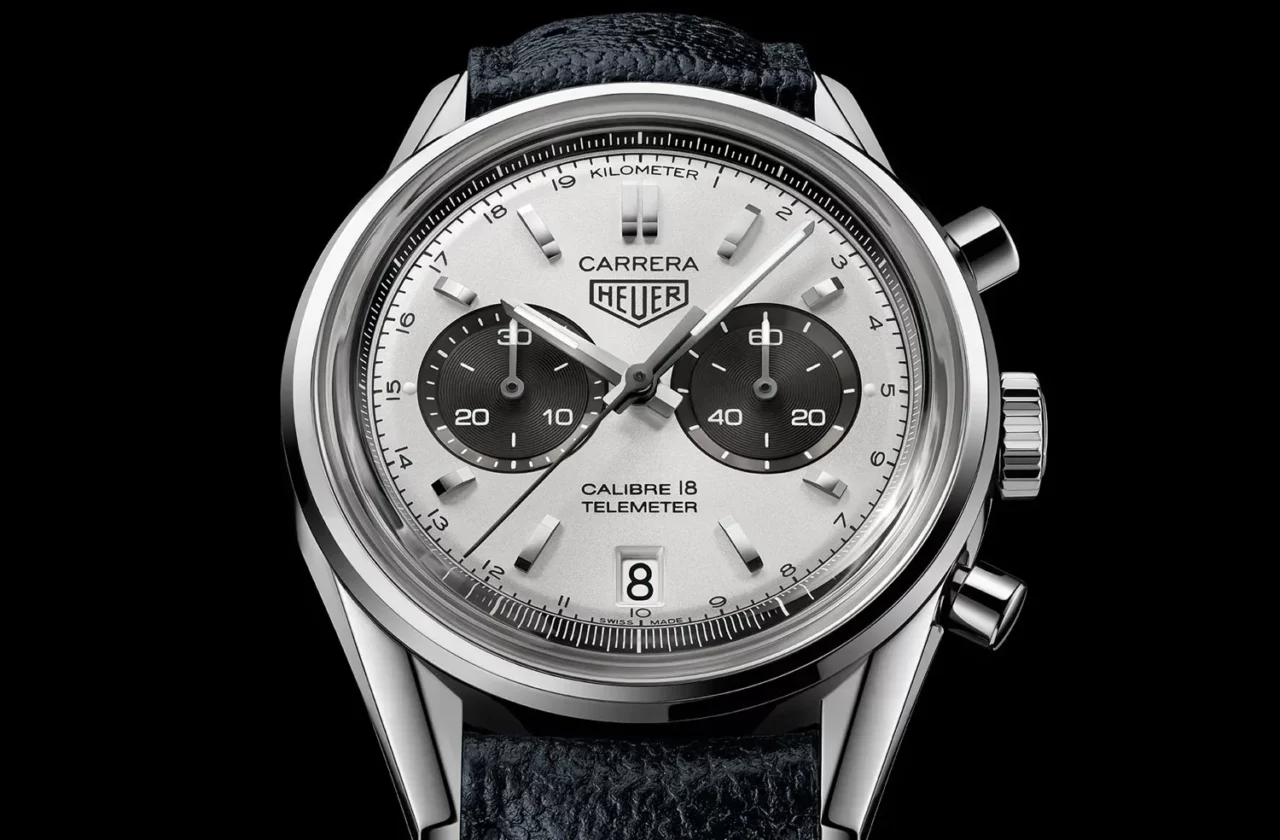

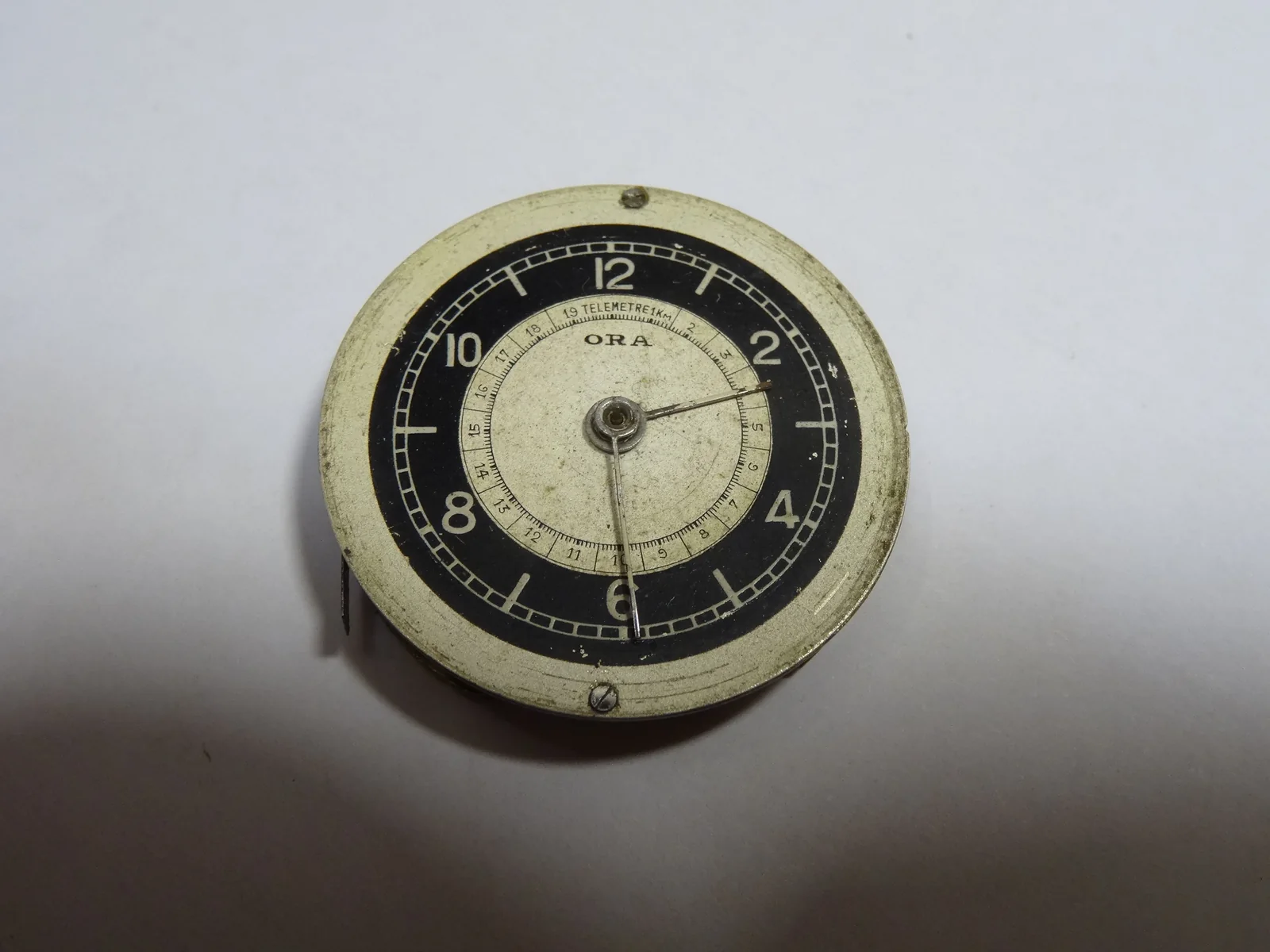
Some scales seem to have been placed on a dial like survivors of a vanished world. We have already looked at doctor’s watches with their pulsometer for calculating heart rate. The telemeter is another of these scales: obsolete, perhaps, but immensely charming on a dial. It can sometimes be found around the periphery of an old chronograph, printed in blue, red or black, its figures speaking of kilometres rather than seconds. It intrigues. It confounds. And, let’s be honest, it is rarely used to determine how far away lightning has struck while wearing a linen shirt at dinner. Yet this scale tells one of the finest stories in instrumental watchmaking.
The telemeter is a functional complication, in the noblest sense of the term. Not an additional mechanical complication like a perpetual calendar or minute repeater, but a function born of the encounter between a chronograph, a physical phenomenon and a very practical need: measuring distance from the gap between light and sound. It is simple, ingenious, almost poetic. And occasionally rather martial.
The telemeter: a distance scale born from the chronograph
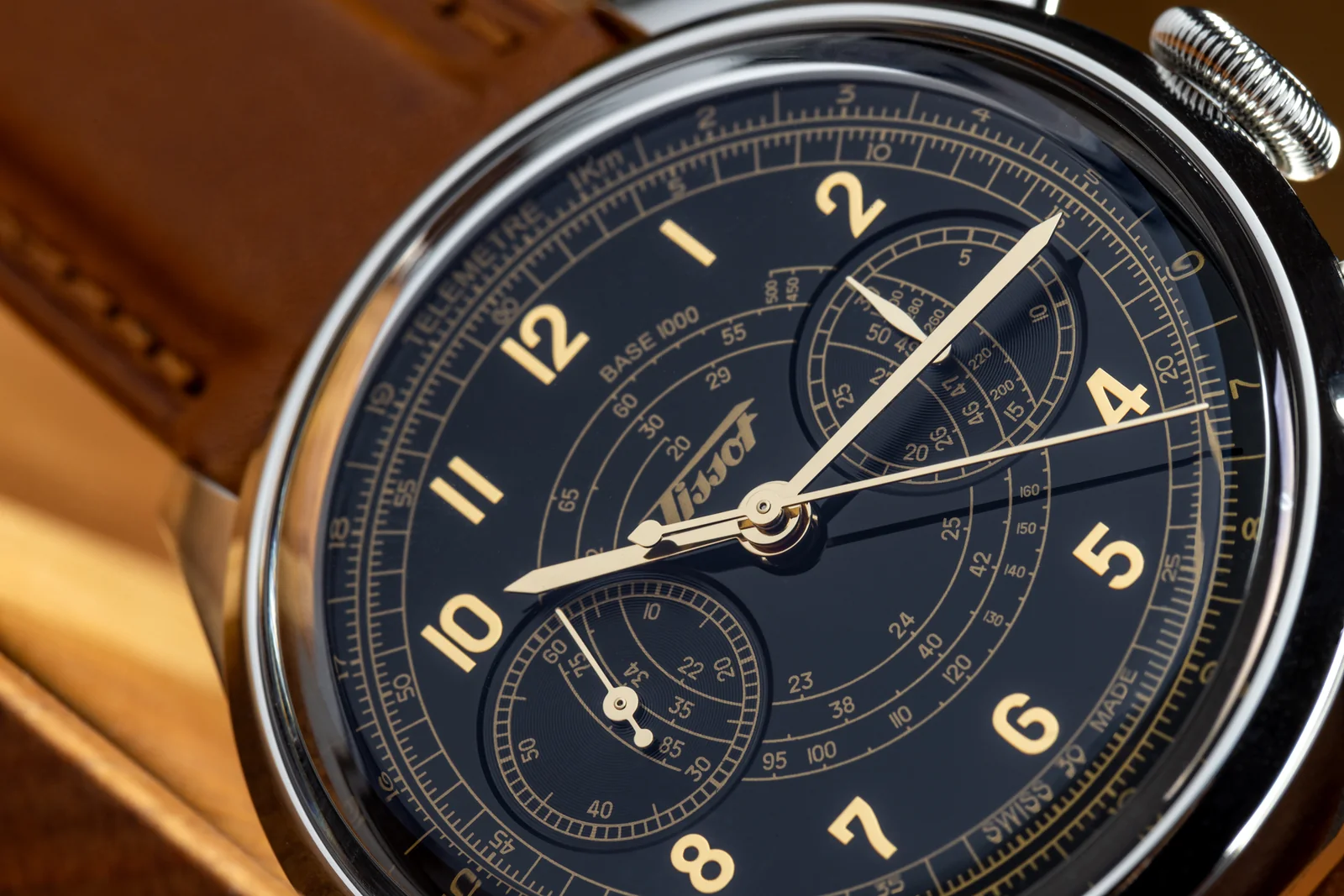
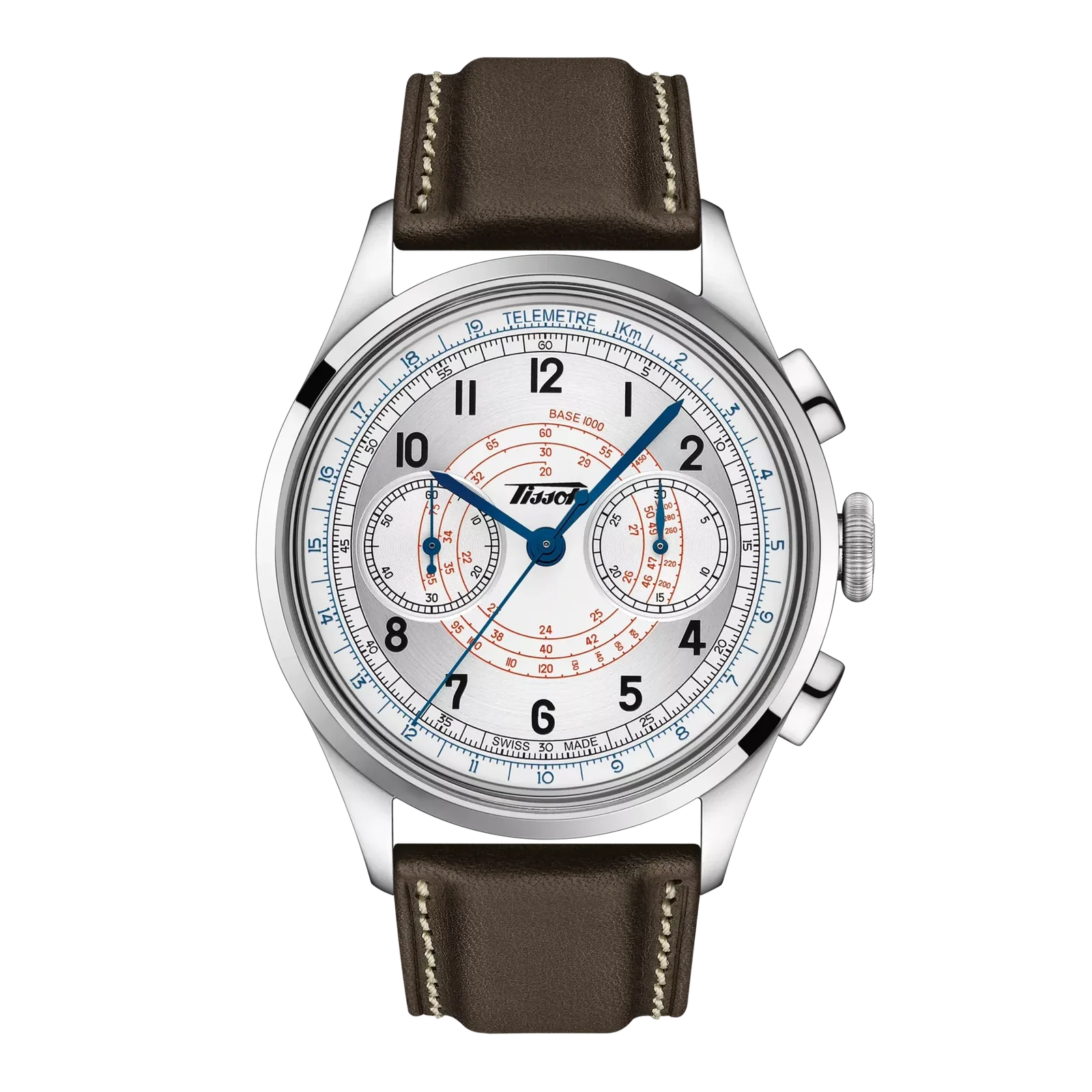
A telemeter watch allows you to estimate the distance separating you from an event that is both visible and audible. The best-known example remains a storm: you see the lightning and start the chronograph; you hear the thunder and stop it. The chronograph’s central hand then indicates the approximate distance to the strike on the telemetric scale.
The principle rests on a basic physical fact: on our scale, light travels virtually instantaneously, while sound moves much more slowly, at around 340 metres per second through air, depending on temperature and atmospheric conditions. Three seconds between the lightning and the thunder? Approximately one kilometre. Nine seconds? Around three kilometres. There you have it. No weather app, premium subscription or American satellite required to find out whether the sky is about to fall in.
The telemeter is therefore not an autonomous mechanism. It is a scale printed on the dial, generally paired with a chronograph. It transforms a measurement of time into an indication of distance. This is exactly the same logic as the tachymeter, which converts time into speed, or the pulsometer, which turns a handful of heartbeats into a heart rate. A whole family of learned scales inherited from an era when the dial was an instrument, not an empty canvas reserved for storytelling.
How do you read a telemeter on a watch?
Using one is disarmingly simple. All you need is a functioning chronograph and a phenomenon that produces an image first and a sound afterwards.
- Observe a luminous event, such as a flash of lightning.
- Start the chronograph at the precise moment you see the light.
- Stop the chronograph when the sound reaches you.
- The central hand then points to a distance on the telemetric scale, usually expressed in kilometres.
Some vintage watches also feature scales in miles. On European models, the kilometre scale naturally predominates. The layout depends on the speed of sound adopted by the manufacturer, often around 333 or 340 metres per second. The graduations are therefore not perfectly universal, but the principle remains the same.
There is also a fundamental limitation to understand: a telemeter does not measure an absolute distance in the way a laser rangefinder does. It estimates distance from the delay between two signals, one light and the other sound. If the source of the sound is unclear, if an echo disrupts perception, or if you start the chronograph two seconds late because you were busy admiring your leaf-shaped hands, the measurement becomes rather fanciful.
What was a telemetric scale actually used for?
Contrary to what is sometimes repeated a little too hastily, the telemeter was not used solely to measure storms. It found its place above all in military, scientific and medical contexts. Artillerymen could estimate the distance to an enemy gun by starting the chronograph at the flash or visible explosion and stopping it at the sound. Observers could locate an explosion. Civilians, meanwhile, could gauge how far away a storm was—which was no small matter when working outdoors, at sea or in the mountains.
This military dimension explains the presence of the telemeter on many chronographs from the 1930s to the 1950s. At the time, the wristwatch chronograph was gradually moving beyond the realm of sporty jewellery to become a professional instrument. The dial grew richer: tachymeter for speed, telemeter for distance, pulsometer for doctors, sometimes all three together in a generous typographic salad. Lovers of uncluttered dials might faint. Collectors, on the other hand, reach for the loupe.
The telemeter is therefore a relic of the chronograph’s heroic age, when a watch was expected to serve a precise purpose. Before “lifestyle” became a function.
Telemeter, tachymeter, pulsometer: don’t confuse the scales
The three scales are often associated with chronographs, but they measure different things.
The tachymeter
The tachymeter indicates average speed over a known distance, usually one kilometre or one mile. You start the chronograph at the beginning, stop it at the end, and the hand indicates a speed. It is the emblematic scale of automotive chronographs, from the Omega Speedmaster to the Rolex Daytona.
The pulsometer
The pulsometer is used to measure heart rate. On a dial marked, for example, “graduated for 30 pulsations”, the doctor starts the chronograph at the first beat, counts 30 beats, stops it, then reads the number of beats per minute. This is why many vintage medical chronographs feature an especially clear pulsations scale.
The telemeter
The telemeter, meanwhile, measures distance based on the time taken for sound to reach you. It belongs to the same visual grammar, but its use is different. You could say it is the most romantic of the three, because it presupposes a scene: a flash of lightning, a cannon, an explosion, a dark sky. The tachymeter smells of petrol. The pulsometer smells of hospital. The telemeter smells of ozone.
Why the telemeter disappeared from modern watches
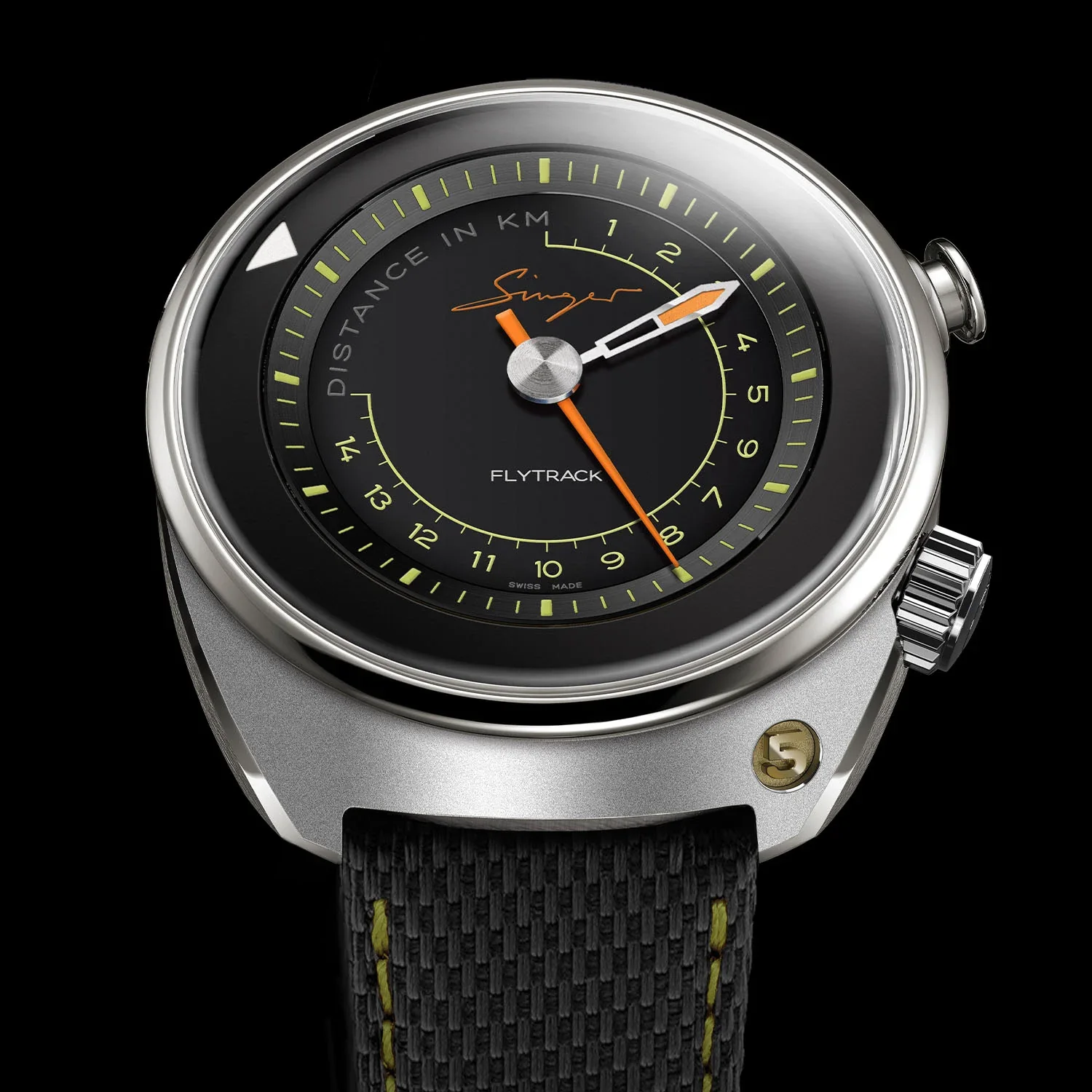
The answer is partly sitting in your pocket. A smartphone can give you the weather, your position, the distance of a storm, wind speed and probably your neighbour’s anxiety level if you ask politely. Specialised analogue instruments have lost their practical urgency.
But there is another reason: legibility. A dial with a telemeter needs space. It adds an extra ring of figures around the indices. On an already busy bicompax or tricompax chronograph, the result can quickly resemble a military map. Contemporary brands, obsessed with design “purity”, have often preferred the tachymeter, more immediately associated with sport, speed and automotive imagery.
The telemeter has therefore become rare. And that is precisely what makes it desirable. In an industry where everyone wants to tell a story, it carries a real one—printed on the dial, without a press release as thick as a telephone directory.
A few famous watches with telemeters
The telemeter appears primarily on vintage-inspired chronographs, historical reissues and collectible pieces. Here are a few well-known examples, with references where these are clearly identified.
Omega Speedmaster Chronoscope
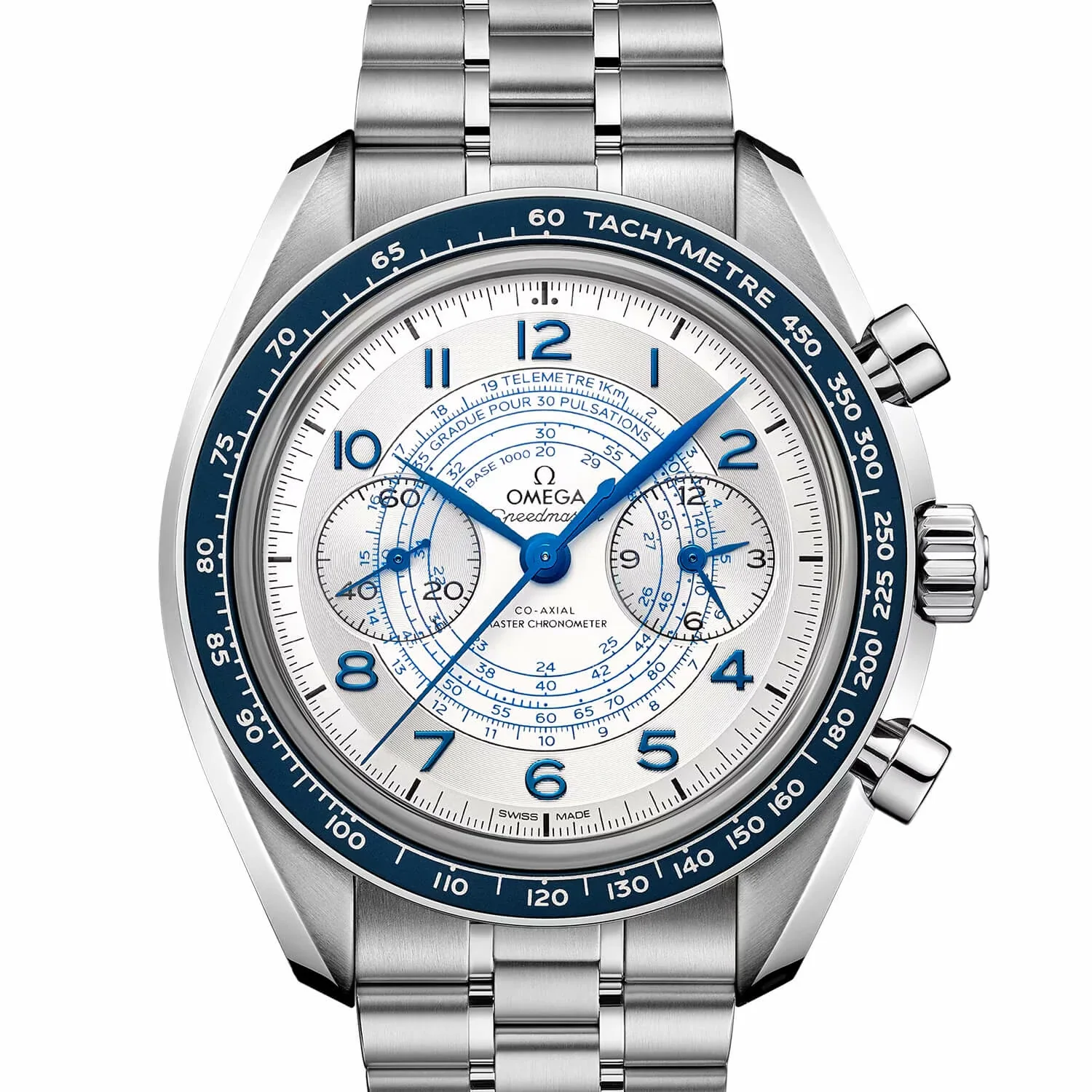
Introduced in 2021, the Omega Speedmaster Chronoscope is one of the most prominent contemporary examples. It combines three concentric scales—tachymeter, pulsometer and telemeter—in a style heavily inspired by Omega chronographs from the 1940s. Its presence in the Speedmaster collection is intriguing: rather than revisiting the space race alone, Omega here evokes the golden age of measuring chronographs.
- Reference: notably 329.30.43.51.02.001, depending on the version
- Case: 43 mm in steel
- Movement: hand-wound Omega Co-Axial Master Chronometer calibre 9908
- Power reserve: approximately 60 hours
- Certification: METAS Master Chronometer
- Water resistance: 50 m
- Price: generally around €9,500, depending on configuration and market
The dial is dense, almost scholarly. Some will see an excess of information. Others will read it like a score. Both camps will be right, but only one will know how to measure a storm.
Montblanc 1858 Monopusher Chronograph
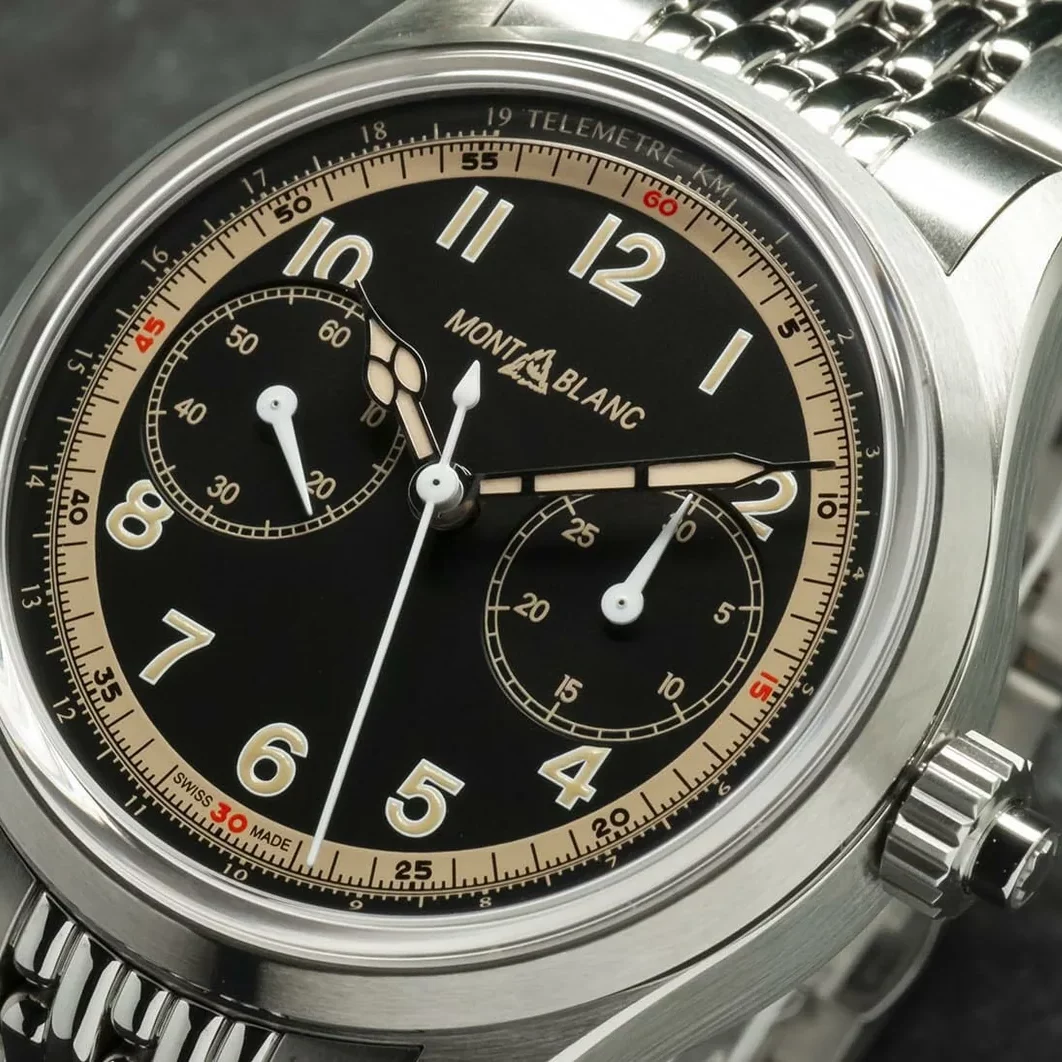
The Montblanc 1858 line, the aesthetic heir to Minerva, has often brought traditional chronographs back into the spotlight. Several models play with peripheral scales, including the telemeter on certain editions. It makes perfect sense: Minerva was one of the great names in precision chronographs during the 20th century, with column-wheel chronograph movements that can still raise an approving eyebrow among even the most jaded enthusiasts.
The monopusher adds a particular flavour. One button to start, stop and reset the chronograph. It is less practical for successive measurements than a conventional two-pusher system, but infinitely more elegant in operation. Yes, watchmaking is sometimes a matter of gestures that are unnecessary yet essential.
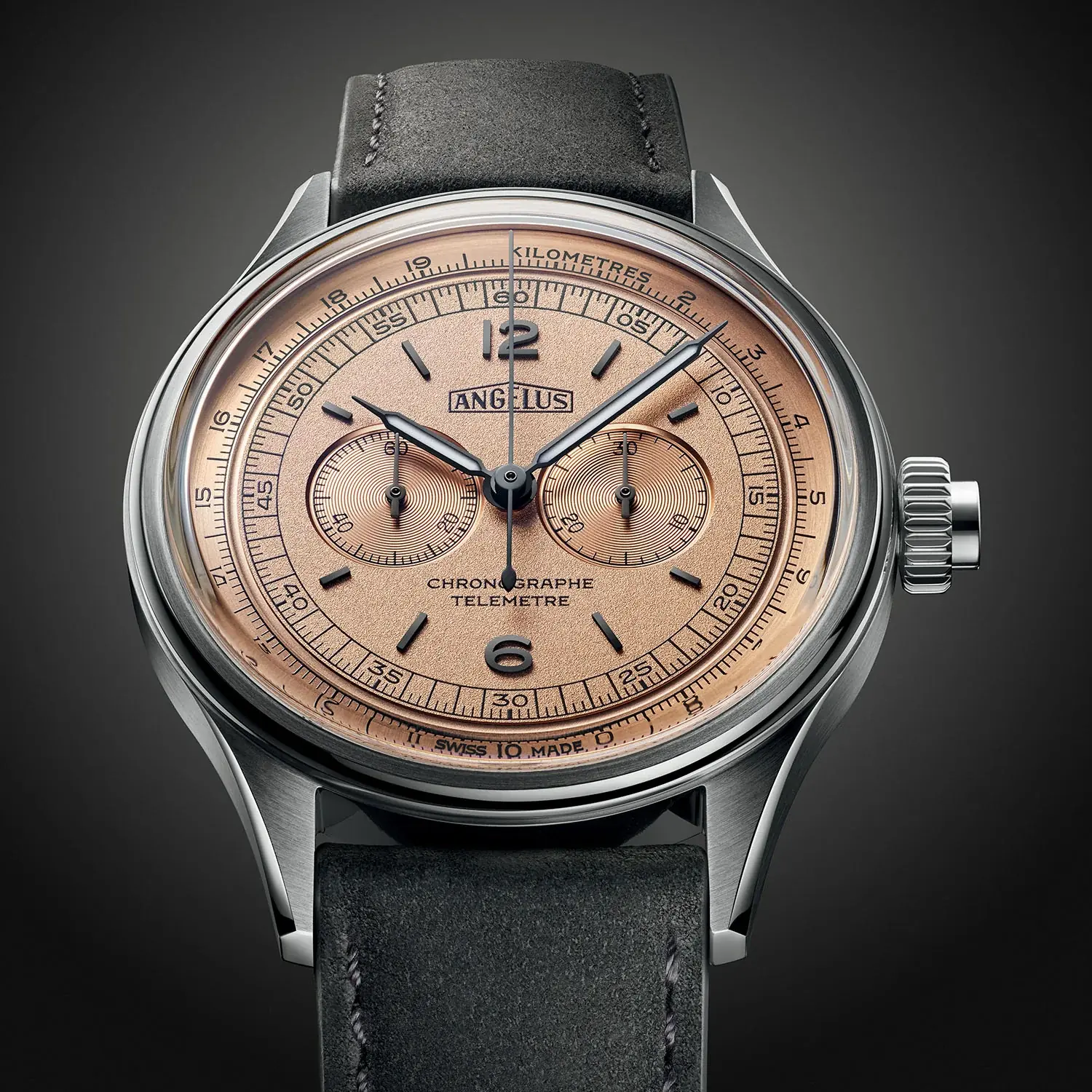
Vintage chronographs from Universal Genève, Minerva, Angelus and Doxa
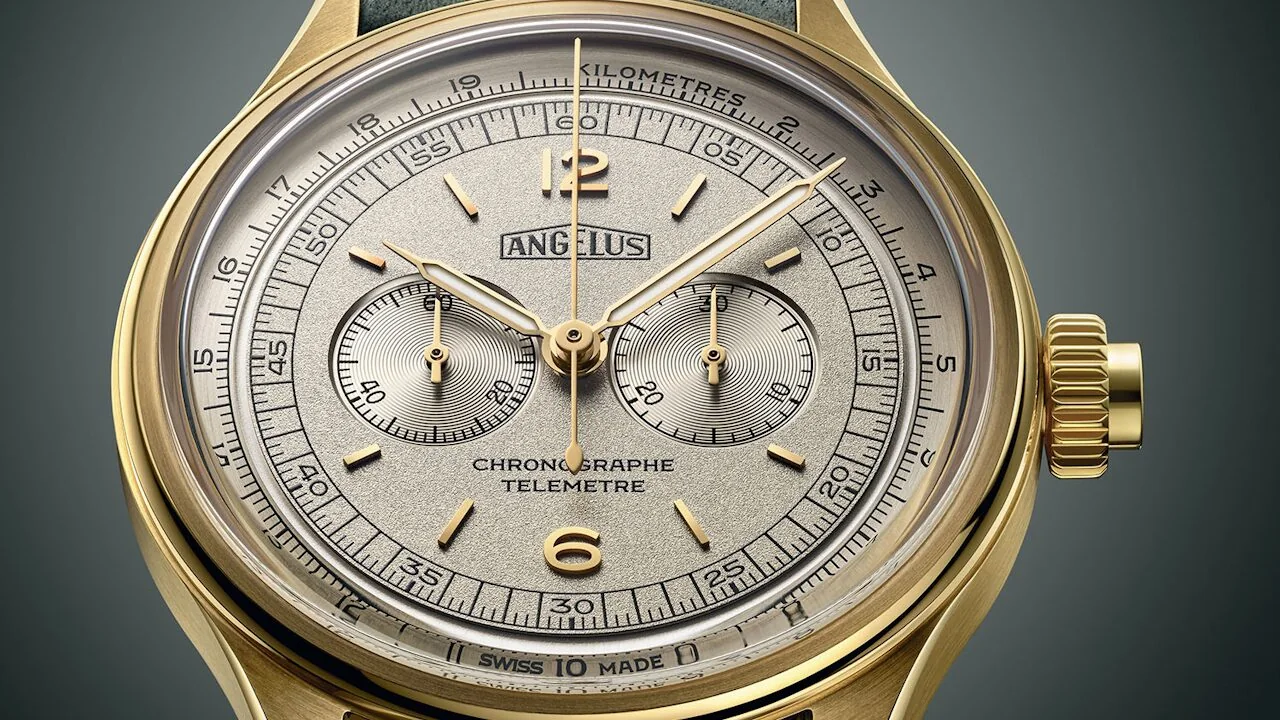
On the vintage market, the telemeter is fascinating territory. Universal Genève, Minerva, Angelus, Doxa, Eberhard, Excelsior Park and certain anonymous makers using Valjoux, Landeron or Venus calibres all produced chronographs with telemetric scales. The dials can be superb, often two-tone, sometimes featuring red and blue printing, fine typography, recessed counters and the visual depth that reissues attempt to capture, not always successfully.
There is a note of caution, however: this is also an area awash with repainted dials, fanciful scales and opportunistic assemblies. A vintage telemeter should be examined seriously: the consistency of the typography, the ageing of the luminous material, the alignment of the printing, and the correspondence between case, movement and dial. Poetry, yes. Naivety, no.
Why we love telemetric dials
The telemeter appeals because it gives a dial an intellectual tension. A watch displaying one does more than tell the time and time a soft-boiled egg. It reminds us that time can become distance, that a few seconds can describe the space between you and a phenomenon. It is a magnificent idea.
Visually, the telemetric scale also creates a particular balance. Placed around the periphery, it frames the dial and heightens its instrumental character. On a bicompax with syringe or leaf-shaped hands, Arabic numerals and a railway minute track, it can transform a fairly simple watch into a narrative object. It catches the eye without necessarily dominating, provided the design is well judged.
Then there is the cultural pleasure. Wearing a telemeter chronograph means wearing a fragment of applied science. An era when simplified equations were printed on 36 mm dials. A very particular kind of elegance, almost scholastic—but in the best sense of the word. The sort of detail that makes those who understand it smile.
A useless detail? Perhaps…
The great irony of the telemeter is that it is almost useless in everyday life today, while remaining profoundly legitimate. Many contemporary watch complications share this fate. A moon phase will not help you get home any faster. An equation of time will not save you from a delayed train. A tourbillon will not make your coffee taste better, even at €180,000. Yet these functions have meaning because they condense a technical culture.
The telemeter belongs to this category. It makes no claim to rival modern electronics. It simply reminds us that the wristwatch was long an interface between humanity and the world. A small mechanical—or rather analogue—calculator worn on the wrist. At a time when connected devices age like yoghurt left out of the refrigerator, that simplicity has something sovereign about it.
Should you buy a watch with a telemeter?
If you are looking for an indispensable everyday function, probably not. If you like historical chronographs, learned dials and watches that have more to say than “look at my ceramic bezel”, then yes, the telemeter deserves your attention.
You simply need to choose with discernment. On a modern watch, check the legibility, the coherence of the design and the quality of the chronograph movement. On a vintage model, prioritise the condition and authenticity of the dial above all else. A beautiful telemetric scale repainted yesterday does not have the same appeal as an original print gently patinated by seventy years of life.
The telemeter is not a spectacular complication. It does not open a window, chime or set a cage spinning. It simply turns sound into distance with the help of a chronograph hand. It is little. It is a lot. And it is exactly the kind of detail that reminds us why watchmaking, when it stops showing off, can still teach us to look at the world differently.