Seiko Star Time: the watch that displays one million hours
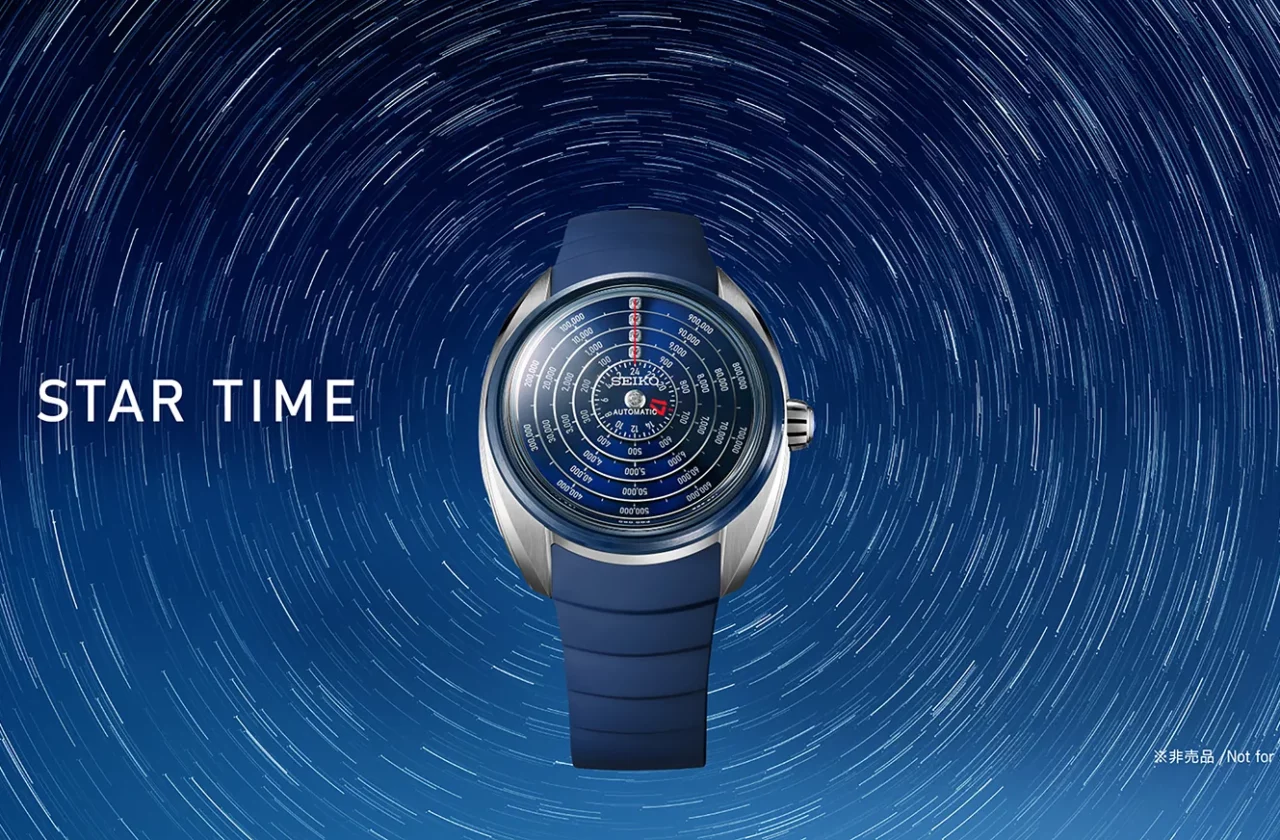

The Seiko Star Time was created for Shohei Ohtani, the Japanese baseball star and an ambassador for the manufacture for the past ten years. That is the context. But this partnership, however prestigious, is not what makes the watch fascinating; in fact, it is almost incidental.
Its appeal lies in a far more conceptual idea: mechanically displaying up to one million hours, or just over 114 years, using five superimposed discs.
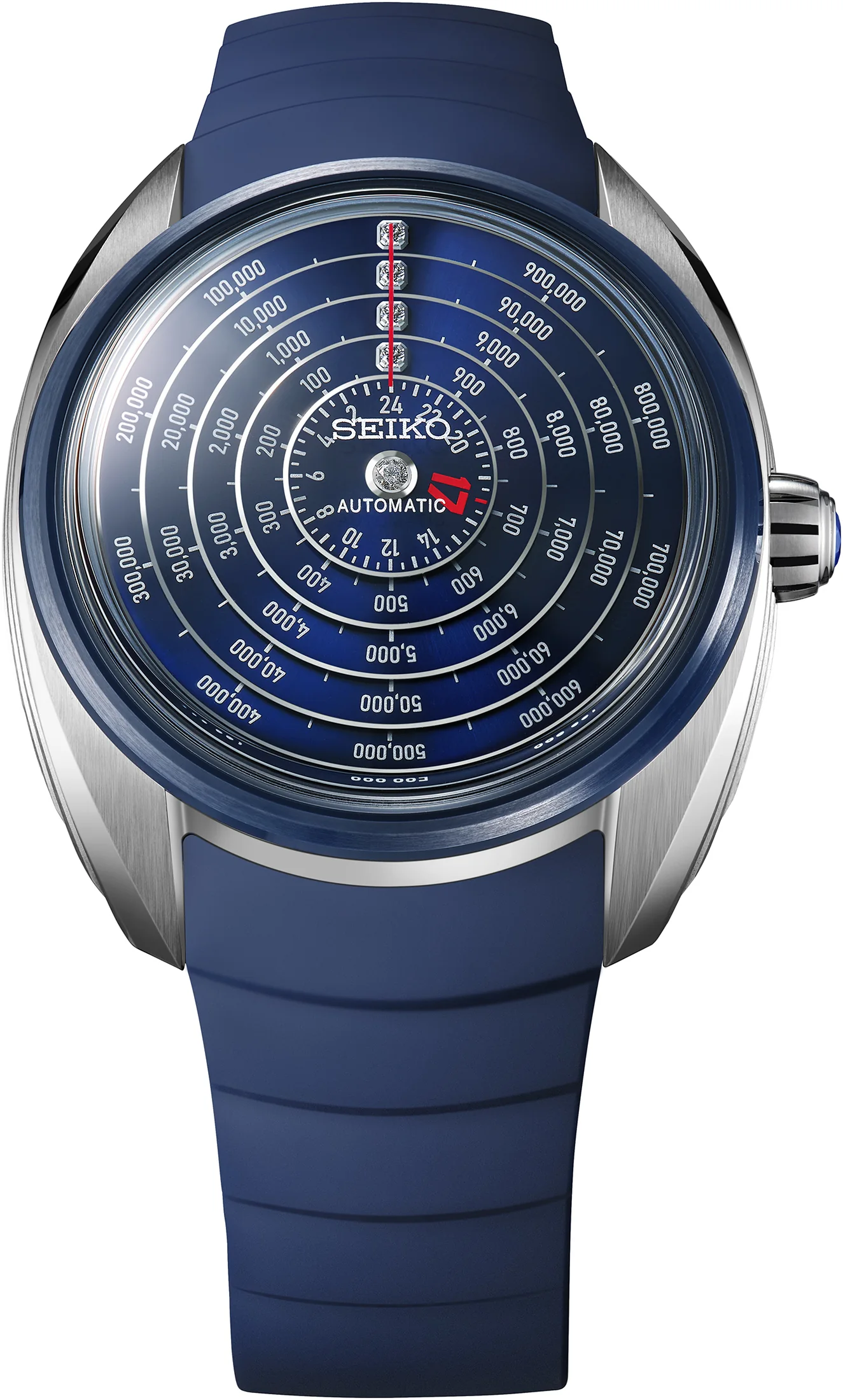
The concept is worth examining. The Star Time has neither the restraint of a traditional three-hand watch nor the immediate clarity of a conventional display. Its concentric dial is dense, almost scientific, with numerous graduations, five aligned diamonds and several levels of interpretation.
That said, the difficulty of the exercise has to be acknowledged. Fitting a day, several years and practically an entire human lifetime onto a single dial, without ending up with something completely illegible, was a serious challenge. On that point, the organisation devised by Seiko has a genuine logic to it.
Seiko Star Time: a unique piece created for Shohei Ohtani
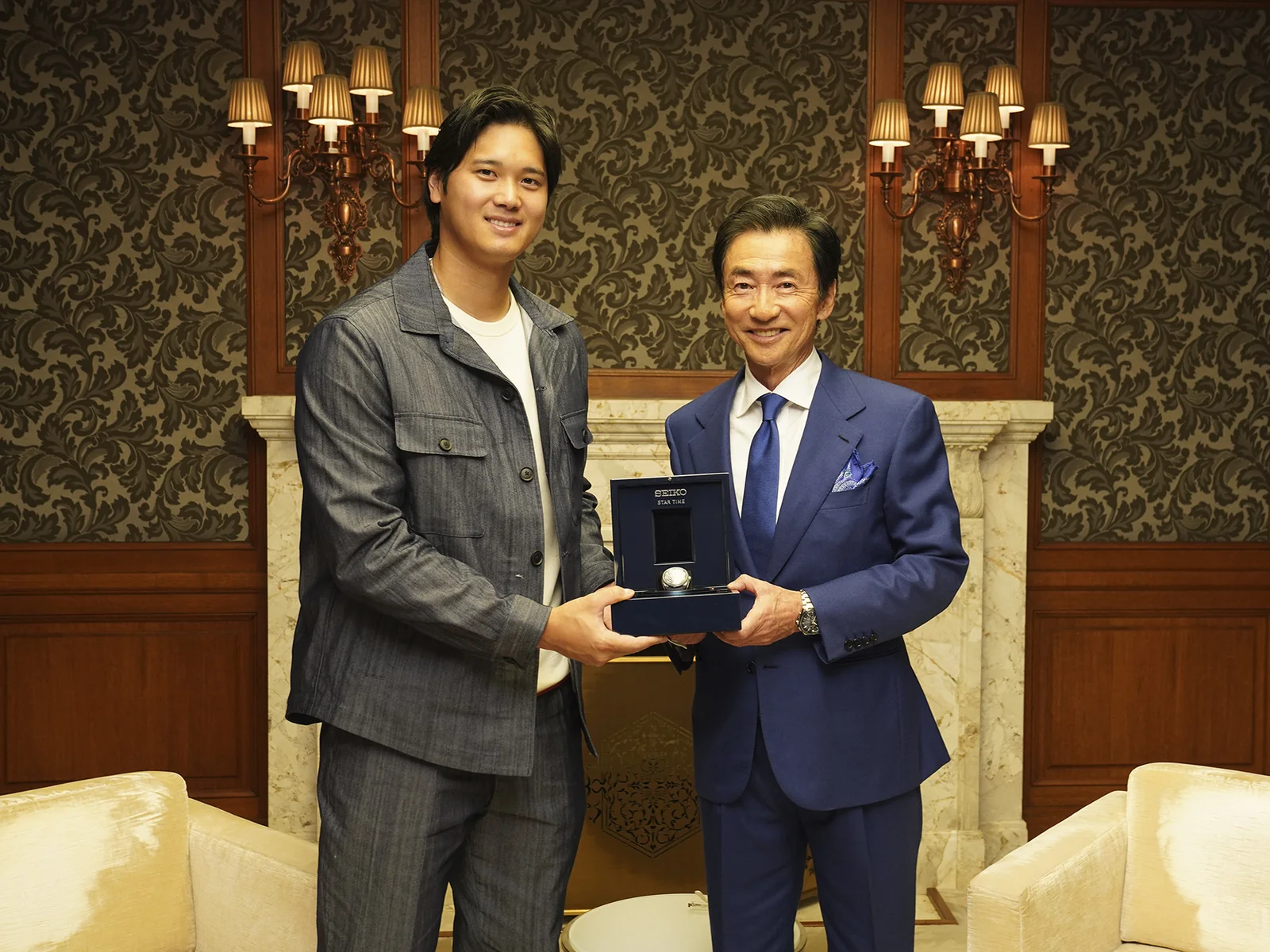
Shohei Ohtani has been a Seiko ambassador in Japan for ten years. To celebrate this collaboration, the manufacture presented him with a unique mechanical watch whose development is said to have begun around three years earlier.
The starting point for the project was a fairly simple question from the player: how much longer will he be able to play baseball?
Seiko could have settled for a special edition with a few sporting references on the dial, a signature on the caseback and a carefully lit campaign. Instead, the manufacture chose to broaden the question considerably. Rather than counting the remaining years of a career, it imagined a watch capable of representing more than a century.
The Star Time was personally presented to Shohei Ohtani by Shinji Hattori, President of Seiko Watch Corporation. It will remain a unique piece and is not intended for commercial sale.
The partnership therefore provides the narrative starting point. Yet the heart of the project lies elsewhere, in the mechanical architecture designed to measure accumulated time on an almost outsized scale.
Why display one million hours on a watch?
A traditional watch divides time. It separates hours, minutes and seconds in order to make the present moment immediately legible.
The Seiko Star Time takes a different approach. It adds the notion of accumulated time to the current hour. The dial no longer represents only the present moment, but a progression capable of continuing for more than 114 years.
One million hours corresponds precisely to approximately:
- 41,667 days;
- 5,952 weeks;
- just over 114 years.
This duration far exceeds that of a sporting career. It approaches that of a particularly long human life and even goes beyond the period during which the watch could realistically remain attached to a single owner.
The concept thus brings several temporalities into relation. At the centre is everyday time, the time we consult to organise a day. Around it unfold increasingly vast scales, until they reach a duration no one can take in at a single glance.
That is where the true power of the Star Time lies: in offering another way of representing time.
How does the Seiko Star Time work?
Five superimposed discs for five time scales
The dial of the Seiko Star Time is based on five superimposed rotating discs. Each corresponds to a different scale:
- 24 hours;
- 1,000 hours;
- 10,000 hours;
- 100,000 hours;
- 1,000,000 hours.
The central disc also indicates the current time on a 24-hour display. The other discs progressively record accumulated time at much slower rates.
The organisation is concentric. The farther the eye moves from the centre, the greater the duration represented becomes. The time of a day occupies the heart of the dial, while long time extends towards its periphery.
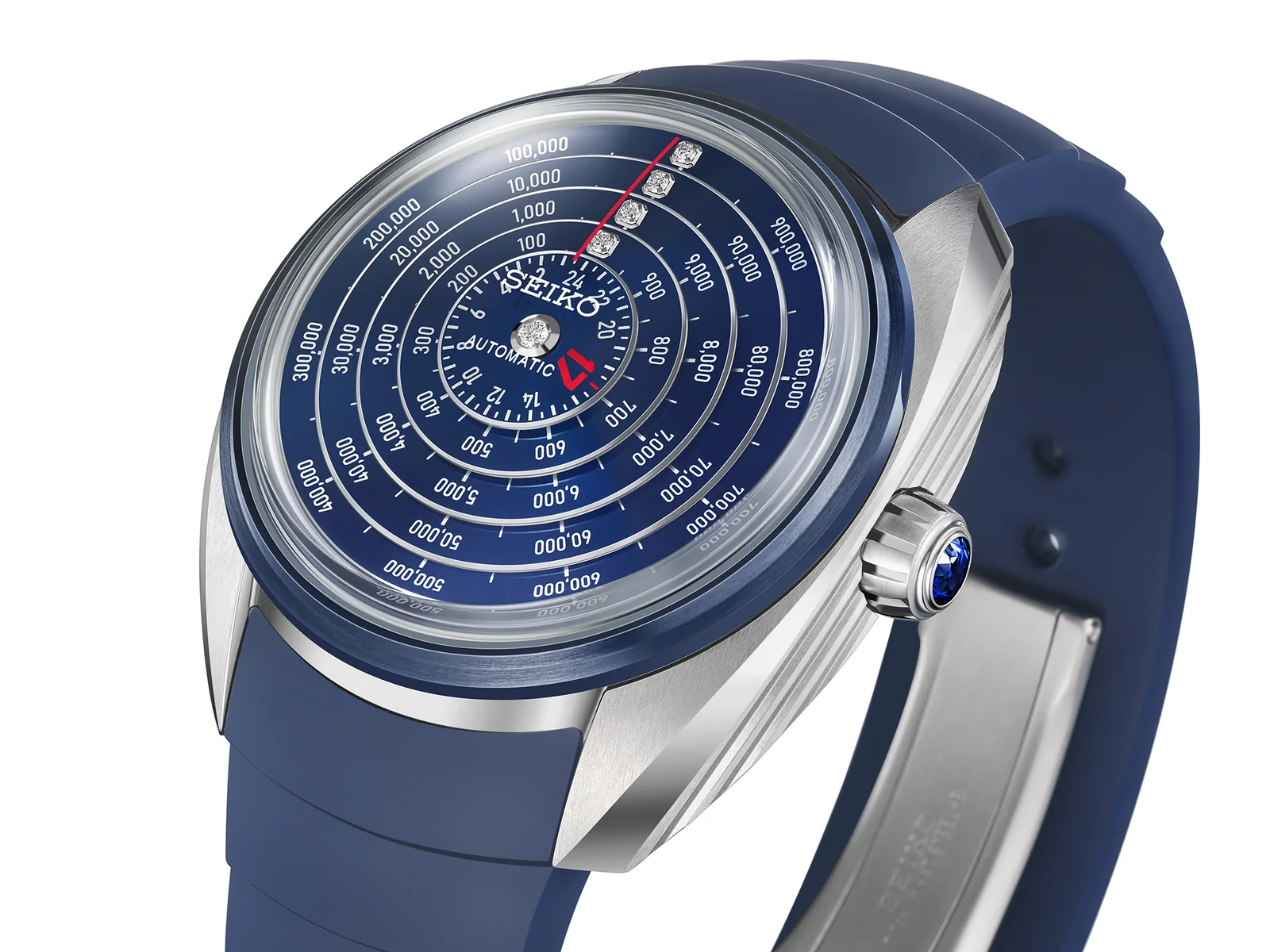
This construction makes it possible to organise several orders of magnitude without multiplying independent counters. It also offers a fairly intuitive visual translation of the concept: the present moment remains at the centre, then the years accumulate in successive circles around it.
Movements that are almost imperceptible
The discs associated with the longest durations naturally move with extreme slowness. Their progression cannot be observed with the naked eye over a few minutes, or even a few hours.
That is precisely the point. Time accumulates without its movement being directly perceptible. The passing of a day seems obvious. The passing of several decades only reveals itself in hindsight.
This slowness distinguishes the Star Time from a conventional complication, whose movement can often be observed immediately. Here, the essential action takes place on a scale that exceeds the ordinary patience of the human gaze.
A reading Seiko does not fully explain
The general organisation is understandable: the five levels correspond to the different scales, and the diamonds make it possible to materialise the position of each disc.
However, Seiko does not provide a complete manual explaining the exact reading of each graduation. It would therefore be unwise to invent a precise method or officially attribute an index function to each graphic element.
The photograph notably shows a vertical red axis that visually aligns the five diamonds. This element clearly structures the dial, but its exact technical function is not explained.
The fundamental idea nevertheless remains legible: each disc continues its rotation according to its own ratio, from the 24-hour day to the million-hour scale.
Five diamonds to materialise the movement of the discs
Each rotating disc carries a diamond. These stones are therefore not merely added to enrich the piece or underline its status as a unique object. They make it possible to visualise the position of the five discs and follow their progression over time.
Aligned on the dial when the watch was presented, the diamonds form an immediately identifiable axis amid the many graduations.
Seiko associates their movement with that of the stars in the night sky. To the eye, a star appears motionless. In a long photographic exposure, however, its trajectory eventually appears. The discs of the Star Time follow a comparable logic: their displacement is constant, but sometimes too slow to be observed directly.
It is from this analogy that the name Star Time comes.
The celestial reference could have remained a simple poetic flourish. Here, it is coherent with the watch’s actual operation. The diamonds move like points of light along concentric trajectories, even if the slowest will take years before fully revealing their progress.
A complex dial, but one organised with method
The design of the Seiko Star Time will probably not win universal approval. The dial is busy, the graduations are numerous and the superimposition of circles creates an almost instrumental appearance.
This density, however, results directly from the concept. The watch has to make five very different time scales, a 24-hour indication and several mobile reference points coexist. A more pared-back presentation would no doubt have been appealing on paper, but far less effective in explaining how it works.
Seiko chose a concentric architecture. It was very likely the most rational solution.
The deep blue dial serves as a common backdrop for the different levels. White inscriptions provide clear contrast, while red is used sparingly to create visual reference points. The diamonds introduce a luminous break at the centre of this highly geometric composition.
The reading is not instantaneous, but the organisation gradually becomes understandable. The centre corresponds to short time. Each additional circle enlarges the scale. This approach retains a certain coherence despite the quantity of information.
The Star Time is therefore more compelling for its concept than for any pursuit of classical beauty. That does not mean its design is neglected. On the contrary, a significant part of the work consisted precisely in giving a legible form to an idea that could easily have produced an incomprehensible dial.
The mechanical challenge posed by the five discs
The five discs of the Star Time are considerably thicker than hands or a traditional dial. Their superimposition therefore required an entirely specific architecture.
It was not enough simply to add a few wheels to an existing calibre. Seiko’s teams had to integrate the design of the movement, the discs and the case simultaneously.
The project required:
- a new movement structure;
- a specific architecture for stacking the discs;
- new assembly methods;
- close coordination between the design and production teams;
- precise control of the different rotation ratios;
- as great a reduction as possible in the overall height.
Each disc must rotate independently according to its own time scale. The one representing 24 hours completes a rotation that is perceptible over the course of a day. The million-hour disc evolves at an incomparably slower pace.
This considerable difference between speeds is one of the most interesting aspects of the construction. The movement has to transmit energy regularly to five displays whose ratios extend from a few hours to more than a century.
Seiko presents this creation as the first wristwatch capable of displaying up to one million hours using five indicator discs, according to research conducted by the manufacture.
An automatic watch, but a movement that remains mysterious
The Star Time is an automatic mechanical watch, as indicated by the inscription visible at the centre of the dial.
Seiko, however, remains very discreet about the movement itself. The brand provides no information regarding:
- the calibre number;
- its frequency;
- its number of jewels;
- its power reserve;
- its accuracy;
- its dimensions;
- its possible origin in an already existing calibre.
This lack of data is rather unusual for a project whose interest rests largely on the mechanics. It may be explained by the experimental and strictly unique nature of the watch, but one should avoid filling these gaps with assumptions.
What is known, however, is that the movement structure was deeply modified to accommodate the five discs, and that new assembly methods had to be developed.
The true complication of the Star Time therefore lies less in a calibre presented as a new commercial reference than in its display module and the integration of its five scales.
A thickness of 17.4 mm explained by the concept
The Seiko Star Time measures 41.8 mm in diameter and 17.4 mm thick.
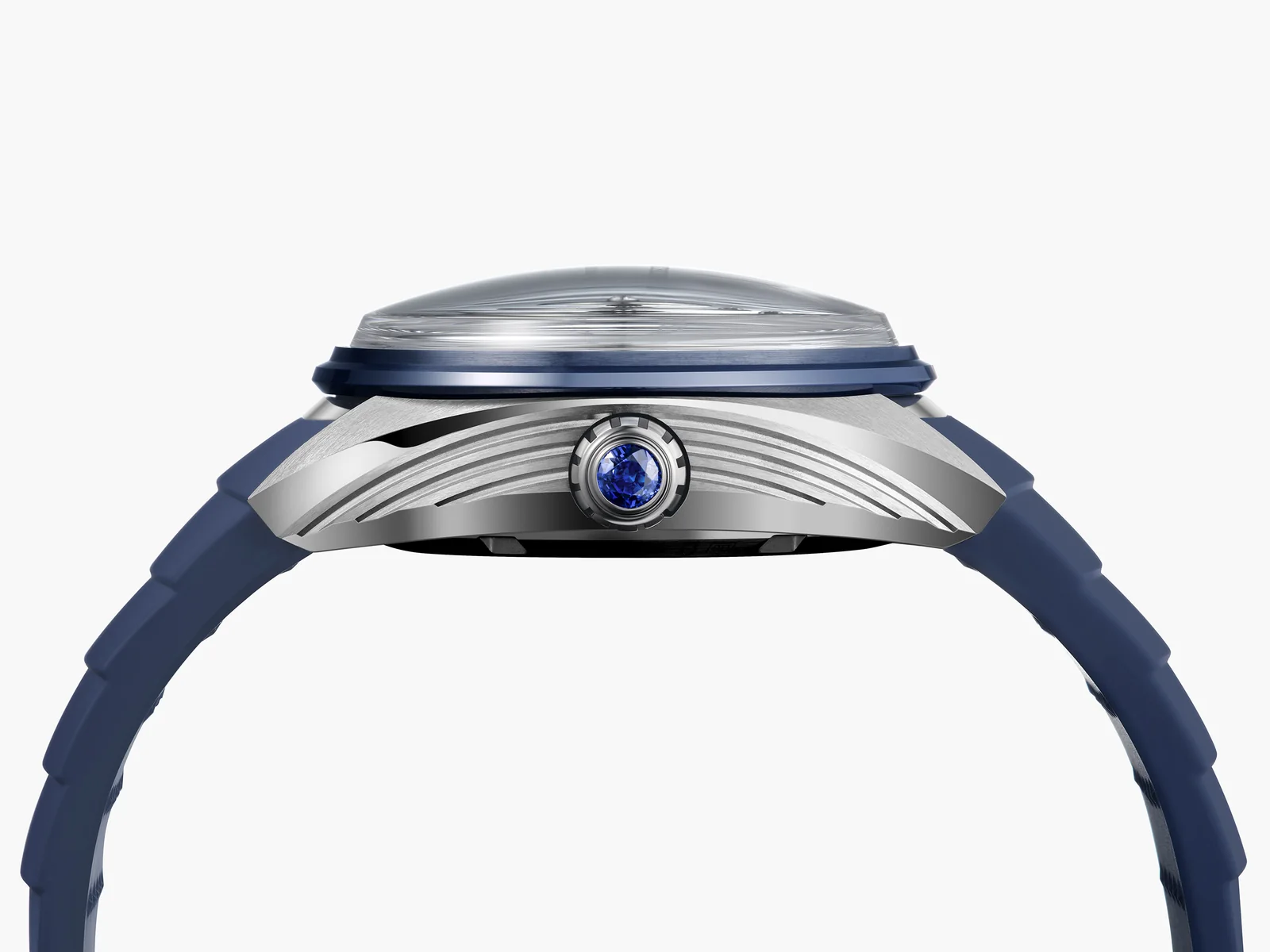
It is obviously not a thin watch. Its thickness is considerable for a diameter under 42 mm. But it cannot be analysed without taking into account the stack of five discs and the domed sapphire crystal.
Seiko explains that it developed a specific architecture in order to limit the overall height as much as possible. The result remains substantial, but the mechanical constraint is very real.
The case adopts angular lines, with broad lateral surfaces in titanium and a blue bezel matching the dial. The box-type sapphire crystal accentuates the visual depth and leaves the necessary space for the different display levels.
The choice of high-intensity titanium is particularly relevant here. On a thick watch, reducing weight becomes essential to preserve comfort. Titanium also offers good corrosion resistance and a contemporary appearance consistent with the experimental nature of the project.
A custom-designed silicone strap
The Star Time is fitted with a blue silicone strap, the length of which was specially adapted to Shohei Ohtani’s wrist.
The choice of silicone is logical. It offers flexibility, limits the overall weight and suits a watch measuring 17.4 mm thick. A complex metal bracelet would probably have made the whole piece heavier without bringing any obvious benefit to the project.
The buckle is also made of high-intensity titanium.
This custom strap is a reminder that the Star Time was not designed for commercial production. Seiko could adapt every element to its sole recipient without worrying about offering several lengths or universal ergonomics.
10-bar water resistance despite the complexity of the case
The watch offers water resistance to 10 bar, or approximately 100 metres.
This feature may seem secondary compared with the million-hour concept, but it deserves to be noted. The Star Time is not merely a technical mock-up or a piece intended to remain in a presentation box. Its case retains sufficient water resistance for daily use.
The box-shaped sapphire crystal has an anti-reflective coating on its inner surface. This precaution is particularly useful on such a complex dial, where reflections could quickly interfere with the reading of the different scales.
Shohei Ohtani: the starting point rather than the true subject
Shohei Ohtani’s exact role in the design is difficult to measure. Seiko mentions several exchanges with its teams and notably attributes the idea of placing a diamond on each of the discs to these discussions.
As is often the case with this type of partnership, it would no doubt be excessive to present the ambassador as the designer of the watch. The engineering, the movement architecture and the development of the assembly methods obviously remain the work of Seiko’s teams.
Nevertheless, the question formulated by Ohtani provided an interesting starting point: not merely to measure elapsed time, but to give a representation to the time still available.
This personal question then became a much more universal project. How many hours have we already lived? How many remain? At what scale does a duration cease to be truly imaginable?
The Star Time becomes interesting when its purpose moves beyond the career of a baseball player.
A unique piece that will not be commercialised
The Seiko Star Time exists as a single example. It was given to Shohei Ohtani and is not available for sale.
No price has therefore been announced.
Nor is there anything to suggest that Seiko plans to use this mechanism in a future collection. The brand could naturally exploit some of the solutions developed for this piece in other projects, but no official information currently points in that direction.
That is almost a pity, because the principle of accumulated time across several scales could give rise to a fascinating series-produced watch, perhaps in a simplified or more compact construction.
For now, the Star Time remains a one-off exercise.
My view on the Seiko Star Time
This watch organises the time of a day, the time of several years and the time of an entire life on a single dial. Five discs, five scales, five diamonds and movements, some of which are too slow to be observed directly.
The design remains dense. The 17.4 mm thickness is considerable. The reading requires a period of adjustment, and Seiko would have done well to explain the operation more precisely, graduation by graduation. The Star Time is therefore not a success founded on simplicity. But its concept is remarkable.
Seiko has taken an abstract notion, accumulated time, and given it a mechanical translation. The dial no longer measures only the passing instant. It places that instant within a duration extending up to 114 years.
That is what has always moved me in watchmaking: starting from a concept and putting mechanical engineering and design at its service. I remember the first watch that truly made me love horology: the Arceau Le Temps Suspendu. A perfectly useless complication, but a powerful philosophical concept: with a simple press of a button, the hands gather at 12 o’clock, time is suspended, it no longer has any hold over the moment. Another press returns the hands to the correct time and sets them back in motion. Is that not a delightful complication?
Technical specifications of the Seiko Star Time
| Specification | Seiko Star Time |
|---|---|
| Type | Automatic mechanical watch |
| Production | Unique piece |
| Recipient | Shohei Ohtani |
| Display | Current time and accumulated time |
| Architecture | Five superimposed rotating discs |
| Scales | 24 h, 1,000 h, 10,000 h, 100,000 h and 1,000,000 h |
| Indicators | One diamond set on each disc |
| Calibre | Not specified |
| Power reserve | Not specified |
| Frequency | Not specified |
| Case | High-intensity titanium |
| Diameter | 41.8 mm |
| Thickness | 17.4 mm |
| Crystal | Box-type domed sapphire |
| Crystal treatment | Anti-reflective coating on the inner surface |
| Water resistance | 10 bar |
| Strap | Custom blue silicone |
| Buckle | High-intensity titanium |
| Price | Not disclosed |
| Availability | Not commercialised |
Frequently asked questions about the Seiko Star Time
How does the Seiko Star Time work?
The watch uses five superimposed mechanical discs. They represent different time scales, from 24 hours to one million hours. The central disc also serves to read the current time.
How many years does one million hours represent?
One million hours corresponds to just over 114 years.
Why does the Seiko Star Time have five diamonds?
A diamond is fixed to each of the five discs. It materialises the disc’s position and movement. The stones also evoke the slow course of the stars through the night sky.
Is the Seiko Star Time an automatic watch?
Yes. The inscription “Automatic” appears on its dial. However, Seiko does not specify the calibre number or its main characteristics.
What is the price of the Seiko Star Time?
No price has been announced. The watch is a unique piece given to Shohei Ohtani and is not commercialised.
Can you buy the Seiko Star Time?
No. No example intended for sale has been announced.
Interested in this watch?
Price, availability, contact: we can activate our watch-industry network to help you.