David Candaux DC6 Night Forest: UD Carbon, Titanium and an Inclined Tourbillon

With the DC6 Night Forest watch, David Candaux continues a body of work already defined by its approach to architecture, materials, and wrist presence. But this new version introduces a genuinely new dimension: the transition to UD carbon, or unidirectional carbon. And for once, this is not a watch that uses carbon as mere visual dressing or as an easy claim to modernity. Here, the material sits at the very heart of the concept.
That’s precisely what makes this piece compelling beyond its rarity or its price. Of course, we’re talking about a watch produced in just eight examples, priced at CHF 250,000—around €272,600—with an inclined flying tourbillon, a complex case, a highly worked dial, and an in-house high watchmaking movement. But that’s not necessarily where its real strength lies. What truly convinces is the overall coherence.
The DC6 Night Forest does not try to seduce through accumulation. It is not conceived as a catalogue of complications or a concentration of outward signs of prestige. Instead, it functions as an object built around a clear idea: to create a watch that is lightweight, robust, tactile, and technically credible, without sacrificing visual identity. And on that front, it delivers.
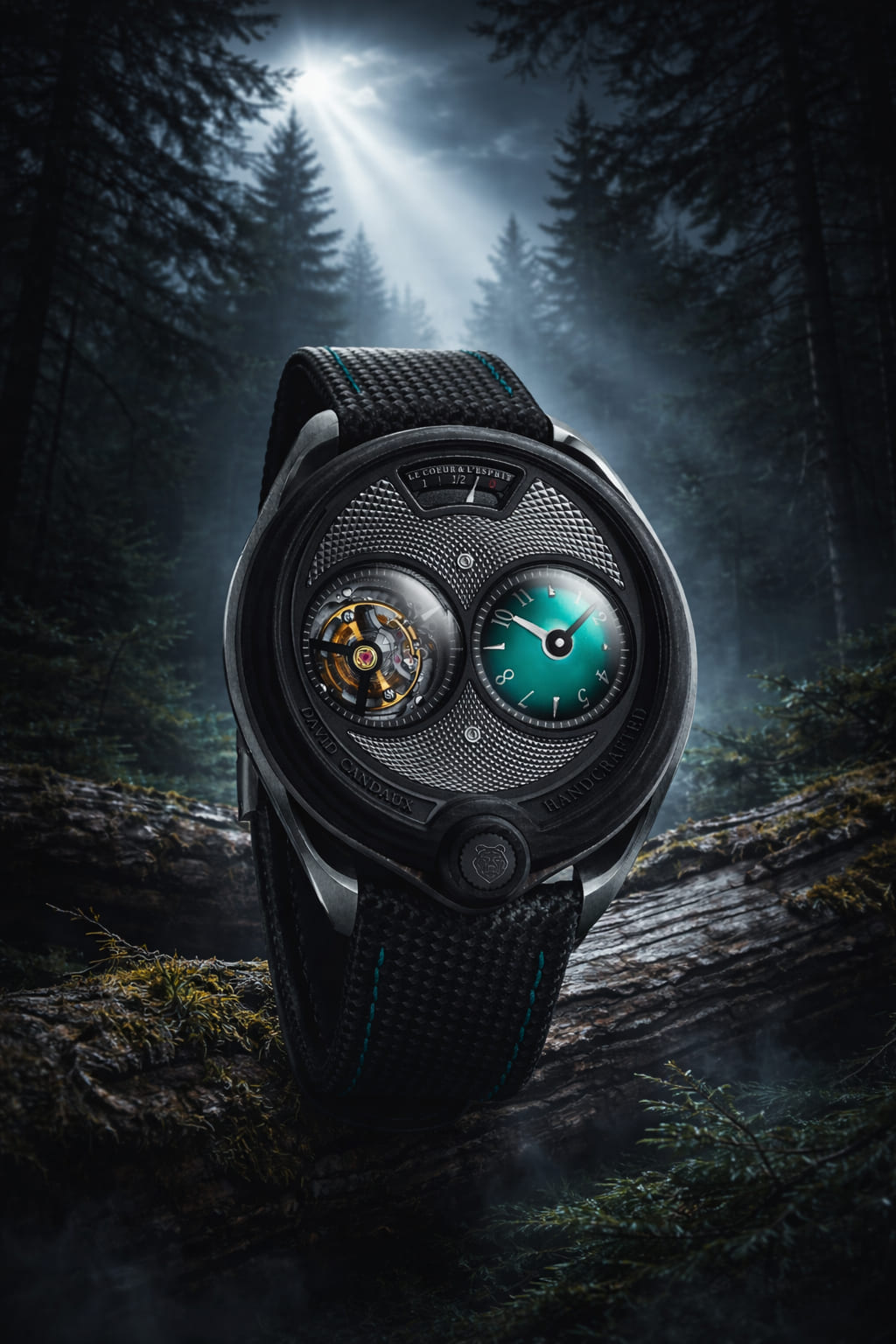
UD carbon truly changes how the watch is perceived
Carbon has become a widespread material in contemporary watchmaking—perhaps too widespread. It appears in sports watches, extreme pieces, and more or less serious limited editions, sometimes with genuine technical reasoning, sometimes simply to create a black, irregular texture that instantly reads as modern. The problem is that it often ends up looking the same.
David Candaux takes a more interesting path here by explaining why the DC6 Night Forest abandons forged carbon in favor of UD carbon. The difference is not merely cosmetic. Forged carbon relies on chips or fragments of fiber mixed with resin and then compressed. This produces speckled, highly animated surfaces—sometimes spectacular—but also a less homogeneous structure. UD carbon, by contrast, is based on continuous fibers arranged in sheets and layered with precision. The mechanical behavior is entirely different. The material becomes more consistent, more resistant to delamination, and more stable over time.
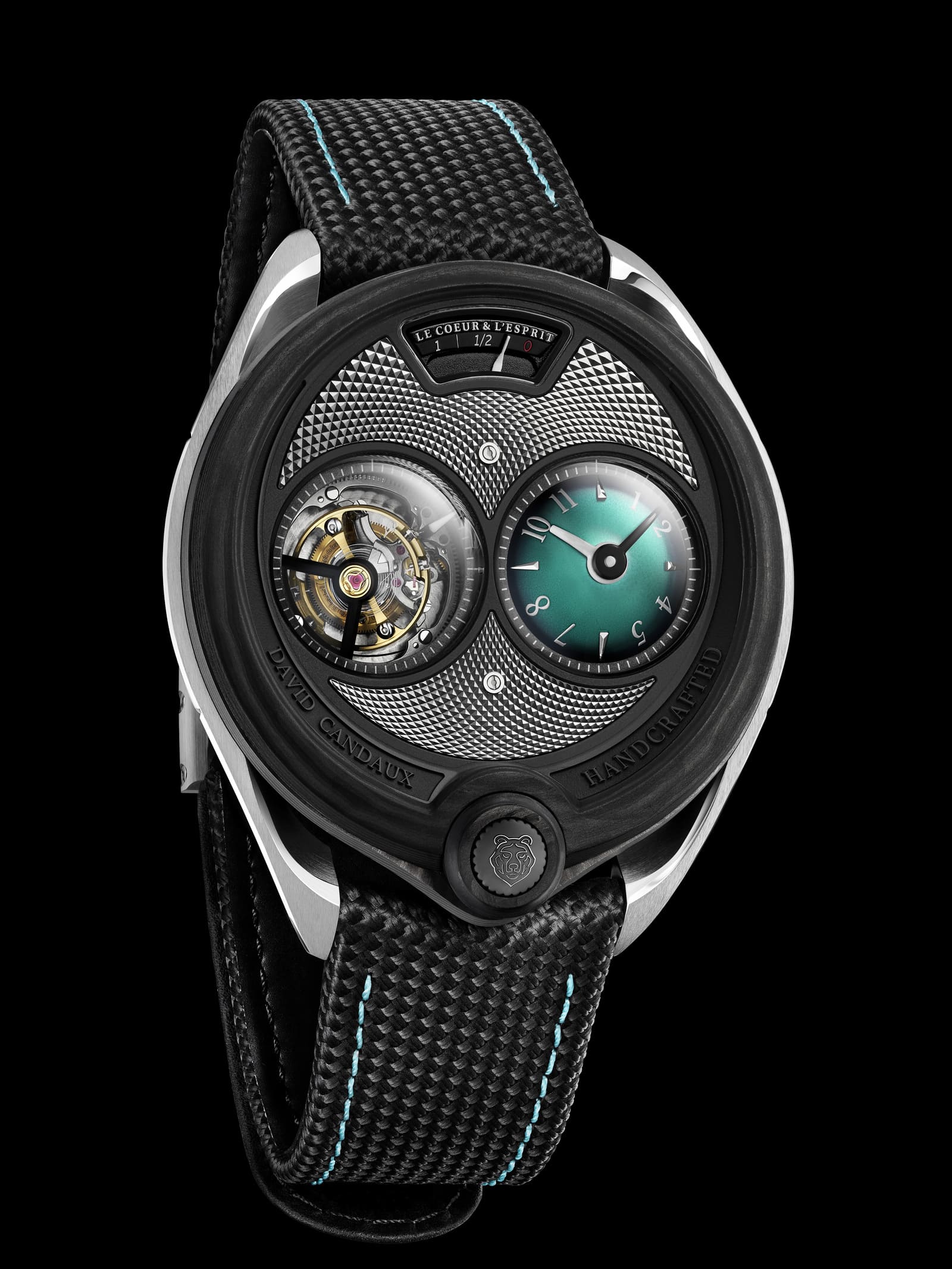
This choice also has an immediate aesthetic consequence. Forged carbon draws the eye with its fragmented, almost chaotic appearance. UD carbon, on the other hand, develops a veined, striated, directional look. There is something calmer about this surface, more structured—arguably even more refined. On the DC6 Night Forest, this finish contributes significantly to the watch’s personality. This is not about raw effect; it is about a material that tells a story.
It is likely one of the strongest ideas behind this piece. Instead of opting for the most demonstrative carbon, Candaux chooses the one that best aligns with his architecture.
Titanium and carbon: a smart division of roles
The other strength of the DC6 Night Forest is that it does not force carbon to play every role. The movement sits within a titanium container responsible for water resistance and protection, while the mid-case, bezel, and visible elements make use of UD carbon. Titanium side struts extend the structure and run through to the lugs.
In other words, the watch is built on a genuine construction logic. Titanium is there for structure, strength, stability, and water resistance. UD carbon provides lightness, texture, durability in use, and a strong visual identity. It’s easy to understand, but it still had to be executed properly.
This combination has a very concrete outcome: the watch weighs just 45 grams, despite a 45 mm diameter. That figure is surprising. We are talking about a high-watchmaking piece with complex architecture, a flying tourbillon, and a strong visual presence. Intuitively, one would expect significantly more mass. And yet, that is not the case. This radical lightness completely changes the relationship with the object.
It’s a detail that matters far more than it might seem. In this category, watches can quickly become wearable sculptures that are admired more than worn. Here, everything points instead to a desire to maintain a connection to real use, to the wrist, to everyday life.
A highly designed case, yet never chaotic
The DC6 Night Forest will not be universally loved—and that is perfectly fine. Its asymmetrical case, crown at 6 o’clock, twin sapphire domes, separated displays, and volumetric organization make it instantly recognizable. It is not a consensual watch, nor is it a neutral one. That said, it remains legible, and that is its strength.
Many highly conceptual watches fall into a simple trap: trying to show too much at once. The eye no longer knows where to settle. Here, despite the apparent complexity, the composition holds together. The tourbillon at 9 o’clock balances with the micro-dial for hours and minutes at 3 o’clock. The power reserve at 12 closes the display. The crown integrated at 6 o’clock anchors the entire design.
There is a sense of controlled tension in this layout. The watch is unconventional, but not disordered. It asserts a strong silhouette without slipping into futuristic caricature.
The smoked topaz-green dial adds the right depth
Another success of the DC6 Night Forest is its dial—or more precisely, its hours-and-minutes micro-dial, as the watch relies on a split display.
The base is sunburst titanium with a topaz-green anodization that produces a very particular shade. It is neither olive green, nor bottle green, nor the now almost obligatory bright green brands use to signal modernity. Here, the color leans more toward a mineral, almost aquatic register. Depending on the angle and light, it can appear deep and dense, or lighter and more luminous.
The cleverest detail lies in the smoked effect. Achieving a convincing gradient on a domed dial is no simple task. The chosen solution relies on trompe-l’œil. The darkening at the periphery is not a classic, evenly applied fumé effect, but rather a visual treatment that suggests depth instead of imposing it directly.
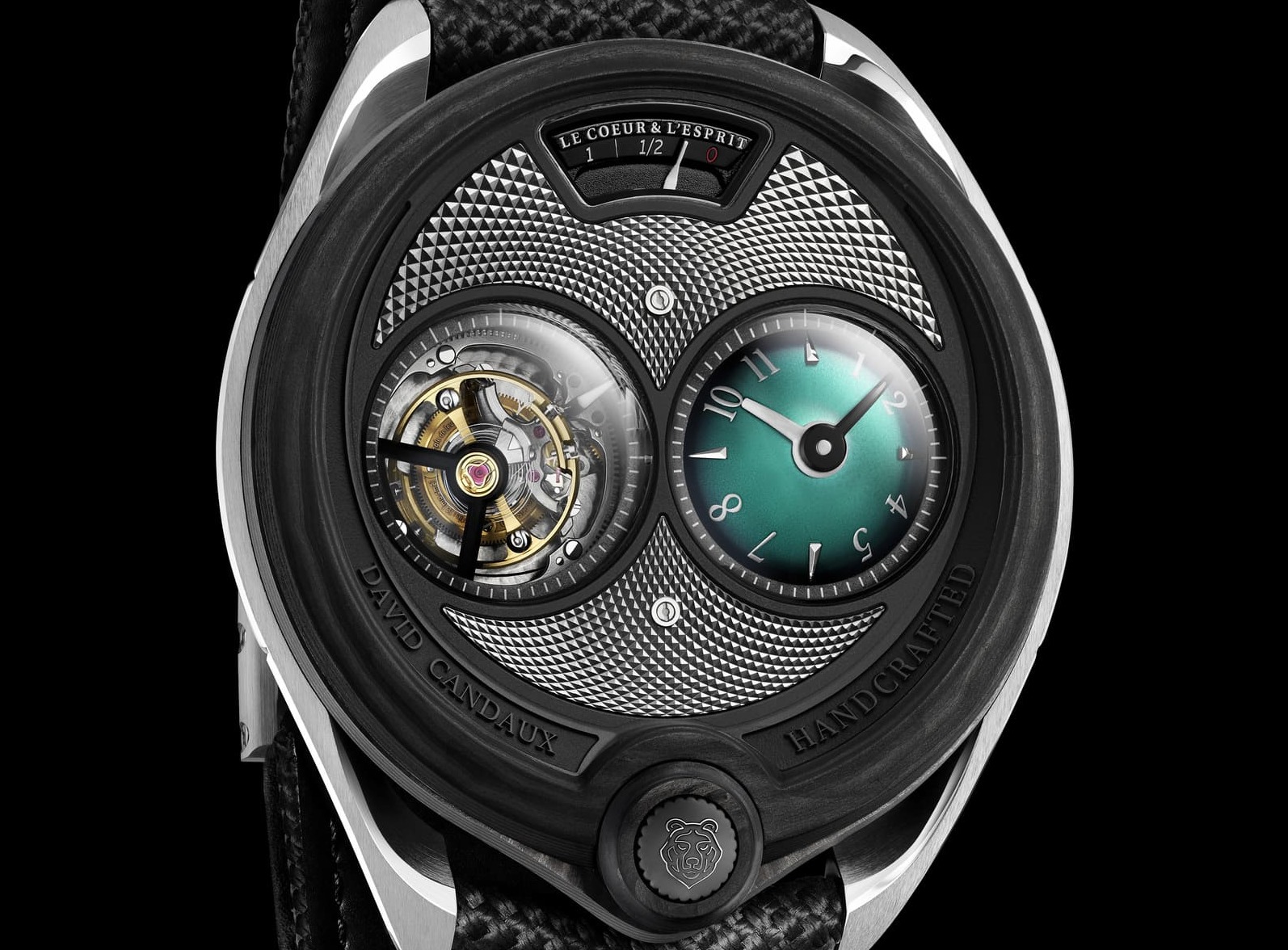
This is where it becomes clear that we are not simply looking at a technical watch. There is also a genuine reflection on perception. The dial does not merely display the time; it creates an atmosphere, a vibration, a sense of density.
The silver powder numerals and markers further enhance this impression. They seem to float slightly above the surface. The dark minute track at the base stabilizes the composition and accentuates its visual relief. It is a small dial, but it carries far more presence than one might expect.
The DC6 Night Forest is also a watch of textures
In this piece, material goes beyond technical specification—it becomes a language.
The guilloché titanium decorative plates, with the Pointes du Risoux motif, do not express the same thing as UD carbon. The former captures light with precision and relief; the latter diffuses it in a softer, denser, more organic way. Between the two, the black tourbillon cage, the case volumes, and the clarity of the sapphire crystals create a compelling play of contrasts.
This watch seems designed as much for the fingers as for the eyes. Bare titanium—microblasted, satin-finished, or polished—does not feel the same as carbon. The transition between the two materials, particularly around the crown, is far from incidental. It contributes to the personality of the piece. There is a clear intention to make surfaces interact, not merely to stack premium finishes.
This is important, because a watch at this level can quickly become demonstrative in the wrong way. Here, the visual richness relies less on excess and more on the quality of contrast.
The H74 calibre offers substance, not just spectacle
The engine powering the DC6 Night Forest is the H74 calibre, a hand-wound movement developed in-house. It comprises 287 components, 47 jewels, a 55-hour power reserve, operates at 21,600 vibrations per hour, and features two coaxial barrels in series. The mono-axis flying tourbillon, inclined at 30°, completes a rotation every 60 seconds and directly integrates the small seconds.
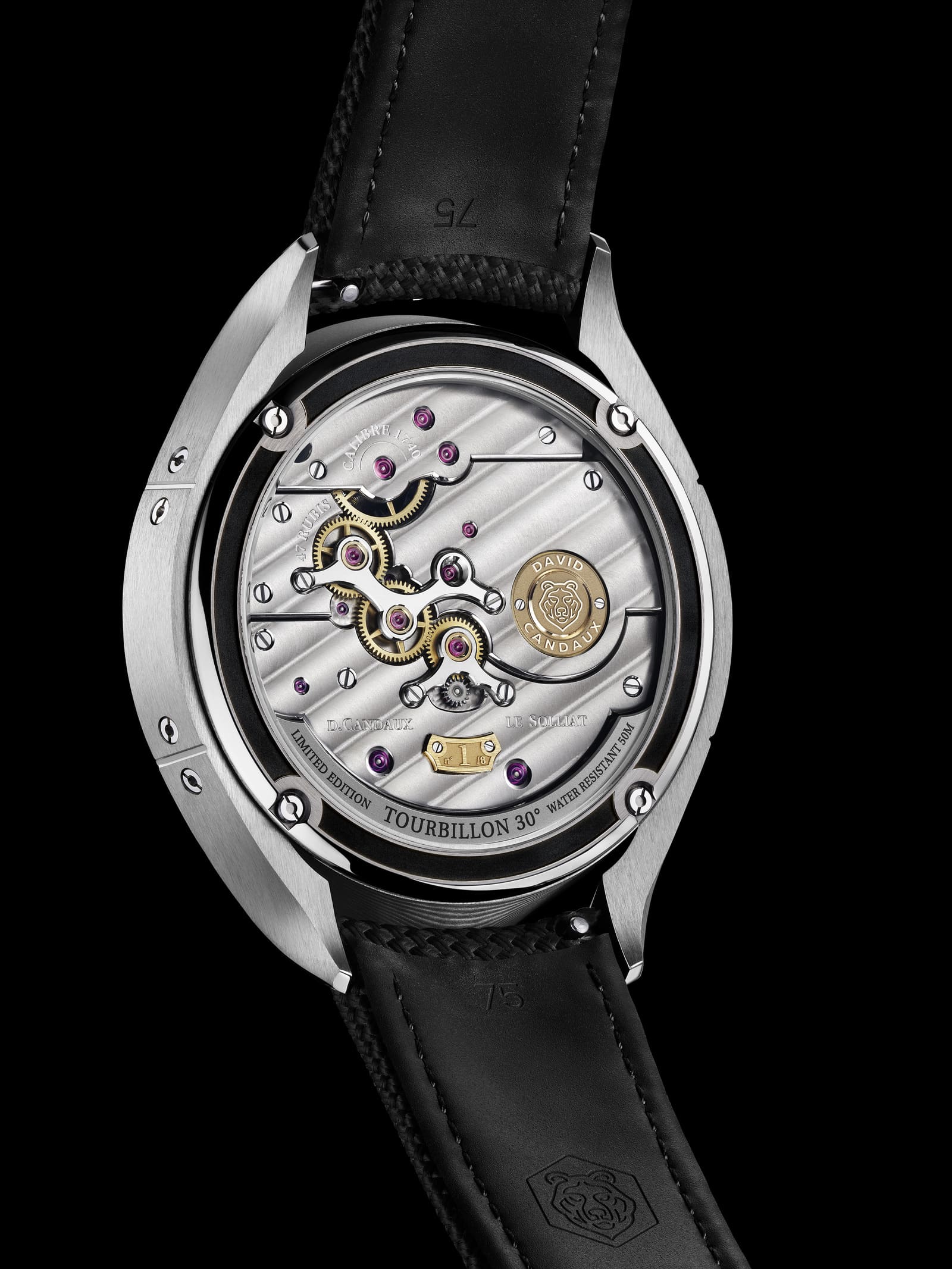
Unsurprisingly, the tourbillon draws the eye first. But the overall architecture of the movement avoids the trap of being mere display. The cascading bridges, inclined by 3° relative to the case, add depth on the caseback side and reinforce the idea that the entire watch was conceived as a cohesive structure—not as a spectacular case built around a conventional movement.
The use of grade 5 titanium for the bridges and mainplate is consistent with the rest of the project. The same logic applies to the beryllium copper wheels, the balance spring with Phillips terminal curve, and the variable-inertia balance with gold adjustment screws. The stated finishing is, unsurprisingly, at the expected level: inward angles, polished bevels, perlage, and clearly executed hand-finishing.
At this price point, that is the bare minimum. But it is still worth stating: here, the technical content genuinely supports the narrative.
The Magic Crown remains one of David Candaux’s strongest signatures
The retractable crown at 6 o’clock is not a secondary gimmick. It is part of the DC6’s core identity.
Its push-operated mechanism, with deployment and retraction, allows the watch’s lateral profile to be completely clean. It is both a mechanical and a design solution. By removing the traditional crown at 3 o’clock, David Candaux immediately reinforces the singularity of the case and the overall horizontal symmetry.
The system makes sense because it genuinely changes the way the watch is drawn. It is not a patent for the sake of having a patent. It is an idea with a concrete, visible, lasting effect.
My take on the David Candaux DC6 Night Forest
With its 45 mm diameter, distinctive architecture, off-center display, inclined flying tourbillon, and stratospheric price, the DC6 Night Forest immediately sits outside the realm of the reasonable.
This watch offers a genuine exploration of material. A real focus on weight. A true structural approach. Many contemporary pieces claim to fuse innovation, craftsmanship, and identity; few achieve it with such coherence. Here, UD carbon is not a gimmick. Titanium is not an excuse. The green dial is not a trend-driven flourish. And the tourbillon is not there to mask emptiness.
The DC6 Night Forest remains a highly distinctive, very expensive, and extremely exclusive watch—and it makes no attempt to be anything else. But it has one essential quality: it feels designed from the inside out. In independent watchmaking, that is often what separates a truly interesting piece from a mere communication exercise.
Technical specifications of the David Candaux DC6 Night Forest
| Specifications | Details |
|---|---|
| Model | David Candaux DC6 Night Forest |
| Edition | Limited to 8 pieces |
| Price | CHF 250,000 (€272,600) |
| Movement | Calibre H74, manual winding |
| Development | Fully developed in-house |
| Number of components | 287 |
| Number of jewels | 47 |
| Power reserve | 55 hours |
| Frequency | 21,600 vibrations per hour, 3 Hz |
| Tourbillon | Flying mono-axis inclined at 30°, 60-second rotation |
| Small seconds | Integrated into the tourbillon |
| Balance | Variable inertia, gold adjustment screws |
| Balance spring | Phillips terminal curve |
| Bridges and mainplate | Grade 5 titanium |
| Wheels | Beryllium copper |
| Case | Titanium container with UD carbon exterior |
| Diameter | 45 mm |
| Thickness | 11.29 mm |
| Weight | 45 g |
| Water resistance | 50 meters |
| Crown | Magic Crown retractable at 6 o’clock |
| Dial | Sunburst titanium, topaz green anodized, smoked trompe-l’œil effect |
| Crystals | Two sapphire domes, sapphire caseback |
| Strap | Handmade black rubber, topaz green stitching, velcro buckle |
| Warranty | 10 years |
FAQ on the David Candaux DC6 Night Forest
How many examples of the David Candaux DC6 Night Forest are produced?
The watch is limited to eight pieces.
What is the price of the David Candaux DC6 Night Forest?
The stated price is CHF 250,000, or approximately €272,600.
What material is used for the case?
The watch combines a titanium container with a UD (unidirectional) carbon exterior.
What movement powers this David Candaux?
The DC6 Night Forest is equipped with the H74 calibre, a manual movement developed in-house featuring a 30° inclined flying tourbillon.
What is the power reserve of the DC6 Night Forest?
The stated power reserve is 55 hours.
Is the watch water-resistant?
Yes, it is rated water-resistant to 50 meters.
Interested in this watch?
Price, availability, contact: we can activate our watch-industry network to help you.
I’m interested in this watch