Why Some Watches Gain More Than They Lose
The Small Wrist Mystery: Why Your Watch “Gains Time”
You’ve almost certainly experienced it: a mechanical watch you love, one you wind with near-ritual pleasure, that—without warning—ends up running a minute fast after a few days. Curiously, we complain about this more often than the opposite. As if watches, deep down, had a natural tendency to hurry. Is it a flaw? A mechanical inevitability? Or, more subtly, a logical consequence of how they are designed, adjusted, and worn?
In the collective imagination, time “should” be neutral: neither fast nor slow. But watchmaking is an art of compromise. Absolute accuracy does not exist in mechanics; it is negotiated, adjusted, lived with. And if some watches tend to run fast more often than slow, it’s not always an accident: it can be a technical, practical—almost cultural—preference.
Running Fast Isn’t (Always) a Problem: Watchmaking and the Psychology of Lateness
A human bias slips into our perception. A slow watch puts us in the wrong: we arrive late, miss a train, an appointment, a museum opening. A fast watch, by contrast, “protects” us by prompting us to leave earlier. In practice, many owners prefer a watch that runs slightly fast rather than slow.
This preference has long influenced how certain watches are regulated when they leave the workshop: better to gain a few seconds per day than to lose them. Historically, in contexts where punctuality was synonymous with seriousness (railways, navigation, the military), running late was less acceptable than running early. That doesn’t mean brands “rig” their watches to run fast, but there is a psychological and practical tolerance that favors gain over loss.
At the Heart of the Matter: Rate and Its Causes
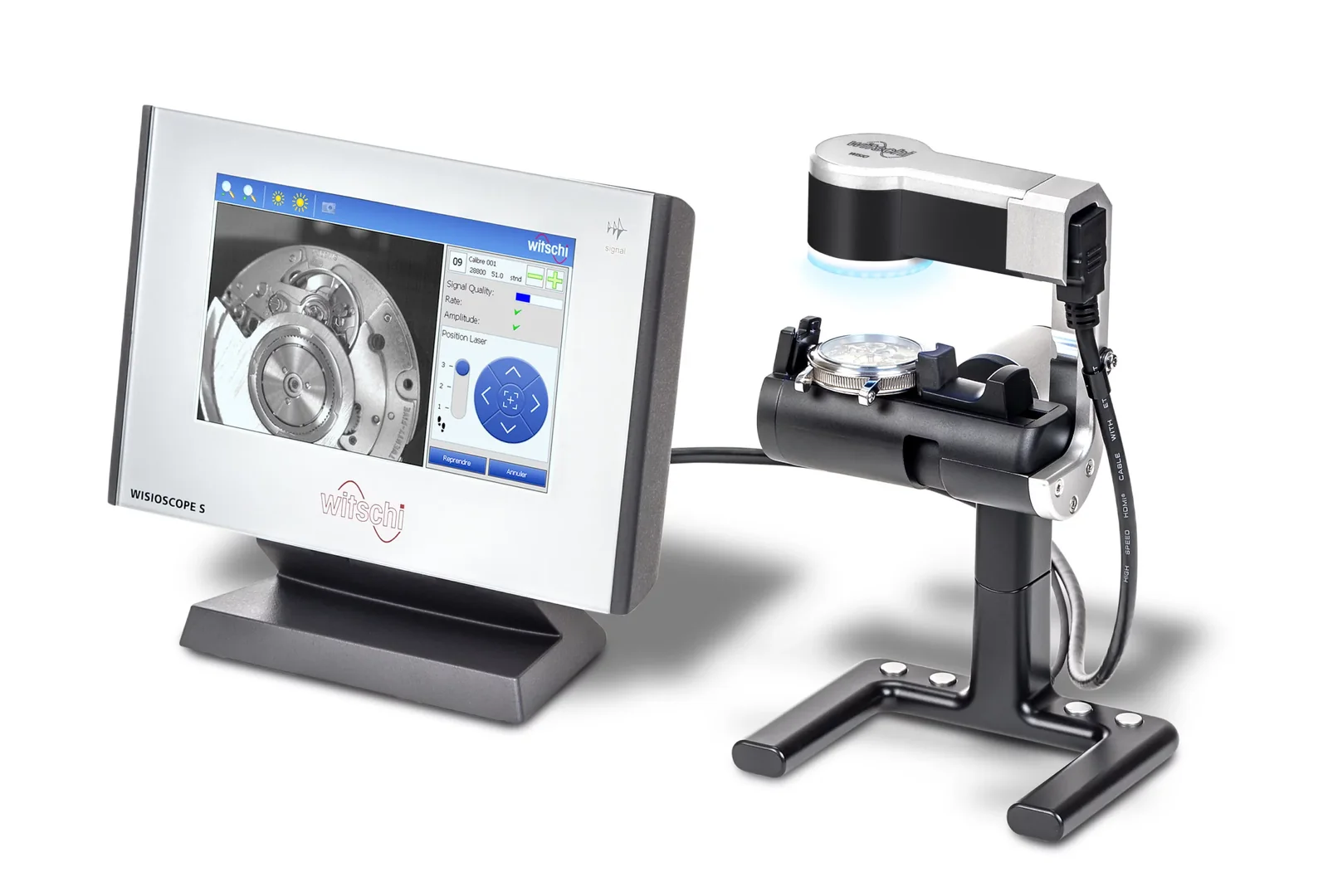
A mechanical watch does not simply display time—it produces it. Its oscillator, the balance wheel, beats at a defined frequency, and the gear train converts that cadence into minutes and hours. Precision therefore depends on the stability of that cadence.
In daily life, several variables influence rate. Some make a watch lose time, others make it gain. But many common factors, on a modern wrist, tend to speed a watch up more often than slow it down.
Position: Dial Up, Crown Down… and Gravity as Arbiter
Gravity does not act the same way whether the watch is flat, vertical, or inclined. Friction, tiny tolerances, the balance of the oscillator and the action of the escapement all vary with position.
A well-regulated watch is usually adjusted in several positions (3, 5, sometimes 6) to minimize variation. But in real life, it moves from a busy wrist to a bedside table, from a desk to a jacket pocket. Certain “typical” resting positions at night (dial up on a table, for example) can make it gain a few seconds, while others will make it lose. Many wearers unconsciously adopt habits that favor gain.
Amplitude: When a Well-Wound Watch Changes Its Pace
Amplitude refers to the angle through which the balance wheel swings. When the mainspring is well wound (either by hand or through active wear of an automatic), amplitude is higher. And depending on the escapement’s setup, lubrication, and the geometry of the hairspring, increased amplitude can alter the rate.
In a perfect world, isochronism—the constancy of the period regardless of amplitude—would be flawless. In reality, it never is. The result: some watches gain slightly when they are “full of energy” and lose when they near the end of their power reserve. If you lead an active life and wear your watch daily, you keep it more often in its optimal torque zone, which—depending on the calibre—may translate into a slight, more frequent gain.
Temperature: The Old Enemy… Never Fully Defeated
Before modern alloys, temperature was a major source of error: the hairspring expanded, the balance changed inertia, and oils varied in viscosity. Progress has been immense (silicon hairsprings, Nivarox-type alloys, more stable lubricants), but real life remains an imperfect laboratory: a warm wrist, cold air, rapid transitions between indoors and out.
Depending on materials and adjustment, thermal variation can slightly speed up a watch. And our watches spend much of their time in contact with a wrist at a relatively stable, elevated temperature. Once again, everyday conditions can statistically favor a small gain rather than a loss.
Magnetism: The Quiet Accelerator of the Modern Age
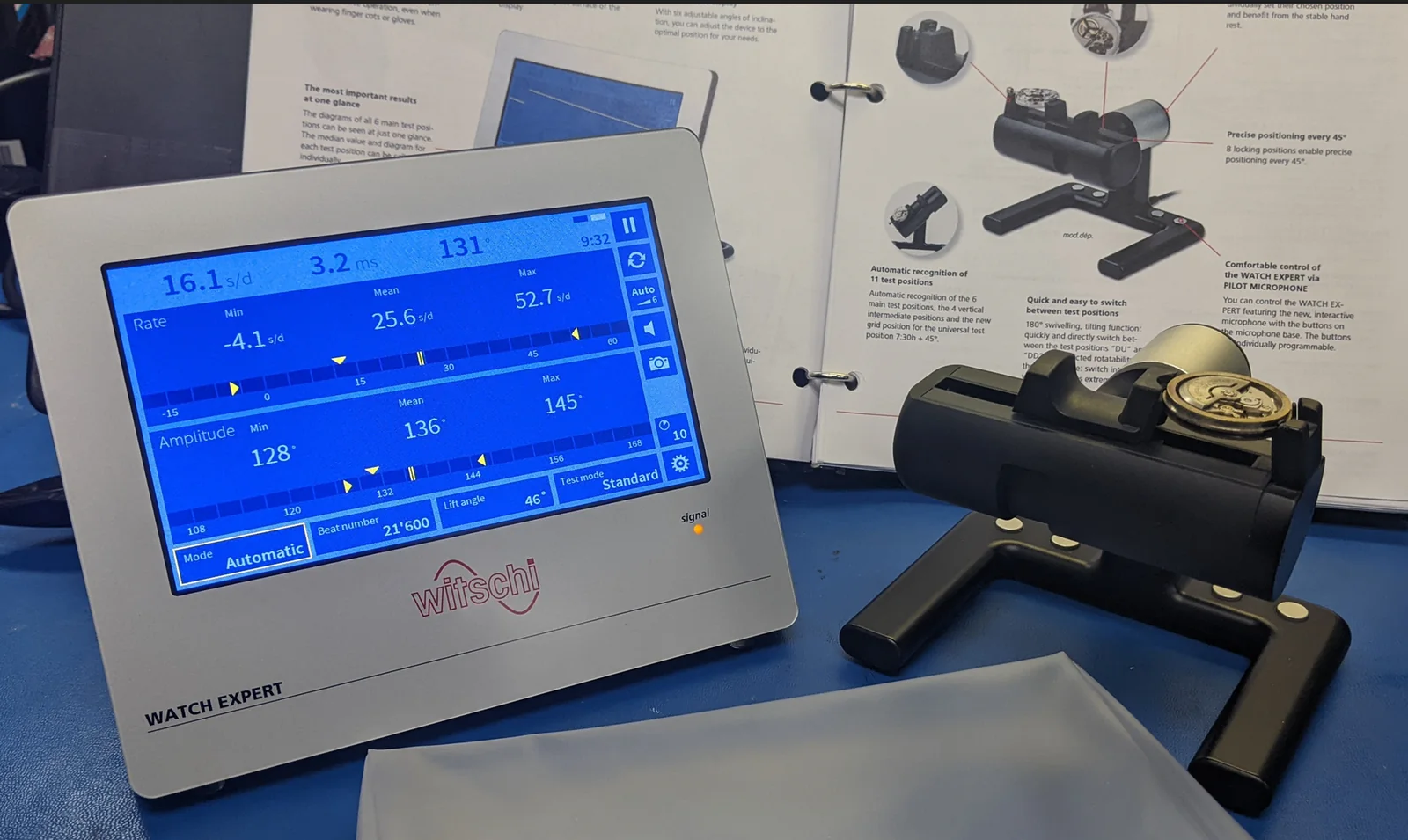
If one contemporary culprit had to be named for watches that run fast, this would often be it. When a watch becomes magnetized, the hairspring can partially stick to itself: its effective length shortens, frequency increases, and the watch may gain dramatically (several minutes per day).
And magnetism is everywhere: bag clasps, earbuds, magnetic cases, speakers, tablets, computers, induction hobs. Recent watches sometimes incorporate anti-magnetic solutions, but not all to the same degree. A watch that suddenly runs fast, with no other symptoms, often warrants a pass on a demagnetizer before any other hypothesis. The device has become very accessible: see a selection.
Tolerances: COSC, “Master Chronometer,” and Life Beyond the Lab
Certifications offer a benchmark—but also an illusion: that of guaranteed precision in all circumstances. COSC, for example, sets average criteria of -4/+6 seconds per day for a tested movement. Other, more modern labels define rate differently depending on exposure to magnetic fields and wearing conditions.
Note the logic: many standards tolerate gain more readily than loss, or accept asymmetries. Why? Because in real-world regulation, achieving a watch that never loses time is often more demanding, and because usage sometimes favors a slight gain over a slight loss. Above all, because tests are conducted under precise conditions—while real life is layered with unpredictability.
A Watch That Runs Fast: Fault, Adjustment… or Simply Mechanical Character?
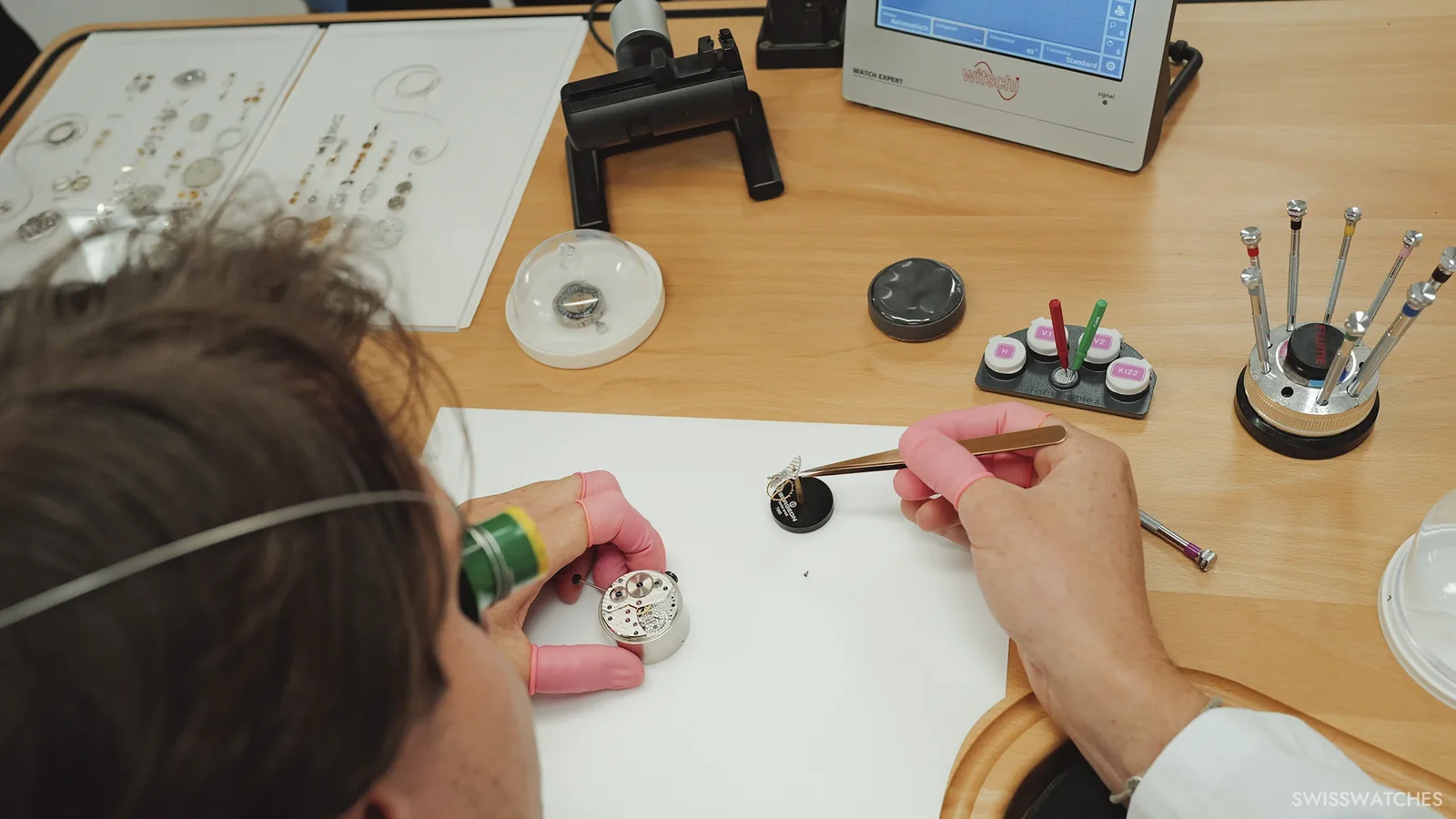
It’s important to distinguish between “reasonable” gain and problematic gain.
- A few seconds per day: often within the norm for a non-certified mechanical watch, and sometimes even for a certified one depending on conditions.
- A sudden change: suggests magnetization or a shock that has shifted a regulating component.
- A large, consistent gain (e.g. +60 s/day or more): often magnetization, sometimes the need for adjustment or servicing.
A mechanical watch is not a smartphone: it also tells the story of its own condition. A gradual drift may signal evolving lubrication, dust, aging oils, or a regulation that needs refining.
How to Bring a Watch Back Into Line (Without Losing Its Charm)
Before rushing to the watchmaker, a few simple steps can provide clues—and sometimes correct the gain.
Observe the Rate Over a Week
Note the daily deviation at a fixed time. A watch lives to the rhythm of your routine: only by observing several days can you distinguish a trend from a one-off.
Test Night-Time Positions
Many enthusiasts play with positions as a form of fine adjustment:
- Dial up: may gain or lose depending on the watch.
- Dial down: sometimes the opposite.
- Crown up / down: vertical positions, often highly influential.
If your watch runs fast, try a night-time position that makes it lose slightly (or gain less). It’s a kind of horological micro-choreography—an elegant remedy, because it respects the mechanism rather than forcing it.
Demagnetize: The Modern Reflex
A watchmaker can demagnetize a watch in seconds. Some collectors equip themselves with a small demagnetizer, but diagnosis remains important: not all gain is magnetic, and one should not confuse speed with erratic deviation. You can find watch demagnetizers for under €20 from the fast-delivery giant: right here.
Regulate Without Overcorrecting
Regulation often involves adjusting the regulator index (if the calibre has one) or making finer interventions on the balance and hairspring depending on the design. The goal is not to turn the watch into a laboratory instrument, but to achieve a rate consistent with your usage. A good watchmaker will ask the real question: how do you wear it?
In the End, a Watch That Runs Fast Reminds Us of a Simple Truth
We love mechanical watchmaking because it humanizes time. It does not recite it; it interprets it. A watch that gains slightly is not always “worse”: it may simply be regulated for the real world, or influenced by the invisible forces of our age—magnetism, motion, temperature contrasts.
And there’s a quiet poetry to the idea: if your watch is running fast, perhaps it’s inviting you to arrive early. In an overfull life, that small gain almost feels like a luxury.
Interested in this watch?
Price, availability, contact: we can activate our watch-industry network to help you.
I’m interested in this watch