What Is a Variable-Inertia Balance Wheel
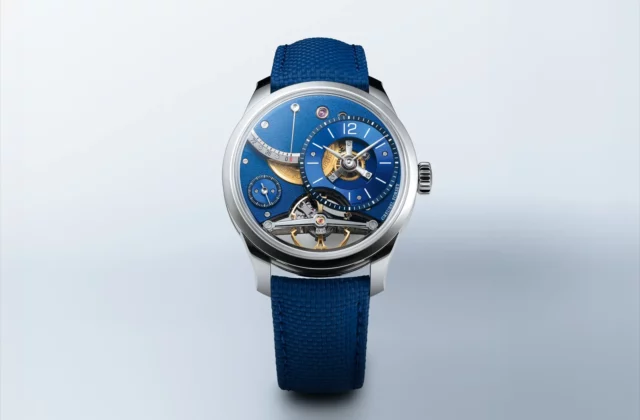
Before even talking about escapements, “free” hairsprings or marketing feats, we need to return to the most vital organ of a mechanical watch—its beating heart. The variable inertia balance is precisely a very watchmaking—and very pragmatic—way of regulating that heart without constraining it. A technical solution that says a great deal about the seriousness of a calibre, and sometimes about the character of the manufacture that designed it.
You’ll find it at Rolex, Patek Philippe, Omega, Grand Seiko, Tudor, but also in more discreet workshops where people prefer to talk about chronometry rather than storytelling. It is often paired with a “free-sprung” hairspring, and the promise is simple: improve rate stability over time, in the face of shocks, positional variations, and the small whims of daily life. In reality, it’s more subtle—and far more interesting.
Variable inertia balance, a simple definition (without oversimplifying)
In a mechanical watch, the balance wheel oscillates back and forth. This oscillation, regulated by the hairspring, sets the rhythm of the movement, much like a musician’s metronome. Accuracy depends largely on the regularity of this balance–spring pair.
To make a watch gain or lose less time, its effective frequency must be adjusted. There are two main approaches:
- Adjust the active length of the hairspring using a regulator (index), pinching the spring more or less to shorten or lengthen it.
- Adjust the inertia of the balance by moving small masses on the balance itself, without touching the hairspring’s length.
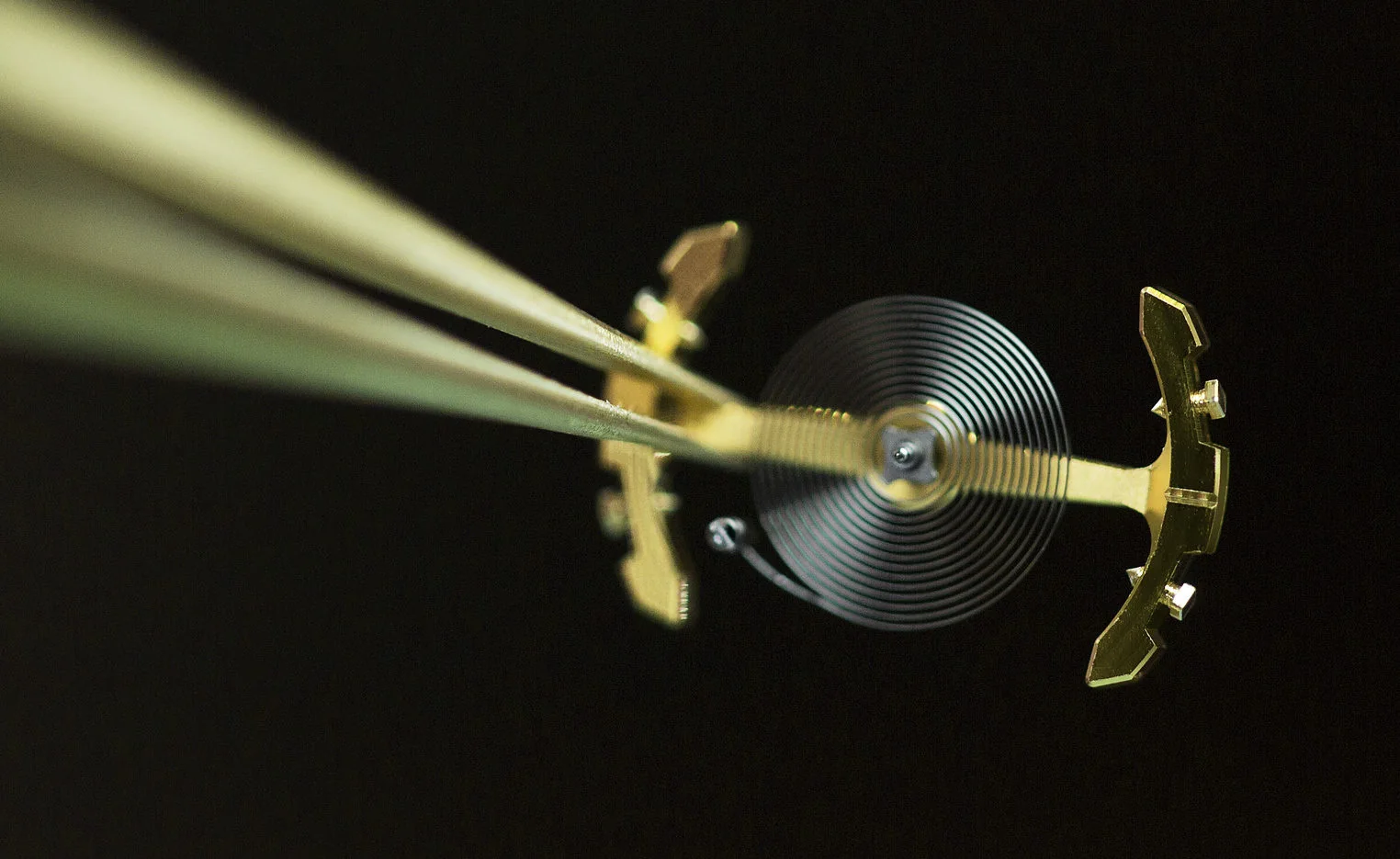
A variable inertia balance is therefore a balance whose rate is adjusted by modifying its mass distribution, via regulating screws or weights on its rim. You change the inertia—and thus the oscillation speed—without “choking” the hairspring. The spring can breathe. And so can the watchmaker.
Why inertia affects accuracy
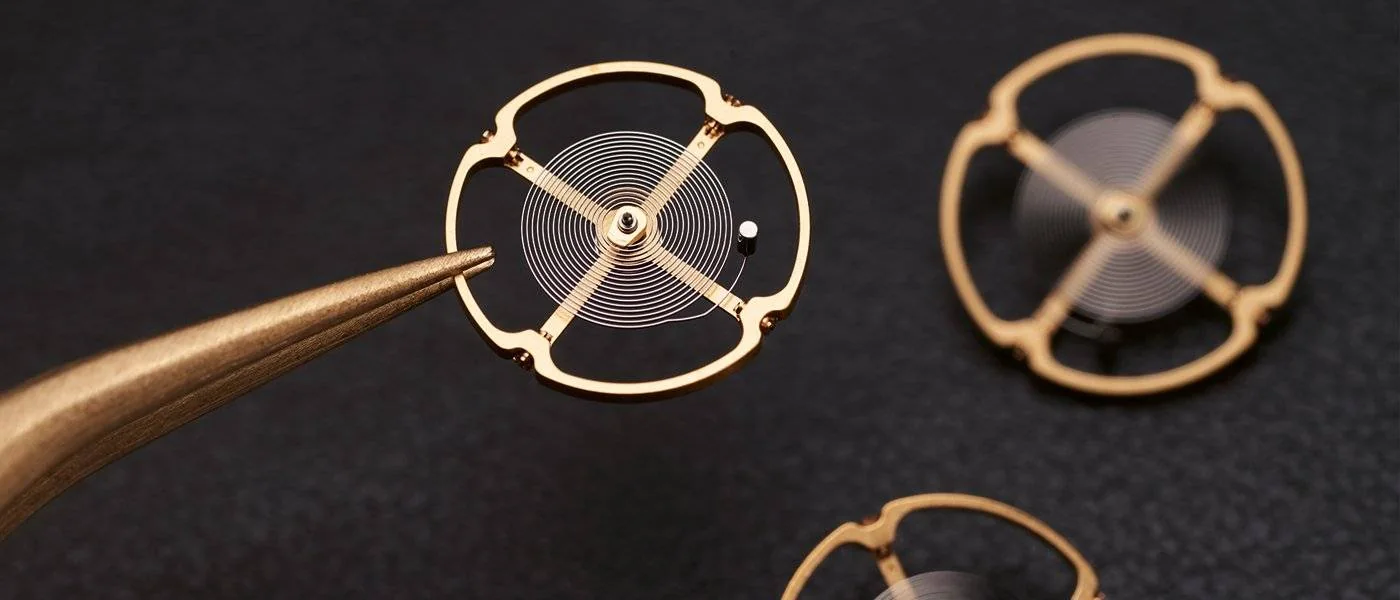
In physics, a balance’s inertia—its moment of inertia—determines the energy and stability of its oscillation. At equal amplitude:
- the higher the inertia, the more the system resists disturbances—shocks, micro-variations in torque, changes of position,
- the lower the inertia, the more “lively” it is—easier to speed up or slow down, and therefore potentially more sensitive.
In practical terms, on a variable inertia balance, tiny masses on the rim are screwed in or out. Inertia is increased or decreased, which modifies the oscillation period. It’s a fine adjustment, often more stable than a traditional regulator, because it allows the hairspring to work in a less constrained geometry.
Variable inertia balance vs. regulator, the real difference
The regulator, the traditional tool (and not necessarily inferior)
The classic system uses a regulator: an index that moves two pins and alters the active length of the hairspring. It’s efficient, quick to adjust, economical—perfect for many industrial movements and routine servicing. And no, it’s not automatically “inferior.” A well-designed regulator can deliver excellent results.
But it has two limitations:
- it constrains the hairspring between pins, which can introduce micro-friction and position-dependent variation,
- it can be less stable over time if the setting shifts, or as the hairspring ages and behaves differently.
Variable inertia, a more “chronometry-driven” approach
With a variable inertia balance, the regulator is often eliminated. The hairspring is “free-sprung”: no regulator pins to pinch it. Adjustment is made by acting on the balance weights, usually with a dedicated key.
Typical advantages:
- better long-term stability of the adjustment,
- potentially better isochronism, the ability to maintain the same period despite amplitude variations,
- better shock resistance of the regulation, as there is no index that can shift.
There are downsides, of course:
- more time-consuming adjustment, requiring real know-how,
- higher industrial cost at equivalent quality,
- and, in some cases, servicing that demands more tools and experience.
Screws, weights, Microstella and friends—what it looks like
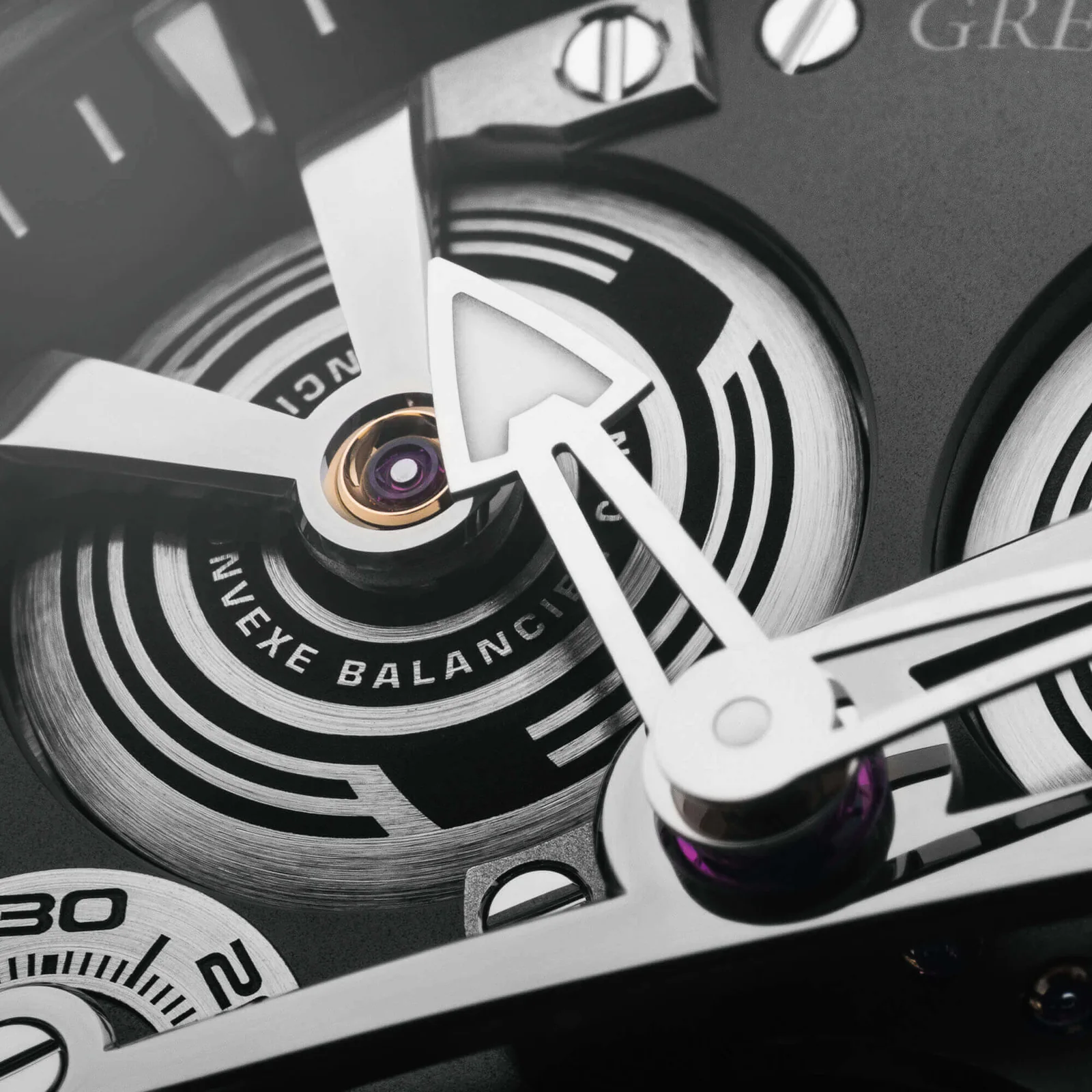
Visually, a variable inertia balance typically features adjustment elements on its rim:
- traditional regulating screws, often evenly spaced around the periphery, in a “classical” high-watchmaking style,
- movable weights, sometimes internal to reduce air turbulence and limit risk,
- proprietary systems whose names become talking points: Microstella at Rolex, Gyromax at Patek Philippe, and so on.
The principle remains the same: inertia is modified by moving mass closer to or farther from the axis. The farther the mass, the greater the inertia, and the balance tends to slow down; move it inward and it speeds up.
Why brands favor variable inertia balances (and why it matters to you)
Because accuracy isn’t just a number on a warranty card. It’s consistency over time—the ability to remain well-regulated as the watch takes knocks on door frames, moves from one wrist to another, shifts between office and weekend, heat and air conditioning.
A variable inertia balance, especially with a free-sprung hairspring, is a design choice that favors:
- robust regulation, with fewer parts liable to shift,
- consistency across positions, a core theme of real-world chronometry—the kind that happens on your wrist, not on a test bench,
- industrial coherence in modern high-end calibres, where controlling hairspring geometry and system stability takes precedence over old-school, assembly-line adjustment.
And yes, it’s also a marker of “moving upmarket.” Not because it’s magic, but because it often signals a movement designed to a more ambitious brief.
Real-world examples, from theory to the wrist
This type of regulation appears in many well-known watches. A few reference points, without inventing prices or guessing vague references:
Rolex, Microstella and a utilitarian approach to performance
At Rolex, many modern calibres use a variable inertia balance with Microstella nuts. The idea is quintessentially Rolex: no unnecessary poetry, but an obsession with stability and repeatability. The brand pairs this with its own oscillator architecture and internal precision standards (often stated as stricter than COSC).
Exact references and prices vary by model and evolve regularly, so it’s more relevant to focus on the principle than to set figures in stone. What matters here is the choice of inertia-based regulation, designed to last and to handle everyday wear.
Patek Philippe, Gyromax—the high watchmaking take on variable inertia
Patek Philippe’s Gyromax is another emblematic example: adjustable masses on the balance allow for fine and stable regulation. Technically, it follows the same philosophy—regulate the oscillator without a regulator and preserve the hairspring’s behavior.
At Patek, this sits within a broader pursuit of chronometric performance, but also finishing and overall movement coherence. The balance is not an isolated component; it is both functional and part of the brand’s identity.
Omega, modern architecture and stable regulation
Omega also uses variable inertia balances in many recent calibres, often paired with silicon hairsprings and solutions aimed at rate stability and resistance to magnetic fields. Here again, the benefit is the same: robust regulation, less dependent on a regulator index, and more stable over time.
Depending on the model, certification specifications (COSC, Master Chronometer METAS) and prices are public, but must be cited case by case, reference by reference, as Omega deploys these technologies across multiple families.
What it really changes day to day
The most sensible question is also the simplest: does a variable inertia balance make a watch “more accurate”? Not automatically. A watch is a system. If the escapement is mediocre, lubrication poorly controlled, or assembly lacks rigor, you’ll simply have a sophisticated balance in a mediocre environment—like race suspension on a pothole-ridden road.
However, in a well-designed movement, the typical benefits are:
- more stable rate between services,
- less drift after a moderate shock,
- more consistent performance across positions, especially when the balance–spring pair is well optimized.
It’s a kind of accuracy that is more “durable” than spectacular—which, in the real world, is the only kind that matters.
What to watch for in a spec sheet
Brands love to showcase “variable inertia balance” as a quality stamp. Fair enough. But a few nuances are worth keeping in mind:
- Variable inertia does not always mean free-sprung. Often yes, but not always. The presence or absence of a regulator changes the architecture.
- The number and design of the masses matter—external screws, internal weights, anti-loosening systems.
- The hairspring is at least as important as the balance: material, terminal curve, geometry, centering, and stud attachment.
- Factory adjustment quality and the level of testing (positions, temperatures, criteria) determine the final result.
And of course, certification. COSC, METAS, the Geneva Seal, in-house standards—each tells a different story. But none replaces the most reliable observation: the watch on your wrist, over several weeks.
Final word: variable inertia as a signature of seriousness
A variable inertia balance is not a gimmick. It’s an engineering decision—a way of saying, “we want fine adjustment, and we want it to hold.” Purists appreciate it because it is elegantly logical. Collectors because it signals high-end construction. Beginners should take away one key idea: when a brand chooses this path, it generally commits itself to a higher level of manufacturing discipline and regulation.
Does it guarantee a perfect watch? No—and fortunately so, or things would be dull. But it is an excellent clue in the great observational game that is watchmaking, where you learn to read a watch not as an object, but as an intention.