How a Dual Time Zone Watch Works
Travelling with Time on Your Wrist: Why the Dual Time Zone Changed Watchmaking
Some complications are born of aesthetic whim, others of pure necessity. The dual time zone watch belongs to the latter. It tells the story of the rise of commercial aviation, the globalization of exchanges, and a new kind of practical elegance: knowing where you are, while keeping one foot “back home.” In the 1950s, as transatlantic flights became the new playground for businessmen, pilots, and journalists, a single time was no longer enough. The wrist demanded a temporal compass.
But “dual time” does not refer to a single architecture. Behind the term lies a range of mechanical solutions, each with its own logic, ergonomics, and poetry. Understanding how a dual time zone watch works is also understanding what watchmaking does best: translating a daily need into the language of hands.
The Main Families: GMT, Jumping Local Time, and Worldtimer
Before diving into the mechanics, let’s clarify the terms. A “dual time” watch displays two different times: local time (where you are) and a reference time (usually home). The most common systems fall into three families.
1) The GMT Watch (24-Hour Hand)
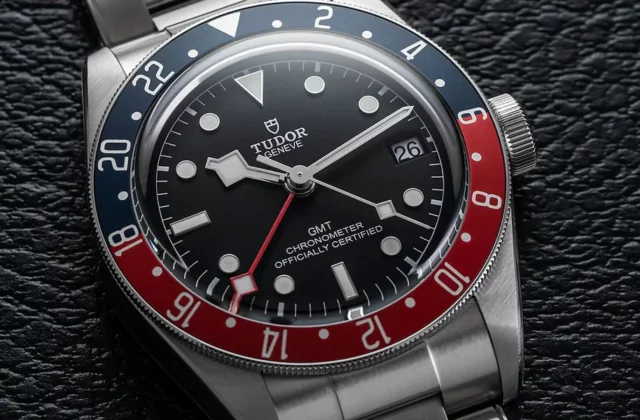
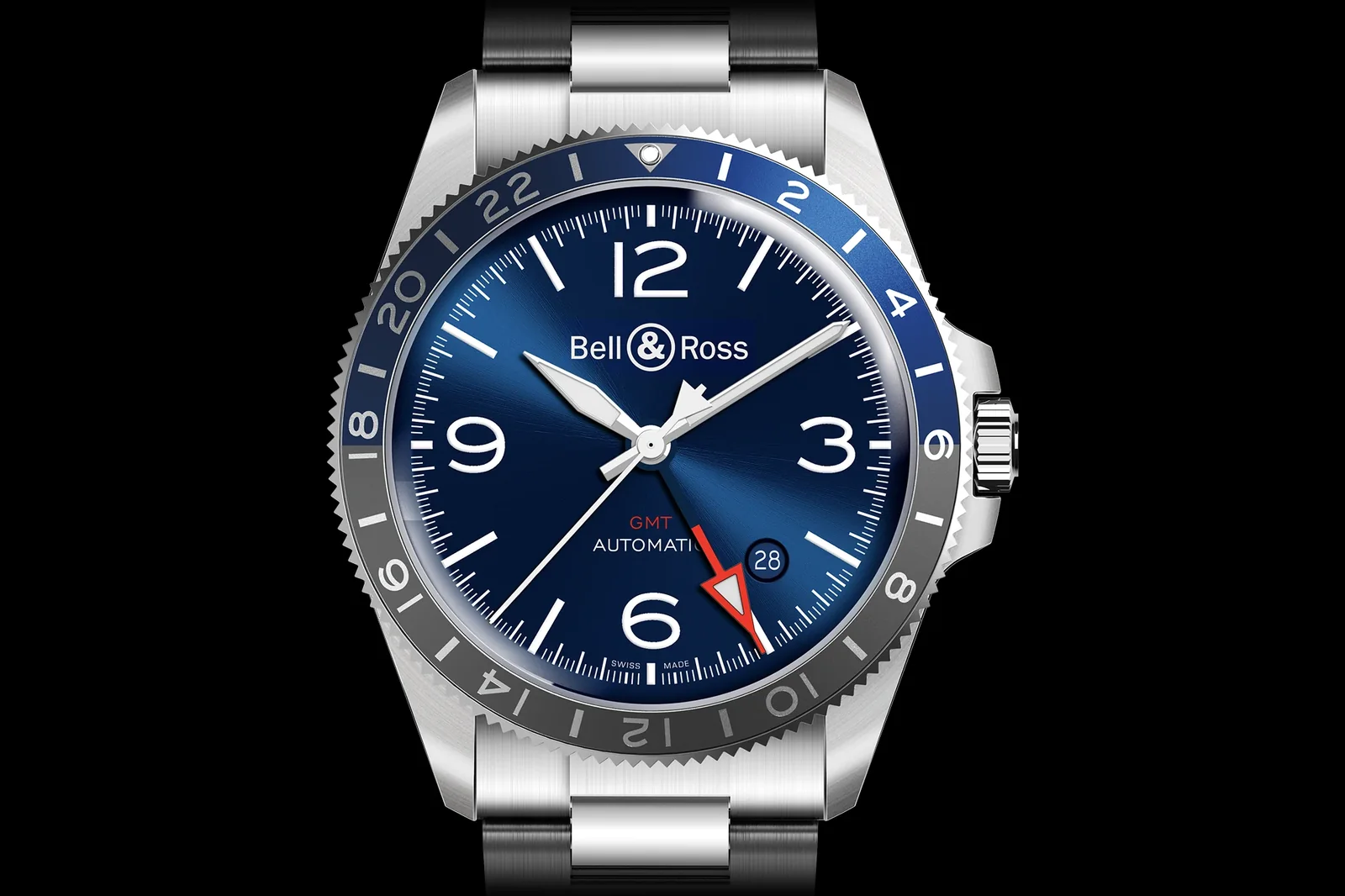
The most iconic. It adds a fourth hand, often brightly colored, that circles the dial once every 24 hours. This hand is read against a 24-hour scale (printed on the dial, bezel, or flange). The result: you retain standard 12-hour time while displaying “GMT” time over 24 hours, avoiding any confusion between day and night.
2) The “True GMT” (Jumping Local Hour)
Here, the watch is designed for the frequent traveler. The local hour hand adjusts in one-hour jumps (without stopping the movement), while the 24-hour hand remains set to the reference time. It’s ultimate convenience when stepping off a plane: no laborious resetting, no disturbance to the minutes, and often a date that automatically follows the change of time zone.
3) The Worldtimer (Universal Time)
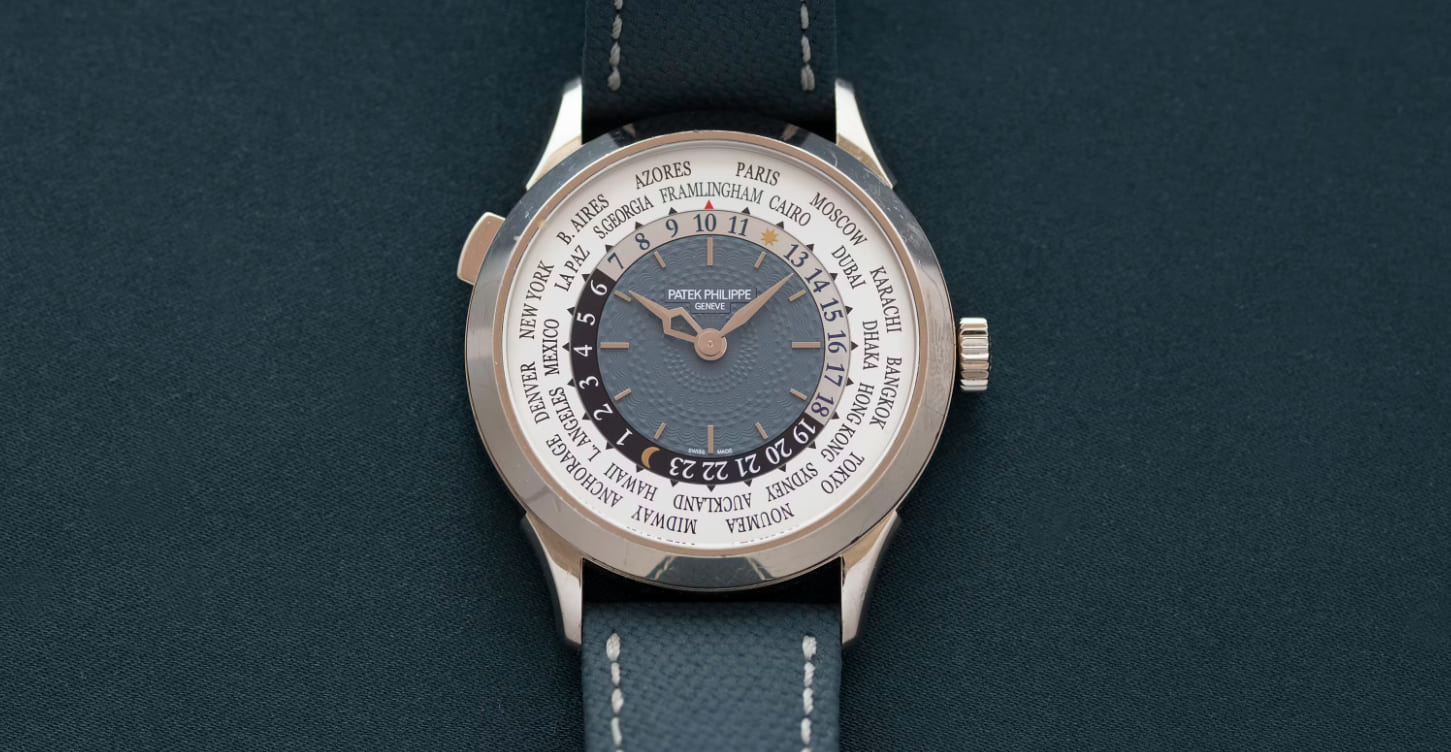
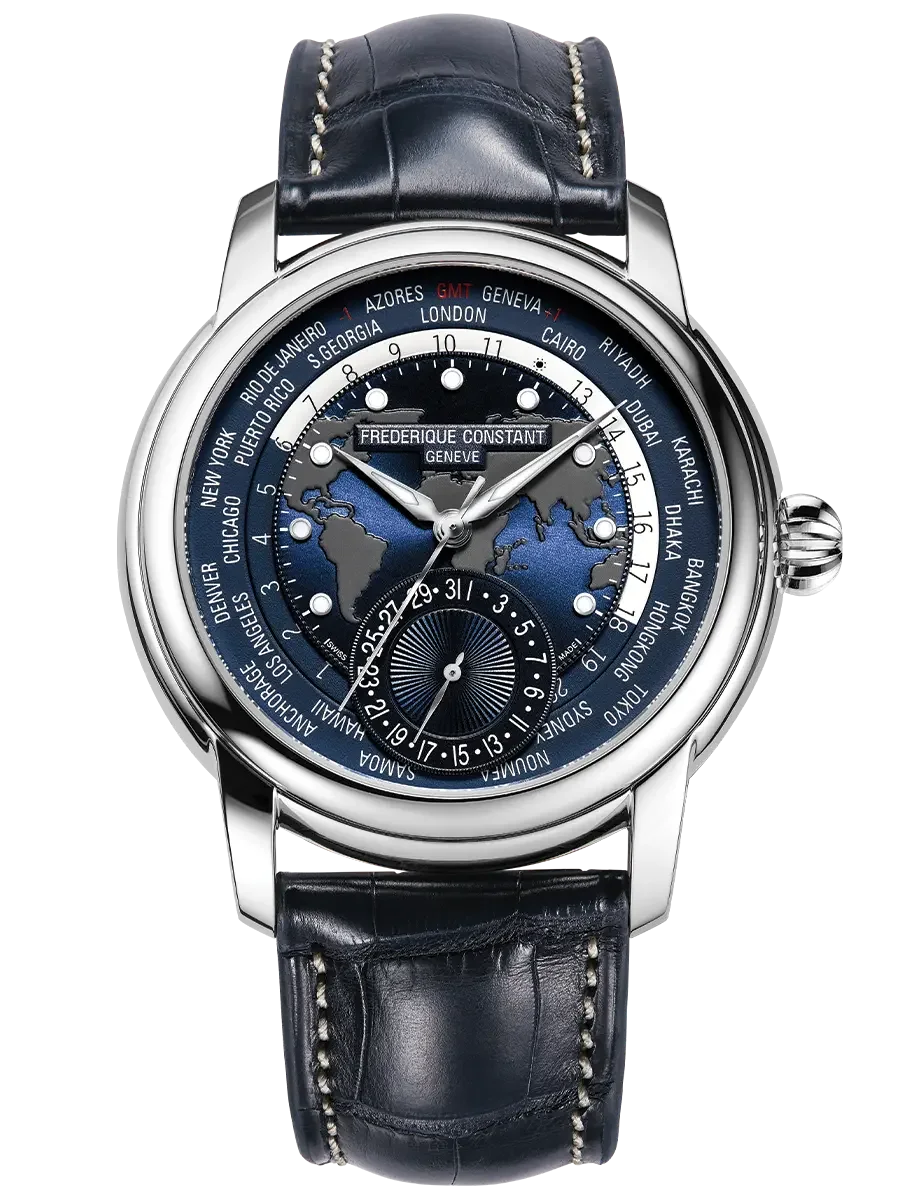
More spectacular: it can display the time in 24 cities (and thus 24 time zones) thanks to a 24-hour disc and a city ring. Strictly speaking, it’s not a dual time display, but rather the encyclopedic version of the same idea: embracing the world at a glance.
In this category, there is one accessible piece that has caught my eye for a long time: the Frederique Constant Worldtimer.
The Core Mechanism: How a Watch “Creates” Two Times
A traditional mechanical watch transmits energy from the mainspring to the escapement and regulating organ, then to the gear train that drives the hands. The magic of dual time lies in adding a second time display without disrupting timekeeping or sacrificing legibility.
The GMT Hand: A Second “Reading” of Time
In a GMT, the 24-hour hand is driven by a gear train that forces it to complete one rotation every 24 hours, while the hour hand completes one in 12. Simply put, the watch creates a different gear ratio for this additional hand. The movement maintains a “base time” and distributes it across multiple displays.
Reading the time is then done via:
- A fixed 24-hour scale (on the dial): practical, restrained, immediate.
- A rotating 24-hour bezel: sometimes allowing a third time zone to be displayed by shifting the GMT hand’s reference.
The Key Difference: “Office GMT” vs “True GMT”
Two philosophies coexist, often confused:
- So-called “office GMT”: the 24-hour hand is independently adjustable (useful at a desk to track a foreign headquarters), while the hour hand is linked to the minutes and moves in the traditional way.
- So-called “true GMT” (or “flyer”): the local hour hand jumps in one-hour increments, independently of the minutes, while the GMT hand remains fixed on the reference time.
This distinction is not a forum triviality—it changes daily use. The “true GMT” is built for crossing borders; the “office GMT” is designed for making calls across them.
Setting It Step by Step: How to Use It Without Mistakes
Procedures vary by brand, but the logic remains the same: set a “home” time and a “local” time. Here is a reliable method, to be adapted to your watch.
Setting a GMT with a 24-Hour Hand
- Step 1: set the reference (home) time using the GMT hand on the 24-hour scale.
- Step 2: set the local time via the 12-hour hand, keeping the minutes precise.
- Step 3: ensure the date matches the correct local day, especially if you have crossed the date line.
If your watch has a rotating 24-hour bezel, you can shift the bezel to read a third time zone: the GMT hand stays put, but its “reading scale” changes.
Setting a “True GMT” While Travelling
- Before departure: set the GMT hand to home time, ideally in 24-hour format.
- On arrival: jump the local hour hand forward or backward one hour per time zone, without touching the minutes.
- Check the date: on well-designed calibres it will follow the hour jumps; otherwise, adjust according to the manufacturer’s instructions.
Golden rule: avoid adjusting the date in the “danger zone” (typically around 9 pm to 3 am), when the date-change mechanism is engaged. Manuals differ—if you don’t know, err on the side of caution.

Why the 24-Hour Scale Matters So Much
A dual time watch should not only display two times—it must prevent mistakes. The 24-hour scale provides vital information: day or night in your reference time zone. When calling Tokyo from Paris, you are not just asking “what time is it?” but “is this reasonable?” That cultural legibility—respecting others’ time—may well be the true sophistication of a GMT.
Dual Time and Design: When Function Becomes Signature
The GMT complication has created an instantly recognizable aesthetic vocabulary: arrow-tipped hand, slender seconds, bi-color bezel, graduated flange, highly legible dials. It is no coincidence that the watch has become a symbol of contemporary mobility. The GMT is to watchmaking what carry-on luggage is to travel: an object designed to be elegant under constraint.
The Most Common Display Solutions
- Central 24-hour hand: the sportiest, most intuitive.
- 12- or 24-hour subdial: more formal, more “desk instrument.”
- 24-hour disc and aperture: highly legible, often with a contemporary touch.
Which Dual Time Should You Choose for Your Life?
It all comes down to rhythm. When well designed, watchmaking follows a lifestyle rather than a fantasy.
- You travel often: opt for a true GMT (jumping local hour). It’s the field choice.
- You work internationally without travelling: an office GMT is more than sufficient, often at a more accessible price.
- You juggle multiple capitals: a worldtimer offers a panoramic, more contemplative reading.
Wearing a dual time watch is not just about displaying two times. It is about embracing a life straddling multiple horizons: a constant back-and-forth between here and elsewhere, between the present and memory. In a world saturated with screens, the GMT retains something delightfully human—it transforms the planet’s complexity into a simple gesture: reading a hand.
And perhaps that is its secret: when everything moves fast, it reminds you that time is not just a measurement. It is a geography.
To close, here is a very special Ed Sheeran watch, whose dial features, at 12 o’clock, the village where he grew up and still lives (Framlingham). Such personalization on a Patek Philippe deserves a mention.