Why Do Mechanical Watches Gain or Lose Time Every Day?
Why does a mechanical watch—sometimes adjusted with the exacting standards of a master watchmaker—lose or gain a few seconds each day? Because behind its flawless dial, a delicate score is being played, where gravity, temperature, oil, and even your lifestyle influence a meticulously choreographed ballet. It is precisely this tension between science and poetry that gives living mechanics their charm. Decoded.
Imperfection as a signature
Daily rate deviation is the difference between the time shown by your watch and the reference time over the course of a day. Where a quartz clings stubbornly to the second, a mechanical watch negotiates. It interprets the score. Far from being a flaw, this slight fluctuation is a reminder that you’re wearing an instrument designed to breathe, not a miniaturised atomic clock. This margin isn’t anarchic: it expresses itself within accepted, measurable thresholds.
What does “well regulated” mean?
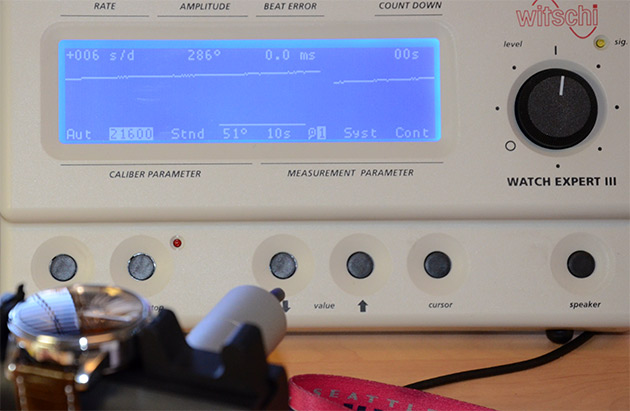
In the industry, accuracy is read in seconds per day. A COSC-certified chronometer allows between −4 and +6 s/day. Some labels go further: METAS requires 0 to +5 s/day on fully assembled watches exposed to strong magnetic fields. Many manufactures claim their own standards—from −2/+2 s/day to ±5 s/day. What matters isn’t only the average, but consistency across different positions and contexts. Because a watch doesn’t live on a test bench: it lives on your wrist.
The main causes of variation
Positions and gravity
Flat, crown up, lugs down… each position changes how gravity influences the balance staff and pivots. The result: rate differences that can amount to several seconds between positions. Good multi-position regulation will reduce the spread, but real life—keyboard time, gestures, sleep—creates its own mix. Hence the value of knowing your watch’s “signature” so you can tame it at night (we’ll come back to that).
Temperature and materials
The oscillation frequency depends on the elasticity of the hairspring and the inertia of the balance. Heat expands; cold contracts. Modern alloys such as Nivarox and silicon have greatly reduced these effects. Historically, compensation came via bimetallic balances; today, silicon hairsprings and anti-variation processes do more than merely offset: they stabilise. But going from 5°C to 35°C in a few hours is still a trial.
Mainspring torque and isochronism
A watch is more consistent when the balance amplitude is stable. Yet the torque delivered by the mainspring decreases as the power reserve runs down. Solutions include optimised barrels, efficient automatic winding, isochronism brakes, and carefully shaped hairsprings (terminal curves or overcoils, when geometry allows). High frequencies (5 Hz) can smooth certain irregularities, but they demand more energy and optimisation.
Lubricants and wear
Oils age, thicken, migrate. Increased friction changes amplitude, and therefore the rate. This is often where a drift that worsens over time is hiding. You don’t service a watch out of snobbery: you service it to preserve the dynamic balance and the health of the movement. A watch that’s rarely worn and poorly stored can age faster than one that runs regularly. To avoid this, proper mechanical watch maintenance is essential.
Shocks, vibrations and magnetism
A shock can shift a balance micro-screw or create an imbalance imperceptible to the naked eye. Magnetism, meanwhile, makes the coils of the hairspring stick together: the watch then runs fast. Today, non-ferromagnetic components, inner cages, and anti-magnetic certification (up to 15,000 gauss) limit this risk. But a magnetised travel bag, a loudspeaker, a tablet clasp… can sometimes be enough to throw the cadence off. A demagnetiser sets things right in a few seconds at the watchmaker’s.
Tolerances and regulation philosophy
Mobile index or variable-inertia balance (Microstella, Gyromax): the regulation method changes the behaviour. A free-sprung balance is more stable over time, because you adjust inertia rather than the active length of the hairspring. But beyond architecture, everything comes down to the watchmaker’s hand: poising a balance, centring a hairspring, minimising beat error, balancing positions… It’s as much an art as a science, and regulating an automatic watch is a perfect example.
How to gain seconds without losing your soul
- Wind regularly: a daily manual wind in the morning stabilises torque. For an automatic, wear it enough or use a quality winder if necessary.
- Test night-time positions: if your watch runs fast, leave it crown down or crown up depending on its behaviour; if it runs slow, flat dial up is often faster. Take your own measurements over a few nights.
- Avoid magnets: keep the watch away from loudspeakers, double phone cases, magnetic clasps. If in doubt, a quick test at the watchmaker’s.
- Keep a cool head: no sauna, no scorching dashboard. Temperature swings are the enemy of isochronism.
- Watch for the signs: a notable drop in amplitude, an unexpected stop, a drift that suddenly accelerates? Head to the workshop. A well-executed service often gives back a few precious seconds.
- Stay realistic: −4/+6 s/day (COSC) is already excellent in real life. The obsession with 0 s/day belongs to laboratory chronographs.
From observatories to your wrist: a culture of precision
In the 19th century, the observatory competitions of Neuchâtel or Kew were the equivalent of Grand Prix racing: Longines, Zenith, Patek Philippe honed movements regulated like scientific instruments. Earlier still, Harrison’s marine chronometers made it possible to determine longitude—an accuracy that quite literally changed the map of the world. Today, METAS, the Superlative Chronometer, and in-house tests carry on that tradition, adapted to the modern wrist and its ever-present magnetic fields.
Precision isn’t the preserve of Haute Horlogerie: it’s the result of a coherent chain—hairspring design, functional finishing, chosen lubricants, regulation protocol—backed by uncompromising controls. The rest? That’s your personal story with the watch, written second by second.
Questions we’re often asked
Does a new watch “settle in”?
People sometimes speak of a running-in period. In practice, any changes after a few days are due to lubricants stabilising and your real-world use. If the drift remains significant, an adjustment under warranty is in order.
Should I aim for 0 s/day?
No. Aim for consistency in line with your watch’s standard and your habits. A known, stable drift is easy to compensate over the course of a week.
How do I know if my watch is magnetised?
A sudden, marked gain, sometimes greater than +20 s/day. A watchmaker will confirm it in a few minutes and demagnetise it just as quickly.
Ultimately, drift isn’t a betrayal: it’s a breath. It says something about the mechanics, about how you live, and about the intimate bond between an object and its owner. The seconds you “lose” are often the ones you gain in watchmaking culture.