How to Choose Your First Automatic Watch
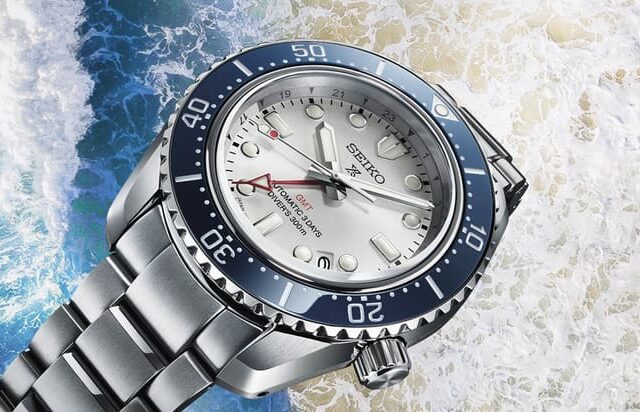
Why Start with an Automatic
Choosing your first automatic watch is more than a purchase: it’s a rite of passage. You discover an object that lives without a battery, driven by your movement, whose mechanics breathe on the wrist. In a world saturated with screens, an automatic reminds us that time can still be read in the swing of a balance wheel, in the whisper of a rotor. This guide is for the man who wants a watch with a soul—a companion of style and history, a piece that doesn’t merely tell the time, but says something about you.
If you’re not yet sure whether your first watch should be automatic or quartz, check out my buying guide for a first watch.
Understanding an Automatic: The Beating Heart
An automatic watch winds itself via a rotor—an oscillating weight that turns with your movements. No battery, but a power reserve, often between 38 and 80 hours, stored in a mainspring. Is it accurate? Yes—accurate enough for everyday life, even if an automatic isn’t an atomic clock. Expect a reasonable drift (around ±10/20 s per day on good models), while a certified chronometer will typically run closer to −4/+6 s.
And above all, an automatic is something you live with: you barely hear it, you sometimes feel it vibrate; it ages, it’s regulated, it’s serviced, it’s passed on.
Define Your Style: Look Before Calibre
Before spec sheets, ask yourself about aesthetic DNA. Your first automatic watch should wear you as much as you wear it.
- Steel sport-chic: the everyday watch, from office to weekend, often on an integrated bracelet, brushed dial, versatile presence.
- Tool watch: diver or field watch, legible, robust, screw-down crown—follows you in the rain as well as on the road.
- Classic dress watch: slim hands, pared-back dial, discreet silhouette under a cuff, heir to Bauhaus style or the 1960s.
- Chronograph: racing spirit and a “piano” of hands—thicker, more assertive.
- Vintage or neo-vintage: the charm of compact proportions (36–38 mm), eggshell tones, retro typography.
If it’s your first watch, think versatility. A dark dial (blue, black, grey), a steel case, and a timeless design will work with the widest range of outfits.
Size and Ergonomics: The Measurement That Changes Everything
Size isn’t just about diameter. Two 40 mm watches can wear very differently depending on lug-to-lug length and thickness.
- Small wrist (≤16.5 cm): aim for 36–39 mm, lug-to-lug ≤47 mm, restrained thickness (<12 mm).
- Average wrist (17–18 cm): 38–41 mm, lug-to-lug ≤49 mm.
- Large wrist (≥18.5 cm): 40–44 mm if the design remains well balanced.
Also look at dial opening (a thin bezel “enlarges” the watch), lug width (20 mm is very versatile for swapping straps), and lug ergonomics. Trying it on in-store remains decisive.
The Movement: ETA, Sellita, Miyota or In-House?
Don’t let the word “in-house” hypnotise you for a first piece. A well-regulated supplier movement is better than a temperamental manufacture calibre. Safe bets include:
- ETA 2824/2836 and derivatives, Sellita SW200/SW300: reliable, serviceable anywhere, parts readily available.
- Miyota 9xxx: slim, efficient, good power reserve.
- Seiko/NH35 and 6R: robust, excellent value for money.
Everyday-useful features: manual winding, hacking seconds for setting the time precisely, quick-set date. A power reserve of at least 40 hours is comfortable if you alternate between weekdays and weekends.
Budget and Value: Buy Better, Not More
Your first automatic doesn’t need to be the “watch of a lifetime”. It should make you want to wear it—and help you understand what you truly like. A few benchmarks:
- Up to €500: very strong entry points (Seiko 5 Sports, Orient Kamasu, Citizen NJ, certain European micro-brands).
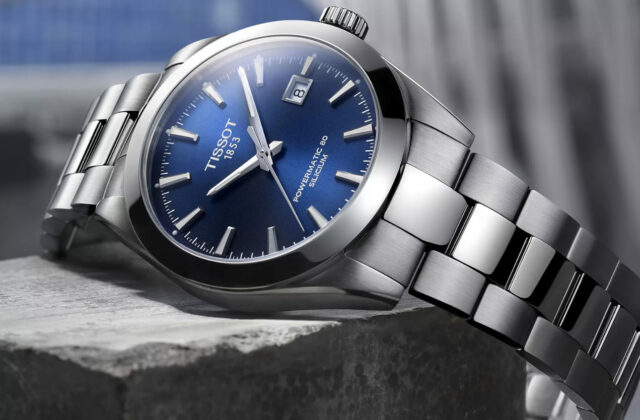
- €500–€1,000: nicer finishing, sapphire, proven movements (Tissot PRX Powermatic 80, Hamilton Khaki Field, certain Longines on promotion).
- €1,000–€3,000: a step upmarket—more elaborate bracelets and dials, finer regulation.
Check the warranty (2 years minimum), the availability of serious after-sales service, and factor in maintenance costs: a straightforward service generally ranges from €150 to €400 depending on the brand. Be wary of “great deals” with no papers or history.
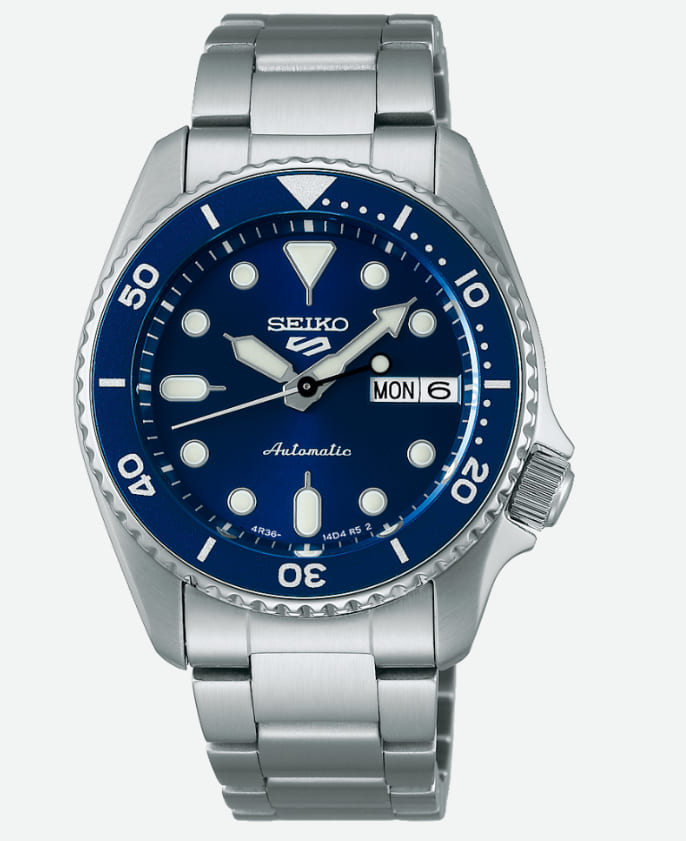
Seiko 5 Sports (€350)
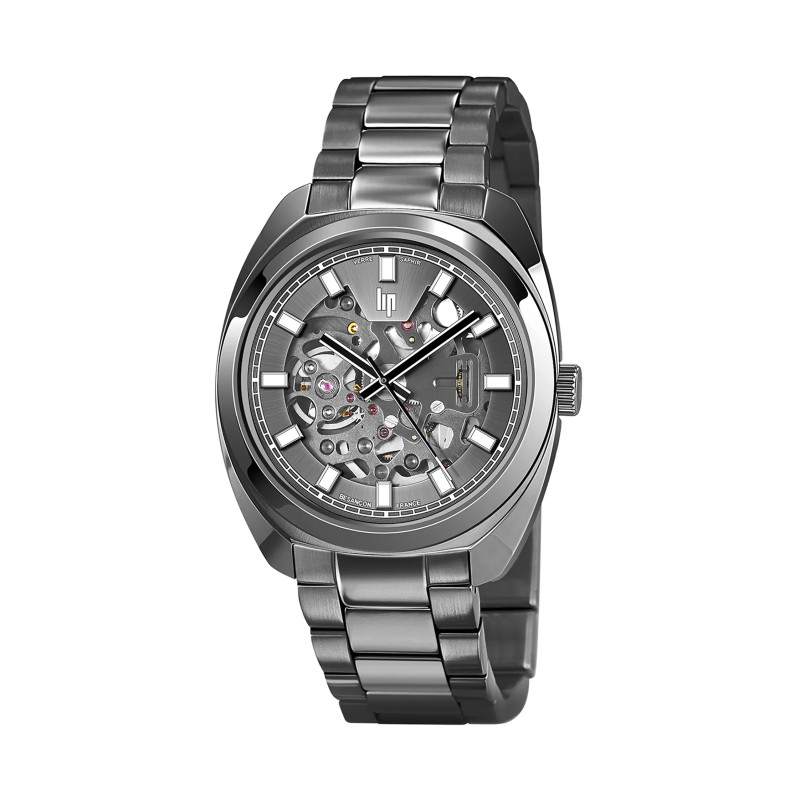
LIP GDG (€479)
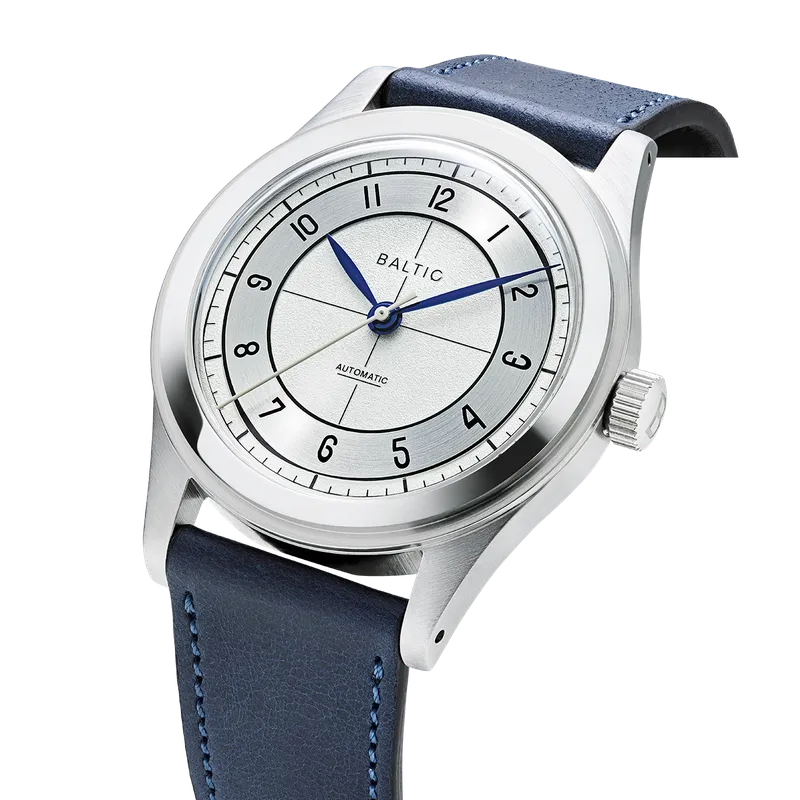
Baltic HMS (€432)
Details That Matter: Everyday Life Under the Microscope
- Crystal: sapphire is more scratch-resistant; an anti-reflective coating improves legibility.
- Water resistance: 100 m and a screw-down crown to handle rain and the occasional swim; 50 m is enough for a dress watch.
- Dial and hands: applied indices, sunburst, grained or lacquered finishing, well-calibrated lume.
- Straps: steel (solid and versatile), leather (elegant), rubber (sporty). A good lug system makes changes easier.
- Weight and balance: a well-balanced watch disappears on the wrist, even in steel.
Try, Compare, Feel
Take your time. In-store, try several diameters, play with the dial in different light, listen to the muted tick. Check the clasp, the smoothness of the crown, the feel of winding. A first watch is chosen with reason, but confirmed by a gut feeling. If you’re torn between two, sleep on it. The next day, one will make itself obvious.
Three Inspiring Directions to Get Started
The steel sport-chic
- Why: the perfect balance between office and weekend, contemporary silhouette, textured dials.
- Worth a look: Tissot PRX Powermatic 80, Citizen Tsuyosa, micro-brands with integrated designs.
- For whom: the man who wants one watch to do it all.
The everyday tool watch
- Why: toughness, legibility, an adventurous spirit; it fears neither rain nor getaways.
- Worth a look: Hamilton Khaki Field Auto, Seiko 5 Sports, Orient Kamasu for a diver’s touch.
- For whom: the pragmatic man, between tailoring and tarmac.
The minimalist classic
- Why: slimness, restraint, the charm of compact proportions—a watch that outlasts trends.
- Worth a look: Junghans Max Bill Auto, Baltic MR01, certain Longines with a heritage look.
- For whom: the lover of clean lines and a sartorial wardrobe.
Maintenance and Rituals: Making the Pleasure Last
An automatic likes to be worn. Rotate it if you have several watches, or give it around twenty turns of the crown before an important day. Avoid shocks and magnets (iPad cases, bag clasps); regulation or demagnetisation is quickly done by a watchmaker. A full service is worth considering every 5 to 8 years depending on use. Rinse the watch with fresh water after the sea, and replace a gasket at the slightest doubt about water resistance.
In Conclusion: Choosing Is Telling Your Story
Your first automatic watch isn’t a destination—it’s a beginning. It will set standards—comfort, style, sound—that will guide your eye from then on. Take it for what it is: a tool that speaks to your taste for things well made, a discreet sign that time, sometimes, deserves to be lived mechanically. This guide gives you reference points; it’s up to you to write the story on your wrist.