The Silicon Hairspring: Watchmaking’s Silent Revolution
Progress in watchmaking is rarely a thunderclap. It’s a breath. An improvement that seeps into workshops, slips beneath dials, and reshapes our relationship with time without fanfare. The silicon hairspring belongs to that family of discreet innovations. No bombastic slogans—just a simple fact: for twenty years, the accuracy and reliability of mechanical watches have stepped up a level, and the culprit is a material born in clean rooms, not in forges. This evolution follows in the footsteps of the useful revolutions that have marked the history of watchmaking, like the day precision became a weapon with the arrival of quartz watches.
The beating heart: what a hairspring really does
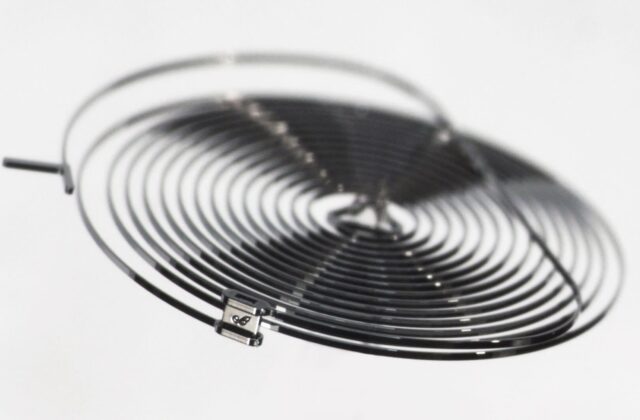
In a mechanical watch, the hairspring is the fine coiled strip that governs the balance wheel’s oscillation. Together with the escapement, it sets the pace of the whole movement: it’s what turns stored energy into a sequence of regular beats. Its geometry, its mass, and its resistance to temperature variations and magnetic fields dictate accuracy. For more than a century, metallic alloys (Nivarox in particular) led the dance. Until the day everyday life became magnetised—smartphones, magnetic bag clasps, speakers—making these once-proven hairsprings falter.
Why silicon changes the game
Silicon isn’t a high-tech whim grafted onto tradition. It’s an elegant answer to three modern enemies: magnetism, thermal shocks, and geometric instability. Monocrystalline, extremely light, and intrinsically non-magnetic, it allows the hairspring to retain its shape and tension with remarkable stability.
- Anti-magnetism: silicon does not become magnetised, limiting rate drift caused by everyday fields.
- Improved isochronism: very low mass and constant elasticity for more regular oscillations.
- Thermal stability: minimal expansion, hence fewer variations between winter and summer.
- Less friction: very smooth surfaces, with no lubricant needed at the hairspring itself.
- Industrial repeatability: each hairspring leaves production strictly identical to the previous one.
On the wrist, that translates into a calmer watch—less sensitive to the vagaries of a bag snapping against a magnet or a sudden change in temperature. The innovation isn’t spectacular to the eye; it is on the timing machine.
From the workshop to the clean room: how a silicon hairspring is born
Forget files and flame bluing. A silicon hairspring is born on a wafer—a disc of pure silicon—in a clean room where dust is the enemy. The hairspring pattern is “drawn” by photolithography, then cut by deep reactive-ion etching (DRIE). At the micrometre scale, you get a part with a level of precision impossible to achieve by hand. The magic also lies in the fact that you can build subtle geometric refinements into the design—a terminal curve, localised stiffness—to optimise isochronism.
Perfect geometry, born from a mask
Because silicon is shaped in layers, a host of potential flaws can be corrected at the design stage: flatness, symmetry, attachment point. Some hairsprings receive a thin oxide layer to further stabilise their thermal behaviour. The watchmaker no longer has to rework each piece: they regulate an already near-ideal regulating organ. That’s one of the strengths of this innovation—serial consistency without giving up fine adjustment.
From pioneers to contemporary standards
At the turn of the 2000s, a few maisons took stylistic and technical risks. Ulysse Nardin led the way with silicon components in conceptual watches. Breguet adopted silicon escapements and hairsprings very early on. Patek Philippe rolled out its Silinvar hairspring, while Omega democratised the silicon hairspring across entire collections. Rolex, long faithful to the metallic Parachrom, also introduced the Syloxi on certain pieces. In two decades, silicon has left the lab to settle at the heart of watches that live… far from laboratories, precisely.
Limits, debates, and the beauty of the craft
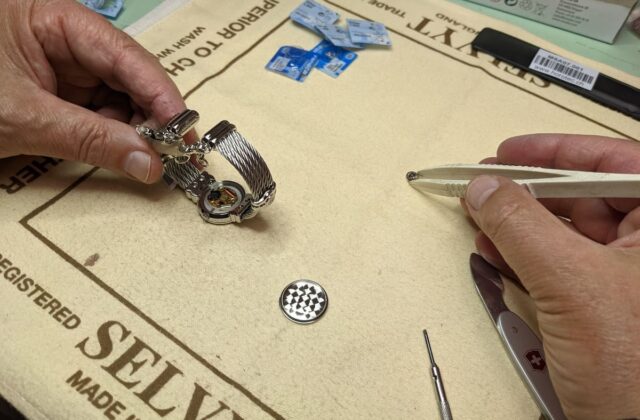
Every advance has its blind spots. Silicon, while rigid and stable, remains more brittle than a metallic alloy. Manufactures compensate with effective shock-protection systems at the balance, but an extreme impact can break this very fine hairspring. Replacement is straightforward in service; repair is virtually impossible—a cultural shift for a trade accustomed to straightening, reworking, saving.
There is also the question of patents and supply-chain independence: for a long time, gaining access to a silicon hairspring meant going through a handful of consortiums. The situation is opening up, but the issue remains, especially for independents. Finally, there is aesthetics. A flame-blued hairspring carries the poetry of old gestures; a silicon hairspring has technical purity, sometimes with purplish, almost unreal reflections. Two ways of loving time.
Innovation and tradition—really antagonistic?
Watchmaking has always absorbed useful revolutions. The Breguet overcoil was as much an upheaval as the modern alloy mainspring. Silicon belongs to that lineage: when it serves chronometry, it doesn’t betray the spirit—it extends it. Bridges can still be hand-bevelled, dials guillochéed, cases satin-finished with cabron—while a silicon hairspring stands guard, silently, over regularity.
And tomorrow: towards the 21st-century oscillator
Silicon hasn’t said its last word. Beyond the hairspring, it is inspiring new constant-force flexure escapements, monobloc oscillators, and geometries impossible in metal. The goal remains the same as ever: more accuracy, more stability, less sensitivity to external aggression. High anti-magnetism is becoming an implicit standard, and chronometry a credible everyday promise—not just on a test bench.
In this silent revolution, the silicon hairspring is the keystone. You don’t see it, you forget it—and that is precisely its victory: letting us live, work, travel, without our modern gestures unsettling the beat. At a time when watchmaking cultivates its memory as much as its future, silicon stands out as the innovation that respects time as much as it measures it.