Is it better to buy your watch in France or Switzerland?

The True Cost of a Dream: Between the Display Window and the Border
In a watch lover’s mind, buying a timepiece is never just about a price tag. It’s a postcard: the boutique on the corner of Place Vendôme, the wood-panelled lounge of a maison in Geneva, the post-purchase coffee where you discreetly unbox the case. But one question always comes back: is it better to buy your watch in France or in Switzerland? For those wondering about authenticity, being able to recognise a genuine Swiss watch can prove crucial in making that decision.
Behind the romance lie the numbers: VAT, tax-free refunds, exchange rates, and the hard pragmatism of availability. Here’s how to separate the fantasy from the final bill—without giving up the pleasure.
Sticker Prices: Labels That Are Almost Harmonised
Today, major brands operate with globally harmonised pricing. Switzerland remains the natural reference point, but French price tags are set to limit international arbitrage.
- France: price incl. VAT at 20%.
- Switzerland: price incl. VAT at 8.1% (as of 1 January 2024).
For the same model, the pre-tax price is often comparable in both countries. What changes is the VAT, the tax-free processing fees, and the CHF/EUR exchange rate.
A Worked Example to Find Your Bearings
Let’s imagine a watch listed at CHF 10,000 in Switzerland. Excluding Swiss VAT, its price is around CHF 9,251. A French resident can, in theory, reclaim Swiss VAT via a tax-free operator, but must declare the purchase upon entering France and pay French VAT (20%) on the value of the watch. Depending on the exchange rate and tax-free fees, the perceived saving can evaporate quickly.
Conversely, a non-EU resident buying in France can reclaim part of the VAT (tax-free), often around 12% to 13% of the VAT-inclusive price after fees. For a French buyer, tax-free shopping in France is not possible for use in France.
Tax-Free, Customs, Legality: What You Really Need to Know
- Entering France from Switzerland: an allowance of €430 (air/sea travel) or €300 (other). Above that, French VAT is due. Customs duties on Swiss watches are generally 0% with proof of origin, but residual duties may apply depending on the circumstances.
- Swiss tax-free: available if you export the watch out of Switzerland; expect operator fees that reduce the effective refund.
- French tax-free: for non-EU residents only, with validation upon leaving the territory.
The legal conclusion is simple: for a French resident, buying in Switzerland and returning without declaring it is a bad idea. Declare it, pay the VAT, and sleep soundly—your enjoyment will only be that much clearer.
Availability: The Geography of Desire
In Geneva, the epicentre beats to the rhythm of the shop windows on Rue du Rhône and the historic maisons. The selection is broad, but competition among international buyers is just as intense. For highly sought-after steel icons, the watch capital does not guarantee priority access; sometimes, it complicates the allocation game.
In France, Paris shines (Vendôme, Saint-Honoré), but regional retailers can hold some wonderful surprises. A local purchase history, an ongoing relationship, and regular exchanges with your advisor often carry more weight than the address on your passport.
The Boutique Experience: Added Emotion
Switzerland offers an extra soul. Seeing the watch in Geneva, a stone’s throw from the manufactures; visiting the Patek Philippe Museum; feeling the cultural density of the Vallée de Joux… the purchase becomes a story. A warranty card stamped “Geneva” has a particular scent in a collector’s notebook.
In France, the experience comes in a Parisian register—hushed salons, personalisation, neighbouring jewellery—or in a more intimate spirit at a historic provincial retailer. In both cases, service has become more professional: private appointments, try-ons on alternative straps, and coordinated after-sales follow-up.
Warranty and Service: Global in Principle, Local for Convenience
Most maisons offer an international warranty. You can have your watch serviced in France even if you bought it in Switzerland, and vice versa. In practice, for a warranty return to after-sales service, going back to the original seller can speed up processing (file, photos, history). Out of warranty, the official network in France offers quality comparable to Geneva.
Pre-Owned: Two Markets, One Global Benchmark
The pre-owned market is sophisticated on both sides of the border. In Geneva, the concentration of independents and wholesalers creates a fascinating depth of stock, but prices reflect the global market, now transparent. In France, certified platforms, “Certified Pre-Owned” retailers, and specialist dealers offer warranties and servicing, with taxation often based on the margin.
Importing a pre-owned watch bought in Switzerland into France still involves VAT and paperwork. The price gap therefore needs to be substantial for the operation to be worth the effort.
Exchange Rates: The Detail That Sometimes Makes the Difference
On a five-figure watch, a small move in the CHF/EUR exchange rate can weigh heavily. Watch the rate, avoid dynamic currency conversion offered by some banks (prefer paying in the local currency), and use a low-fee card. Brands adjust their prices periodically, but timing remains a discreet lever.
So, France or Switzerland? A Nuanced Verdict
- You are a French resident buying new: France is often the simplest route, with no tax surprises and a high-level boutique experience.
- You dream of Geneva and a purchase “at the cradle”: treat yourself to the Swiss experience, but play it straight at the border; the final difference will be mostly emotional.
- You are a non-EU resident: depending on the tax-free refund and the exchange rate, France can become very competitive.
- You are looking for a highly sought-after model: prioritise the client relationship, not the country. Your advisor in France can matter more than a waiting line in Geneva.
- You are hunting a specific pre-owned piece: compare globally, factor in VAT and shipping, and choose the seller who inspires confidence.
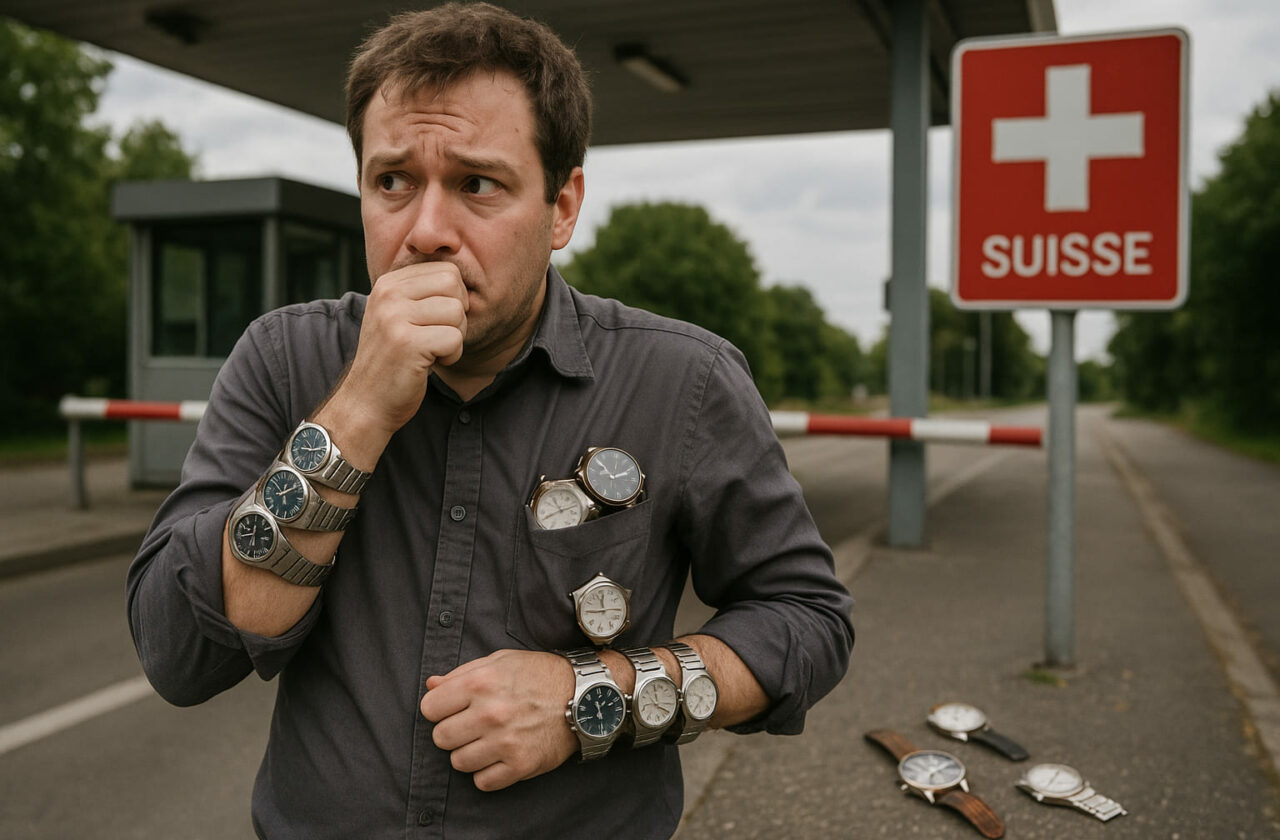
In watchmaking, you buy a story as much as a mechanism. France offers clear-cut convenience and a refined network; Switzerland—and Geneva in particular—adds a cultural vibration found nowhere else. The best place? Wherever value meets emotion—provided you’ve done the right maths beforehand. Some will try the adventure of buying the watch in Switzerland and crossing the border without declaring it… Be warned: French and Swiss customs are not the kind to joke around.
Interested in this watch?
Price, availability, contact: we can activate our watch-industry network to help you.