Why the Submariner Remains the Most Copied Watch in the World
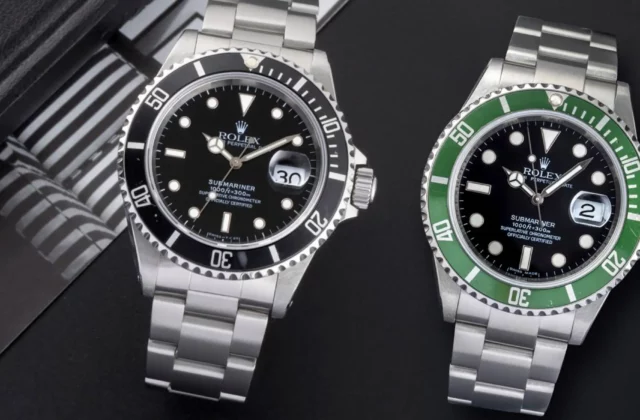
From instrument diver to cultural icon
You might spot it on a diver’s wrist, peeking from under a tuxedo cuff, or topping the front page of an enthusiasts’ forum. The Rolex Submariner, born in the early 1950s and swiftly thrust into the spotlight by James Bond, has transcended its tool-watch status to become an icon. It wasn’t the first dive watch in history, but it imposed an aesthetic, a visual language, an entire imaginary. Its power lies in that singular equation of uncompromising functionality and universal elegance. That is precisely why it is the most copied watch in the world: because its design touches the very prototype of the dive watch—something people seek to appropriate, reproduce, détourne, or simply dream about, depending on the era and the budget.
The archetype of dive-watch design
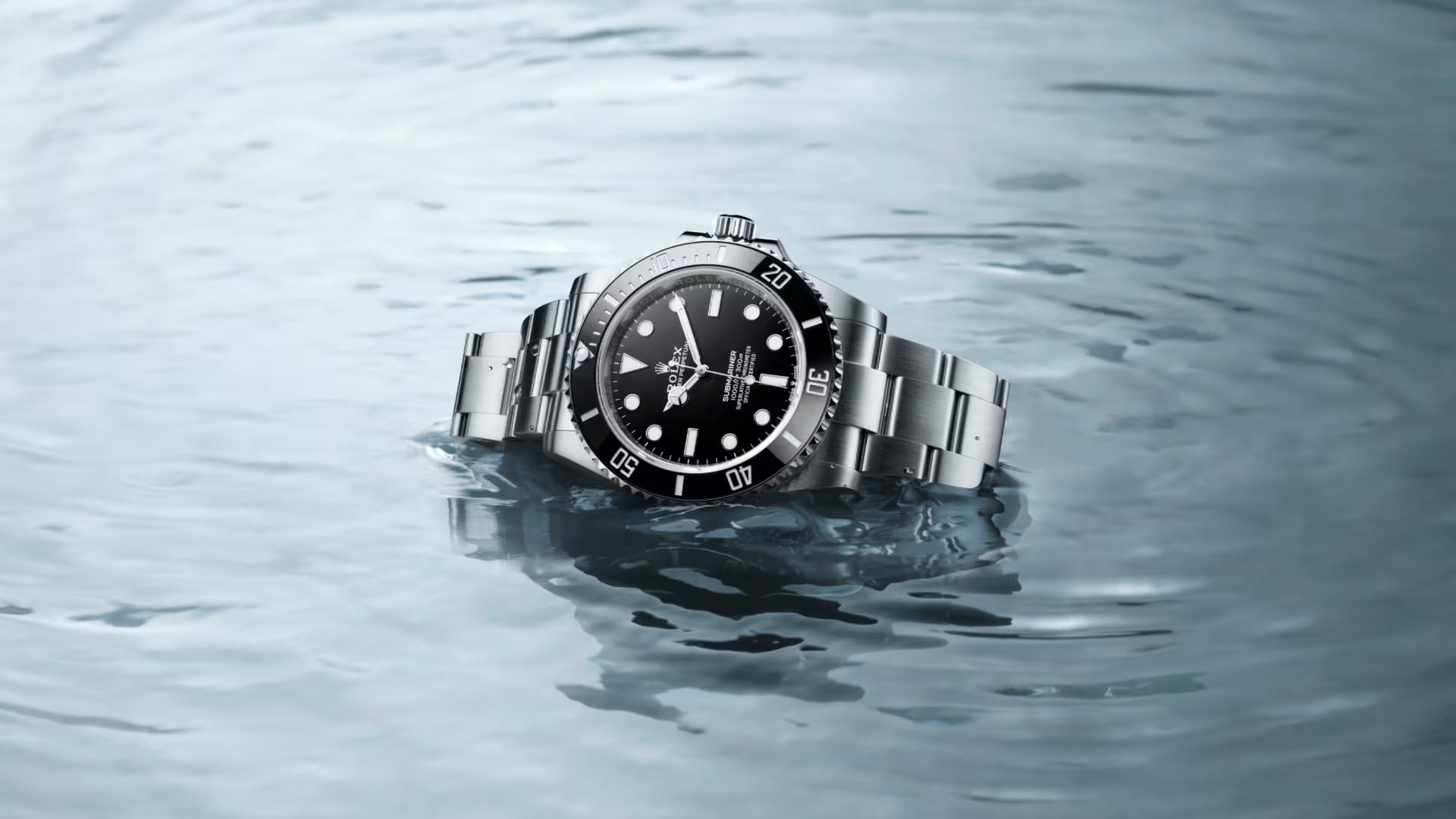
The Submariner established itself by setting codes so clear that any deviation is instantly noticeable. Its extreme legibility, balance, and reassuring proportions became the template. From the earliest references, the waterproof Oyster case, the graduated rotating bezel, and the high-contrast black dial formed a grammar the entire industry still speaks—shaping the creation of dive watches to this day.
- A unidirectional bezel with a dark insert and functional typography.
- A matte or glossy black dial, punctuated by high-contrast round and rectangular hour markers.
- So-called “Mercedes” hands, instantly recognisable.
- A case with solid flanks, crisp lugs, and a pronounced crown guard.
- A three-link Oyster bracelet—brushed, robust, ready for the sea as well as the city.
Over the decades, Rolex has sharpened this archetype without betraying it: reinforced crown, a wetsuit extension system, Luminova then Chromalight, a ceramic bezel insert, Oystersteel with superior metallurgical properties. Everything changes, nothing moves—the magic of evolution by small touches, strengthening the icon without uprooting it.
Why it’s the most copied
- A design perfected for purpose: form serves function and legibility. Copying the Submariner means copying a proven solution.
- A universal face: from the betting shop to the red carpet, the Sub always looks at home. The industry imitates this stylistic chameleon.
- A cultural aura: from Sean Connery to street culture, the Submariner image carries a story. Reproducing the silhouette is a way of capturing a little of that myth.
- Instant recognition: you see it, you know. Entry-level brands borrow from it to reassure; counterfeiters to deceive.
- Engineered scarcity and desirability: waiting lists, a feverish secondary market. The gap between desire and access fuels both homages and counterfeits.
From Steinhart to Invicta on the homage side, not to mention a myriad of micro-brands, the market is awash with “Sub-like” watches. Some explore a broader colour palette; others reinterpret the proportions. But everywhere, you recognise the matrix: a clean dial, a decisive bezel, three hands that tell the time without fuss.
Homage or counterfeit: the ethical line
You have to distinguish a nod from a crime. An homage reprises the codes without hijacking the logo or pretending to be anything other than what it is. It can have cultural or mechanical interest, and sometimes genuine quality. A counterfeit, by contrast, steals a name, deceives the customer, and undermines creation. If the Submariner is the most copied, it’s also because its name has become a social symbol—an magnet for pretence.
- Homage: acknowledged inspiration, clearly identified brand, price that makes sense.
- Counterfeit: stolen logo and markings, intent to deceive, inconsistent quality.
Watch culture benefits from celebrating honest inspiration and fighting fakes. The icon is better for it: it remains a living reference, not a caricature.
What Rolex has that copies don’t
You can reproduce a silhouette; you can’t copy a standard. Behind the Submariner sits an industrial specification, a global service network, mastery of materials, and quality control that set the pace. The tolerances, the assembly, the feel of the bezel with its precise click, the chronometric stability certified as a Superlative Chronometer, the Chromalight that breathes perfectly through the night—together these define a threshold imitation struggles to cross.
- Continuous micro-evolutions: ergonomics, secure clasps, a dive extension designed for real use.
- Proprietary materials and careful metallurgy (Oystersteel, scratch-resistant ceramic bezel).
- Historical coherence, from the “big crown” Sub to contemporary references, telling the story of a lineage.
- Service and residual value the market recognises, beyond fashion.
It’s this sum of engineering and narrative that makes the Submariner an icon, not merely a handsome dive watch. The object speaks on the wrist, but it also speaks to the imagination.
The silhouette that outgrows its own myth
The Submariner no longer belongs only to Rolex; it inhabits our visual culture. You can iterate it endlessly, parody it, hyper-specialise it, colour it, “vintage-ise” it or polish it: it remains instantly legible. That explains its legacy as much as its proliferation. Copying the Submariner is an attempt to get hold of an entire alphabet of watch design. But a language lives only through those who speak it with talent. That is where Rolex, patiently, continues to write—line after line—the grammar of an icon.