Gérard Pouyet and His Clocks: A Legacy of Watchmaking


When we talk about watchmaking, our eyes automatically turn to Switzerland. Yet historically speaking, Switzerland was more of a land of refuge for French and European watchmakers, who, over the years, made it the nerve centre of this craft (Breguet, the Berthouds, Huyghens).
France has always been a land of watchmaking traditions, so it is a discreet French clockmaker, creator of fabulous clocks, whom I am going to introduce in this article. I will focus more specifically on his latest creation, “Celeste”, an incredible astronomical clock with perpetual calendar.

Originally from Cluses, the French capital of bar turning and micromechanics, a formerly prosperous hub for watchmaking subcontracting.
Gérard grew up to the sound of ticking; the son of Robert Pouyet, a former student at the famous Cluses School of Watchmaking from 1930 to 1934, who would go on to become a watchmaking teacher at that very school from 1949 to 1981. His father left his mark on generations of watchmakers through his rigour, his love of the craft and his passion for passing it on. His passion was not limited to teaching his knowledge: he was also a creator of regulators, clocks and even complicated calibres for wristwatches.
Inevitably, Gérard Pouyet was affected by it: he entered the Cluses School of Watchmaking in 1966, then the Geneva School of Watchmaking until 1971. He graduated top of his class—something that at the time was not common for a Frenchman in a Swiss school—along with the Hans Wildorf Prize among other distinctions.
Exceptionally gifted and in love with his craft, Gérard received many offers from major Swiss manufactures, but he turned them down, having little desire to work on quartz which, let us remember, had by then become the norm.
He preferred to set up his small repair workshop in Cluses where, from 1972 to 1978, he worked as a repair watchmaker for shops in the Arve Valley. Earning a rather modest living, he decided to open his own jewellery and watch shop in Cluses where, until 2015, he moved from selling jewellery and watches to repairing, restoring and servicing clocks, pendulums and complicated mechanical watches in his well-equipped workshop located at the back of his shop.
Running his business and his repair work left him little time to express his creativity through the clocks and pendulums he is passionate about. But for the turn of the year 2000, he created his first major work: La 2000 (below).

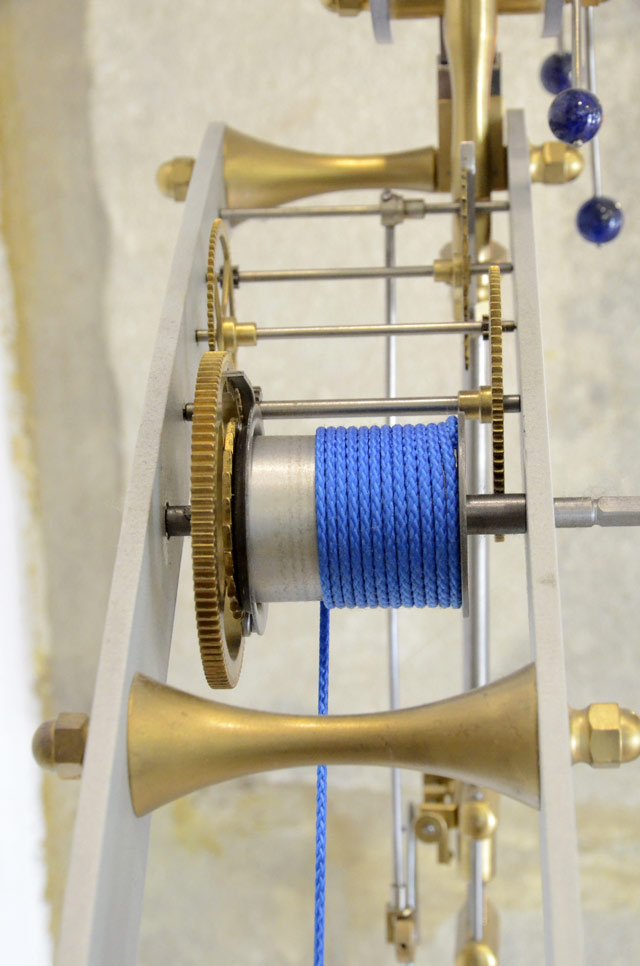
A superb clock with decidedly modern lines and an innovative construction. Made of steel and brass as if to recall its Cluses origins, it gives pride of place to the mechanism, fully visible through a transparent dial. A little marvel that immediately sets the tone in terms of the man’s creativity and technical mastery.
No swinging weight as the regulating system, but a weight that rolls along the clock’s support like on a rail, guided by eight ball bearings. It pulls a Comtoise clock train which, thanks to the escapement, makes the whole assembly—dial, pendulum rod and globe—swing. The oscillation of the assembly drives an anchor actuated by a suspended crown, which turns the escape wheel and the train to indicate the time.
It is difficult to find a direct lineage between La 2000 and Céleste, Gérard’s latest creation. The style changes completely, except perhaps for the central place given to mechanics: in both, all the trains, cams and gears are visible. This allows you to admire every impulse delivered, to see the gearwork move and, ultimately, to have it tell us the time—but also many other indications.


The first time I saw his latest creation in photos, I was immediately captivated by this clock. Yet until now, at least, it was an area of horology that left me rather indifferent.
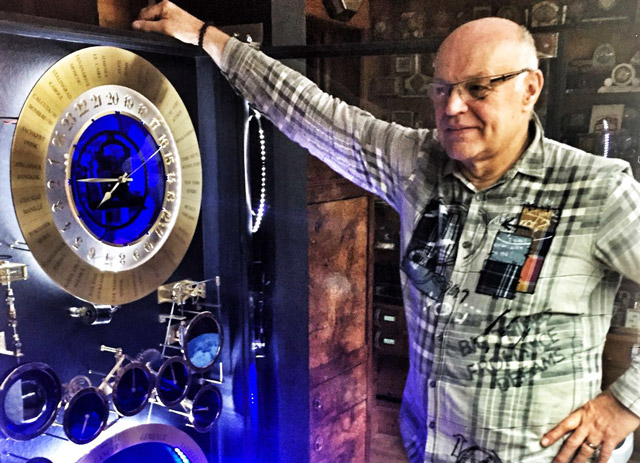
Behind an Art Deco look (originally intended by its creator) lies an ultra-contemporary piece, both in terms of construction and in the materials and colours used. A more-than-successful fresh take on the traditional astronomical clock.

What strikes you first is the imposing size of the beast; having only seen a few photos without any scale, I was expecting a table clock…
Wrong: “Céleste” measures 190cm x 113cm, a small monument with real presence.
The base is entirely matte black, which makes the counters and other brass-coloured discs stand out, with the rather bold choice of using violet LEDs to bring the whole thing to life. Personally, I find the harmony of this piece magical. All the mechanisms are visible thanks to the use of Altuglas (a kind of Plexiglas) tinted blue as the dial.
The three-dimensional moon phase, with its visible mechanism, is particularly striking. The moon was hand-painted by Laurence, Gérard’s wife, as was the planisphere indicating the times of sunrise and sunset.


The perpetual calendar mechanism was conceived, then drawn, sawn, filed and cut by Gérard (brass and steel).

Two enormous “dials”: the planetarium and world time; a series of asymmetrical horizontal dials; a 3D moon phase—this entire little world is fully transparent to give pride of place to the mechanism. It is, definitively, an original and innovative construction that would make even the most sceptical take notice.


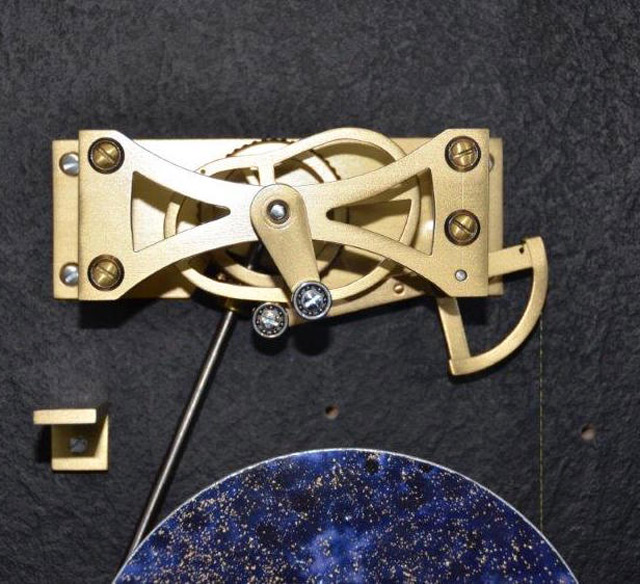
This clock is an electro-mechanical clock; the movement is a Brillié master clock movement with inverted half-minute impulses.
This movement drives four slave units:
- One for driving the moon phases
- One for the reference time
- One for sunrise and sunset times
- One for the 24-hour disc of world time
The master clock also delivers an impulse at midnight to drive the perpetual calendar and the planetarium.
The planetarium drives the central wheel, which makes one revolution in one tropical year, i.e. 365 days, 5 hours, 48 minutes and 48 seconds. The Earth, as well as the Moon, is integral with the 57-tooth satellite pinion, which rotates around a fixed 705-tooth ring in order to recreate the lunar cycle with precision. The Moon revolves around the Earth in one lunation, and the Earth–Moon assembly around the Sun in one tropical year through the 12 zodiac constellations as the seasons progress.
As for the moon phases, Gérard wanted to get as close as possible to the real lunar cycle; the gear train was cut to achieve a cycle of 29 days, 12 hours, 44 minutes and 2 seconds.

Around all of this:
- Mean solar time at the Greenwich meridian (base time),
- The equation of time: the difference in minutes between mean Greenwich time and true time,
- Sunrise and sunset according to the seasons, based on Greenwich time
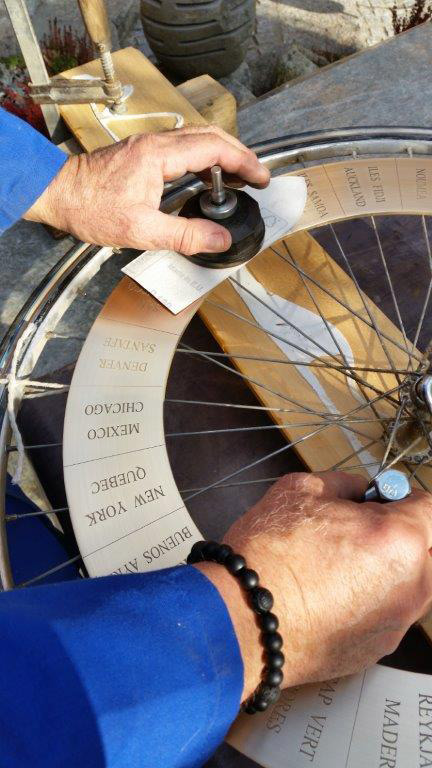
- Paris legal time in the centre, with an intermediate ring that makes one revolution in 24 hours and indicates, on the outer ring, universal time in several cities around the world.
As someone who has never been a big fan of clocks, I was forced to change my mind. Many independent creators like Gérard do remarkable work, reinventing their craft through creativity and technical mastery, creation after creation. As for Gérard, he promises us one clock per year, so we are already waiting for what comes next…